

Key Takeaways
- Foreign investors must navigate approval processes under Fiji's Foreign Investment Act and oversight from the Foreign Investment Board, adding procedural layers before operations can legally commence.
- Fiji's small domestic consumer base constrains revenue scalability for businesses that depend on local market demand rather than export or regional trade models.
- The Companies Act 2015 governs corporate structuring in Fiji, but gaps in banking infrastructure mean that even compliant entities can face difficulties accessing reliable trade finance and multi-currency accounts.
- Foreign exchange controls impose restrictions on the movement of capital in and out of Fiji, creating additional complexity for internationally-focused businesses managing cross-border cash flows.
Fiji operates under an evolving regulatory framework, shaped by legislation including the Companies Act 2015 and overseen by bodies such as the Registrar of Companies and the Foreign Investment Board. Understanding the disadvantages of incorporating in Fiji requires examining how these rules interact with commercial realities on the ground.
The drawbacks covered in this article span regulatory, financial, operational, and structural dimensions. Not all of these will apply equally to every business — the relevance of each depends heavily on your industry, the legal structure you choose, and whether your entity will operate locally or position itself for cross-border activity.
This article is most directly relevant to foreign investors and internationally-focused founders who are evaluating the cons of registering a business in Fiji against the requirements of their specific sector or capital strategy.
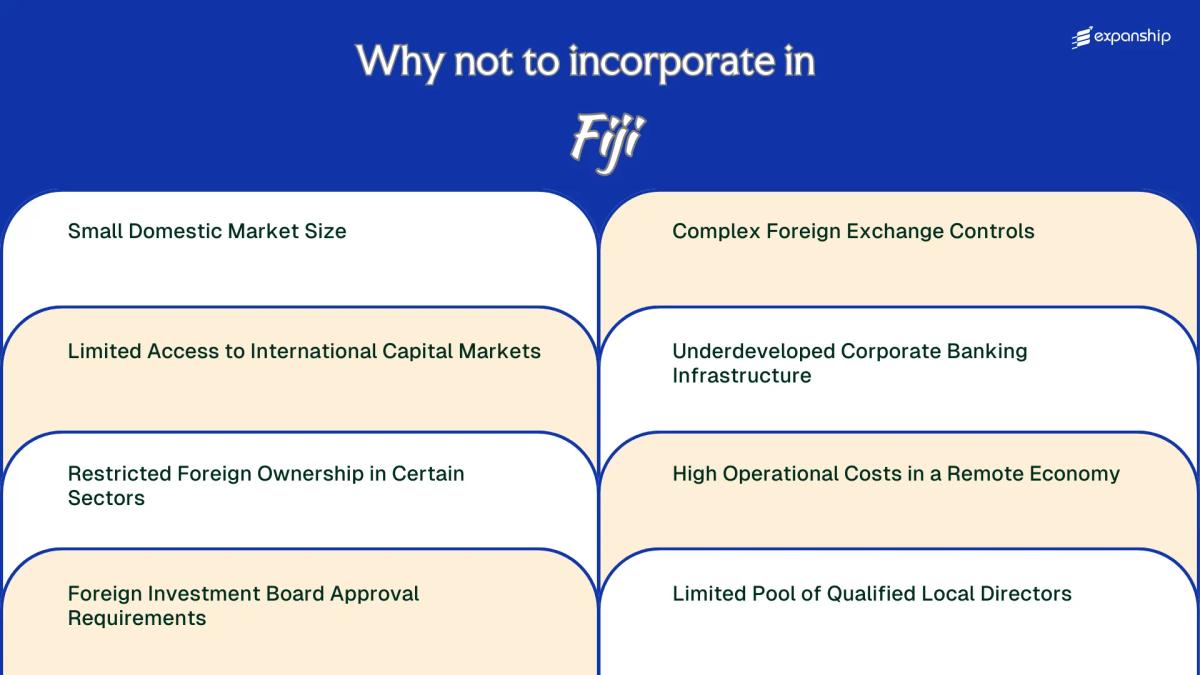
Small Domestic Market Size
Fiji small market size limitations present a structural constraint that directly affects revenue potential and long-term scalability for foreign-incorporated entities.
A Consumer Base Too Small to Anchor a Business
Fiji's population sits at approximately 930,000 people, spread across two main islands and over 300 smaller ones. For a foreign business relying on domestic sales volume to recover setup and operational costs, this ceiling on addressable consumers creates a fundamental viability problem from the outset.
Per capita GDP hovers around USD 5,000 to 6,000, which restricts purchasing power across most consumer segments. A firm entering the market with premium-priced goods or services will find the limited consumer base in Fiji insufficient to generate the revenue density achievable in larger Pacific or Southeast Asian markets.
Sector Concentration and Its Effect on B2B Demand
Domestic commercial activity is heavily concentrated in tourism, sugar, and garment manufacturing. This narrow economic base limits B2B demand outside those sectors, leaving firms in professional services, technology, or light manufacturing with few viable local clients.
Your business should not expect domestic market revenue alone to justify incorporation costs, as the structural size of Fiji's economy makes it unsuitable as a primary revenue market for most foreign commercial strategies.
Limited Access to International Capital Markets
Fiji limited access to capital markets is a structural constraint that most foreign businesses discover only after incorporation. The South Pacific Stock Exchange (SPX), which serves as the country's primary securities market, lists fewer than 20 companies. That limited depth means raising equity capital through public markets is not a realistic option for most foreign-owned entities.
Debt financing from international institutions is equally constrained. Global banks and institutional lenders rarely extend credit facilities to companies incorporated in small Pacific island economies without substantial collateral or parent company guarantees.
For foreign business owners, this creates concrete operational friction:
- Your entity cannot access IPO-based growth capital without the scale and profile that SPX's thin market cannot accommodate
- Syndicated loan markets available in Singapore or Hong Kong are effectively out of reach, forcing reliance on retained earnings or offshore parent funding
- Securing venture or private equity investment becomes harder when fund managers lack established legal frameworks for exit mechanisms in the local market
Foreign exchange controls administered under the Reserve Bank of Fiji add another layer of restriction on repatriating or deploying capital across borders, compounding the difficulty of managing an internationally funded structure.

Company Incorporation in Fiji
Understand the structural and regulatory requirements before establishing a company in Fiji.
Restricted Foreign Ownership in Certain Sectors
Fiji foreign ownership restrictions by sector represent one of the more concrete structural barriers for foreign investors. Under the Investment Fiji framework and the Foreign Investment Act 1999, certain sectors are entirely reserved for Fijian citizens, while others impose ownership ceilings that prevent a foreign entity from holding a majority stake.
The reserved list is not incidental. It covers economically significant categories where foreign capital might otherwise flow freely.
| Sector | Restriction Type | Practical Burden |
|---|---|---|
| Inshore fishing | Reserved for citizens only | Full exclusion from market entry |
| Retail trade below FJD 300,000 threshold | Reserved for citizens | Blocks small-scale foreign retail ventures |
| Duty-free retail | Restricted to approved operators | Limits foreign retail footprint |
| Land ownership | Non-citizens cannot freehold | Requires lease arrangements that add cost and tenure uncertainty |
For sectors that permit foreign participation but impose ownership caps, your business cannot hold a controlling interest. This directly affects governance, profit repatriation decisions, and the ability to implement group-level policies without a local majority partner's consent.
The list of reserved sectors is administered by Investment Fiji and can be updated by regulation, meaning the boundaries of permitted foreign activity are not permanently fixed by statute. Structuring around these restrictions through nominee arrangements carries legal risk under Fijian company law.
Foreign Investment Board Approval Requirements
Fiji Foreign Investment Board approval risks are a concrete operational burden, not a procedural formality. Under the Investment Fiji Act, the Fijian Investment Board (FIB) must approve foreign investment applications before a business can legally commence operations in reserved or restricted activity categories.
The approval process introduces timing uncertainty that directly affects your setup timeline. Delays in FIB clearance can stall lease agreements, staffing, and capital deployment, none of which can proceed with confidence until registration is confirmed.
Fiji investment registration challenges extend beyond initial approval. Registered foreign entities must maintain ongoing compliance with the conditions attached to their Foreign Investment Registration Certificate (FIRC), and any material change to the business, such as a change in activity or ownership, requires fresh FIB notification or reapproval.
- Foreign investors must obtain a FIRC before commencing any business activity in a restricted category
- Any change in business activity, ownership structure, or principal officers must be reported to the FIB
- Non-compliance with FIRC conditions can result in cancellation of the registration certificate
- Certain activities are entirely closed to foreign investment under the reserved activities list
Even businesses with 100% foreign ownership are permitted in most sectors, yet still require a FIRC, meaning the registration obligation applies regardless of the activity's open status.
Complex Foreign Exchange Controls
Fiji foreign exchange controls problems extend well beyond basic currency conversion. The Reserve Bank of Fiji administers a tightly managed exchange control regime under the Exchange Control Act, and foreign-incorporated entities operating locally face restrictions that directly affect how and when capital can exit the country.
Structural Restrictions on Capital Movement
Transactions involving the transfer of funds offshore require prior approval from the Reserve Bank of Fiji, including dividend remittances, loan repayments to foreign parent companies, and capital repatriation. Each approval request introduces delays that disrupt treasury planning, particularly for firms managing multi-currency operations across multiple jurisdictions.
Fiji FJD repatriation limitations mean your business cannot freely convert local earnings into foreign currency without documented justification and regulatory sign-off.
Operational Consequences for Foreign Firms
Fiji currency restrictions for foreign companies create a structural mismatch between local revenue generation and offshore financial obligations. A firm billing in FJD but servicing USD-denominated debt faces both approval delays and exposure to exchange rate movement during the waiting period. Reserve Bank of Fiji exchange control drawbacks compound further when approval timelines are unpredictable, making accurate financial forecasting difficult for parent entities reporting under IFRS or US GAAP standards.
Managing Incorporation Challenges in Fiji
Understand the regulatory and exchange control hurdles facing foreign businesses in Fiji before you commit to incorporation.
Underdeveloped Corporate Banking Infrastructure
Fiji corporate banking infrastructure challenges present a tangible operational barrier for foreign-incorporated entities. The Reserve Bank of Fiji (RBF) oversees a sector dominated by a small number of commercial banks, which limits both product diversity and service responsiveness for corporate clients.
- The concentration of commercial banking in Fiji among a handful of institutions, primarily ANZ, BSP, HFC Bank, and Westpac, means your business has minimal competitive leverage over fee structures or credit terms.
- Opening a corporate bank account requires extensive documentation and prolonged due diligence periods, creating delays that can stall your business operations before they begin.
- Access to trade finance instruments such as letters of credit and bank guarantees is constrained compared to financial centres in Singapore or Hong Kong, limiting your firm's ability to support international transactions efficiently.
- Fiji business bank account limitations extend to digital banking, where corporate online platforms remain less developed than those offered in comparable Pacific or Southeast Asian jurisdictions.
- Credit facilities for foreign-owned entities are difficult to secure without substantial local collateral, restricting your company's working capital options.
High Operational Costs in a Remote Economy
Fiji's high operational costs stem directly from its geographic position in the South Pacific, roughly 3,000 kilometres from the nearest major freight hub. For any foreign business relying on imported equipment, materials, or finished goods, this distance translates into freight premiums, longer lead times, and supply chain fragility that are structural, not incidental.
The country imports a significant share of its fuel, machinery, and industrial inputs. Each disruption — a weather event, port congestion at Suva or Lautoka — cascades into production delays that businesses in continental economies simply do not face.
Utility costs add a separate layer of burden. Electricity tariffs in Fiji are high relative to many competing Pacific jurisdictions, partly because the grid relies on imported diesel in areas outside hydroelectric coverage.
Local labour costs for skilled roles are also elevated when offshore recruitment is required. Qualified professionals often expect relocation packages, which compounds payroll expense beyond the base salary.
A hypothetical scenario: A manufacturing firm importing AUD 500,000 in machinery annually could face freight and insurance costs exceeding 15–20% of cargo value, adding AUD 75,000–100,000 per year in overhead that the same firm would not carry operating out of Singapore or Malaysia.
Limited Pool of Qualified Local Directors
Fiji's limited qualified local directors present a structural sourcing problem that goes beyond inconvenience. The country's population of roughly 930,000 means the overall talent base for corporate governance roles is narrow, and professionals with the specific combination of directorial experience, legal literacy, and sector expertise are scarce relative to demand.
Under the Companies Act 2015, every company incorporated in Fiji must have at least one director who is ordinarily resident in the country. For a foreign-owned entity, this effectively forces you into a constrained hiring market where qualified candidates can command terms that reflect their scarcity rather than market norms.
The practical consequence is that local director pool restrictions in Fiji companies translate into real cost and governance risk. A nominee director with limited business understanding of your industry may struggle to discharge their statutory duties adequately, which exposes both them and the entity to liability under the Act.
Fiji director residency requirement challenges are compounded by geography. Professionals concentrated in Suva or Nadi are often already committed to multiple directorships, reducing availability and attentiveness.
The residency requirement under the Companies Act 2015 applies regardless of your company's size or operational model, meaning even a dormant or holding structure must maintain a qualifying resident director at all times.
Overcoming the Key Incorporation Challenges
Overcoming the Key Incorporation Challenges
Overcoming Fiji incorporation challenges requires structural preparation before the entity is registered, not after problems surface. The regulatory environment, governed by bodies including the Foreign Investment Board and the Reserve Bank of Fiji, sets firm procedural constraints that cannot be bypassed.
- Register your business activity against the Foreign Investment Act category list to confirm sector ownership thresholds before committing to a structure.
- Submit a Foreign Investment Registration Certificate application through the Investment Fiji portal to satisfy FIB approval requirements upfront.
- Obtain advance rulings from the Reserve Bank of Fiji on foreign exchange transactions to reduce repatriation uncertainty.
- Structure director appointments to account for the limited local talent pool by identifying eligible resident directors before incorporation.
- Open corporate banking relationships in parallel with registration, given documented account-opening delays at local financial institutions.
These steps address procedural bottlenecks that are specific to Fiji's statutory framework. Each measure corresponds directly to a regulatory requirement under existing Fijian law, not a general best practice applicable across jurisdictions.
Fiji's Overall Business Viability
Fiji's incorporation environment presents genuine structural challenges, but the Pacific jurisdiction remains a credible option for businesses oriented toward regional trade, tourism-linked services, or holding arrangements. A clear-eyed Fiji business viability risks assessment reveals that the constraints are real and material, not procedural inconveniences that dissolve with good planning.
| Pros | Cons |
|---|---|
| Gateway position within Pacific regional trade networks | Small domestic consumer base limits revenue potential for locally focused businesses |
| Tax incentives available through Investment Fiji for qualifying sectors | Foreign Investment Board approval adds time and uncertainty to the incorporation process |
| Freehold and leasehold structures available for certain commercial arrangements | Foreign ownership is prohibited or capped in specific sectors under the Foreign Investment Act |
| Bilateral investment treaties provide a degree of legal protection for foreign-held assets | Foreign exchange controls under the Reserve Bank of Fiji restrict capital movement and repatriation |
| Established legal framework derived from common law principles | Qualified local directors are scarce, creating governance and compliance appointment difficulties |
| Underdeveloped correspondent banking relationships increase operational friction for international transactions |
Securing approval, meeting local directorship requirements, and managing foreign exchange compliance under the Reserve Bank of Fiji's framework each carry administrative weight. Your entity must be structured with those realities factored in from the outset, not treated as secondary considerations.
Compliance Services for Companies in Fiji
Maintain your Fiji-registered company in good standing with ongoing compliance support, including annual return filings, regulatory reporting, and Reserve Bank of Fiji obligations.
Conclusion
A Fiji company formation drawbacks summary requires honest accounting of where the jurisdiction creates structural friction for foreign investors. Foreign exchange controls administered under the Reserve Bank of Fiji, mandatory Foreign Investment Board approval across numerous sectors, and the thin domestic market collectively represent the most consequential barriers covered here. These are not incidental compliance steps — they reflect embedded regulatory architecture that shapes operational timelines and capital flexibility. For firms requiring a Pacific presence, understanding these constraints in advance determines whether the structure chosen will function as intended.
Expanship's Fiji Expansion Support
Fiji business expansion support services from Expanship are designed to help foreign investors manage the specific compliance obligations this jurisdiction imposes. From coordinating Foreign Investment Board approval under the Foreign Investment Act to addressing the foreign exchange reporting requirements overseen by the Reserve Bank of Fiji, Expanship reduces the operational burden of working through these processes without replacing your legal counsel.
Expanship's service scope covers the practical steps your entity needs from formation through ongoing operation.
- Company registration and document preparation are handled in accordance with FRCS and Companies registration requirements.
- A registered agent and local office address are provided to satisfy statutory presence obligations.
- Government filing and regulatory body liaison is managed on your behalf throughout the process.
- Post-incorporation compliance management keeps your firm in good standing with Fijian authorities.
- Banking introduction assistance connects your business with local financial institutions.
- Tax registration and liaison with the Fiji Revenue and Customs Service are coordinated for you.
Reach out through Expanship Fiji to discuss your incorporation requirements.
Frequently Asked Questions (FAQ)
Foreign ownership restrictions under the Foreign Investment Act 1999 apply to specific reserved activities, not all industries uniformly. Sectors including certain retail trade, small-scale agriculture, and some professional services are partially or fully closed to foreign investors, with ownership thresholds set by the FIB's reserved activities list. Operating outside those permitted boundaries without correct registration exposes your entity to penalties and potential deregistration.
The Reserve Bank of Fiji administers exchange controls that require approval before transferring funds offshore, including dividends, loan repayments, and management fees. Delays in obtaining approval directly affect your firm's cash flow and can make Fiji structurally unsuitable for structures that depend on regular profit repatriation to a parent entity. The controls are applied on a transaction-by-transaction basis, so ongoing compliance is a recurring operational burden rather than a one-time clearance.
Breaching the Reserve Bank of Fiji's exchange control regulations can result in fines, forced reversal of the transaction, and in serious cases, criminal liability under the Exchange Control Act. The severity of penalties scales with the value of the non-compliant transfer and whether the breach is treated as deliberate or administrative. This makes informal or undocumented offshore transfers a high-risk approach for any foreign-owned business operating in Fiji.
Fiji's talent pool for qualified local directors is constrained relative to larger Pacific hubs, though it is generally wider than in smaller island jurisdictions such as Kiribati or Tuvalu. The challenge is most acute in technical sectors requiring directors with specific industry credentials, where the domestic supply of eligible candidates is thin. For foreign companies requiring a locally resident director to satisfy regulatory or banking requirements, this shortage translates into higher appointment costs and limited negotiating leverage.
There is no fixed published fee for Reserve Bank of Fiji exchange control approvals, but the cost comes primarily from professional fees for local legal or accounting advisors who prepare and submit the requisite applications on your behalf. For a business requiring frequent cross-border transactions, these advisory costs accumulate materially across a financial year. Beyond fees, the opportunity cost of delayed fund transfers can affect working capital management in ways that are difficult to quantify in advance.
Using a nominee arrangement to circumvent FIB registration requirements does not exempt your business from the Foreign Investment Act 1999, and Fijian law looks to the beneficial owner rather than the nominal shareholder when assessing compliance. A structure designed to disguise foreign ownership in a reserved activity sector carries a risk of being treated as a violation of the Act, which can result in the entity's registration being cancelled. Regulatory scrutiny of nominee arrangements has increased in line with Fiji's obligations under international transparency standards.
Legal Disclaimer
The information provided in this article is for general informational purposes only and does not constitute legal, tax, or professional advice. While we strive to ensure the accuracy and timeliness of the content, laws and regulations are subject to change, and the application of laws can vary widely based on specific facts and circumstances.
Readers should not act upon this information without seeking professional counsel tailored to their individual situation. Expanship and its authors disclaim any liability for actions taken or not taken based on the content of this article.
For specific advice regarding your business setup, compliance requirements, or any legal matters, please consult with qualified legal and tax professionals in the relevant jurisdiction.