

Key Takeaways
- Fiji's 20% corporate tax rate, combined with the absence of capital gains tax on business profits, produces a materially lower effective tax burden on investment returns than most comparable Pacific jurisdictions.
- Under the Investment Facilitation Act, incentives available to qualifying foreign-owned entities carry formal statutory authority rather than depending on administrative discretion, giving incorporated businesses a more legally defensible foundation.
- Foreign investors benefit from the predictability of Fiji's English common law judicial framework, which reduces structural uncertainty around commercial dispute resolution for entities registered under the Companies Act 2015.
- Businesses with regional trade or operational exposure gain treaty-level protection against double taxation through Fiji's network of double taxation agreements with key Pacific and international trading partners.
Fiji is an independent sovereign nation situated in the South Pacific Ocean, comprising over 300 islands and positioned as a recognized jurisdiction under international corporate and trade law. Company registration is overseen by the Registrar of Companies, which administers incorporations under the Companies Act 2015. Foreign businesses most commonly establish a limited liability company when structuring a local presence.
The country operates a low-tax regime, with a territorial dimension that makes it relevant for regionally focused investment structures. Foreign ownership is permitted across a broad range of sectors, with the Investment Fiji agency serving as the primary body facilitating inbound foreign direct investment under a defined regulatory framework.
The benefits of incorporating in Fiji extend across tax policy, legal infrastructure, and sector-specific opportunity. This article examines the concrete advantages your business may access through Fiji company formation, drawing on the applicable laws, administrative bodies, and economic conditions that shape the incorporation environment today.
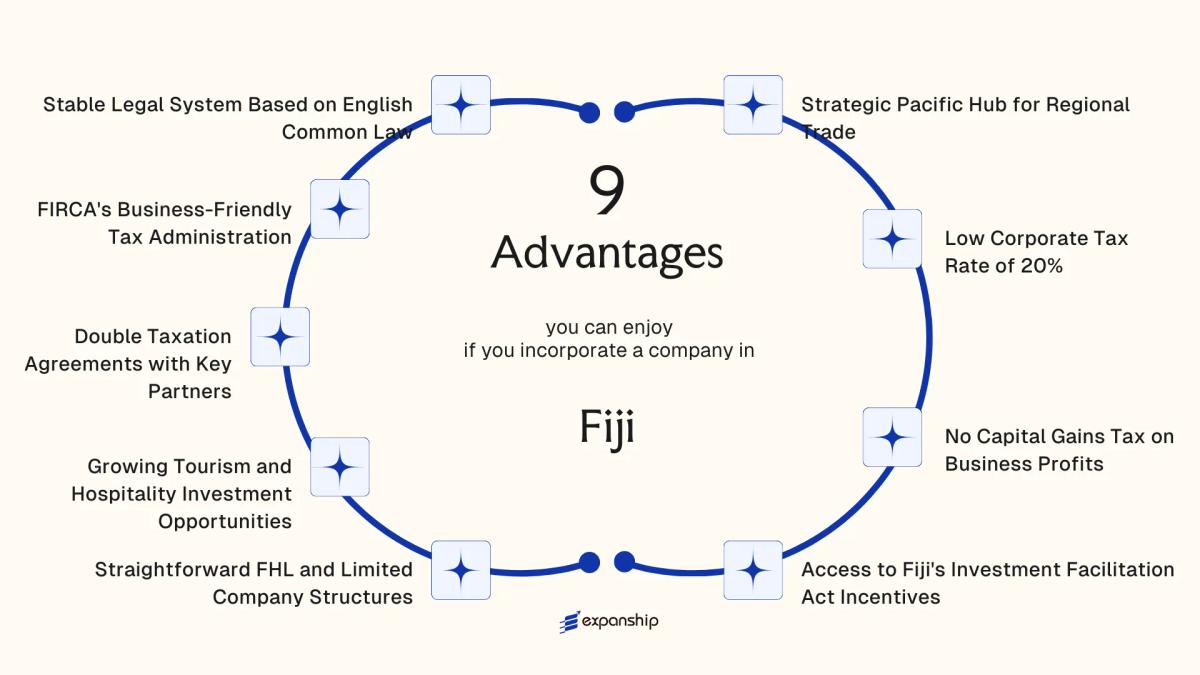
Strategic Pacific Hub for Regional Trade
Fiji's geographic position in the South Pacific places it at an intersection of trade routes connecting Australia, New Zealand, North America, and Asia. That positioning has practical consequences for businesses that need a base with real regional access.
Proximity to Major Pacific Economies
Suva and Nadi sit within a four-to-five hour flight radius of Sydney, Auckland, Tokyo, and Singapore. For companies engaged in goods distribution, financial services, or regional operations management, that accessibility reduces transit times and simplifies multi-market coordination across the Asia-Pacific corridor.
Fiji holds membership in the Pacific Islands Forum and benefits from the Pacific Agreement on Closer Economic Relations (PACER Plus), which governs trade arrangements between Pacific Island countries and Australia and New Zealand. These frameworks give businesses incorporated locally a defined trade architecture to operate within, rather than navigating bilateral arrangements from outside the region.
Regional Hub Status in Practice
Port Denarau and the Suva port together handle significant inter-island and international cargo flows. A business registered under the Companies Act 2015 can use Fiji as an operational base to serve smaller Pacific Island markets that lack comparable commercial infrastructure.
Your entity gains direct access to PACER Plus trade frameworks and a central Pacific location without needing a separate regional subsidiary structure.
Low Corporate Tax Rate of 20%
Fiji's standard corporate tax rate sits at 20%, which is notably lower than the OECD average of around 23% and considerably below the rates applied in many Asia-Pacific economies. For a foreign-owned company generating profits through a local entity, this rate applies to net taxable income as assessed under the Income Tax Act. The Fiji Revenue and Customs Service (FRCS) administers collection and compliance.
What this means in practice is that a larger share of after-tax profit remains available for reinvestment or repatriation, without the drag of a higher statutory rate eroding returns from the outset.
The Fiji 20 percent corporate tax rate advantage becomes particularly relevant when structuring regional operations through a local limited company. Profits earned within the jurisdiction are taxed at this flat rate, and the structure itself does not impose tiered or graduated corporate tax schedules, which simplifies tax forecasting for your business.
Several features of the tax rate framework make it accessible for foreign investors:
- The rate applies uniformly, regardless of company size or sector, reducing uncertainty in financial planning
- No minimum capital requirement inflates your tax base artificially before trading begins
- Fiji corporate tax rate advantages extend to both resident and non-resident companies on income sourced locally

Incorporate a Company in Fiji
Set up your Fiji-registered company with Expanship's end-to-end incorporation service, covering entity selection, registration, and compliance setup.
No Capital Gains Tax on Business Profits
Fiji imposes no capital gains tax on business profits. For a foreign investor disposing of shares, selling business assets, or realising gains on the winding-up of a local entity, this means the full gain is retained rather than surrendered to the tax authority. That structural absence is not a temporary concession or an incentive granted under a specific scheme; it reflects the general design of the Income Tax Act as administered by the Fiji Revenue and Customs Service (FRCS).
| Event Type | CGT Applicable | Governing Body |
|---|---|---|
| Sale of business shares | No | FRCS |
| Disposal of business assets | No | FRCS |
| Realised investment gains | No | FRCS |
| Ordinary business income | Yes (20% corporate rate) | FRCS |
The distinction between capital and revenue gains matters here. Because no separate capital gains regime exists, proceeds from asset disposals are not reclassified and taxed as income under a different rate. Your business retains that flexibility in structuring exits, asset transfers, or portfolio realisations without triggering an additional layer of liability.
For businesses operating across multiple jurisdictions, this position reduces the complexity of intercompany asset transfers routed through a Fijian holding or operating structure. The absence of a capital gains charge at the point of disposal allows for cleaner profit repatriation planning, without requiring mitigation strategies that would otherwise be necessary in jurisdictions maintaining capital gains rates of 20% to 33%.
Access to Fiji's Investment Facilitation Act Incentives
Enacted in 2016, the Investment Facilitation Act (IFA) is the primary legislative instrument governing foreign investment in Fiji. It replaced the earlier Foreign Investment Act and introduced a more structured framework for registering, protecting, and incentivising foreign capital. For your business, this matters because the IFA provides statutory certainty — rights granted under it are backed by law, not administrative discretion.
Under the IFA, qualifying foreign investors receive protections against arbitrary expropriation and have the right to repatriate profits and capital freely. This means your returns are not trapped in-country, which is a practical concern in many emerging markets. The Act also grants access to sector-specific concessions administered through the Fiji Revenue & Customs Service (FRCS) and Investment Fiji.
Eligible sectors have historically included tourism, agriculture, manufacturing, and ICT. Incentives can include import duty concessions, tax holidays, and reduced withholding tax rates, subject to investment thresholds and sector classification.
Keep these points in mind:
- Registration with Investment Fiji is required before IFA protections apply
- Incentive eligibility depends on sector and minimum capital investment thresholds
- Profit repatriation rights apply only to registered foreign investments under the IFA
- Incentive packages are reviewed periodically and terms may change at policy level
Foreign investors registered under the IFA can hold 100% equity in most sectors without requiring a local partner.
Straightforward FHL and Limited Company Structures
Fiji offers two primary corporate vehicles for foreign investors: the Foreign Holdings Limited (FHL) and the standard limited liability company. The Fiji FHL limited company structure benefits foreign owners in a specific and practical way — each entity type is purpose-built, which means your chosen structure aligns with your ownership profile from the outset rather than requiring post-incorporation restructuring.
FHL: Designed for Full Foreign Ownership
The FHL structure exists precisely because Fijian law distinguishes between locally owned and foreign-owned entities. An FHL can be 100% foreign-owned, removing any requirement to bring in a local partner. This matters because many Pacific jurisdictions impose local equity thresholds as a condition of operation — the FHL sidesteps that constraint entirely.
Registration is handled through the Fiji Revenue and Customs Service (FRCS) and the Registrar of Companies under the Companies Act 2015. That single statutory framework governs formation, directorship, and ongoing filing obligations, so your compliance obligations are predictable from day one.
Limited Company: Structural Simplicity with Legal Certainty
For entities with Fijian shareholders or mixed ownership, the standard limited company under the Companies Act 2015 provides a familiar structure for anyone accustomed to English common law corporate forms. Liability is capped at the amount unpaid on shares, which separates your personal assets from business risk.
Both structures require a registered office address in the country. That requirement is administrative rather than operational, meaning your business can be managed from abroad while maintaining full legal standing locally.
Plan Your Corporate Structure in Fiji
Get expert guidance on whether an FHL or limited company structure suits your ownership profile and operational goals in Fiji.
Growing Tourism and Hospitality Investment Opportunities
Fiji tourism investment opportunities for businesses have expanded considerably following structural reforms under the Investment Fiji framework and targeted incentive categories introduced through the Investment Facilitation Act. Tourism remains one of the country's largest foreign exchange earners, which translates into active government support for entities entering the sector.
- Investment Fiji, the statutory body responsible for facilitating inward investment, maintains a dedicated tourism desk that assists foreign companies with registration, site identification, and liaison with relevant ministries. This reduces the procedural friction that often delays entry into unfamiliar markets.
- The Investment Facilitation Act designates tourism as a priority sector, making qualifying businesses eligible for accelerated depreciation allowances and import duty concessions on capital equipment. For a hospitality firm importing fit-out materials or specialist equipment, this directly reduces initial capital outlay.
- Visitor arrivals have historically concentrated through Nadi and the Mamanuca and Yasawa island groups, but government policy has actively encouraged investment in lesser-developed coastal and interior areas, where land lease terms under the iTaukei Land Trust Board can be structured over extended periods. Longer lease durations give your business greater security when planning the depreciation horizon for fixed assets.
- The hospitality sector's integration with regional air connectivity, including direct routes from Australia, New Zealand, and North America, supports sustained occupancy rates that underpin revenue projections for incoming operators.
Double Taxation Agreements with Key Partners
Fiji double taxation agreements benefits are most relevant to foreign investors with cross-border income flows, particularly those receiving dividends, royalties, or service fees from overseas parent entities or subsidiaries.
Fiji has entered into DTAs with Australia, New Zealand, the United Kingdom, Japan, South Korea, and Papua New Guinea, among others. These treaties define reduced withholding tax rates on cross-border payments and establish clear rules on which country holds primary taxing rights over specific income categories.
For a foreign business operating through a Fijian entity, a DTA with your home country can prevent the same income from being taxed twice — once locally and once abroad. Without treaty protection, withholding taxes on dividends or royalties can compound significantly across jurisdictions.
- Australia and New Zealand, two of the most active trading partners in the region, are both covered under existing treaty arrangements.
- Treaty provisions typically address permanent establishment thresholds, which determines whether your overseas activities trigger a local tax liability.
A business owner resident in Japan receiving royalties from a Fiji-registered entity would, under the Japan-Fiji DTA, be subject to a capped withholding rate rather than the standard domestic rate — reducing the total tax cost on that income stream compared to a non-treaty jurisdiction arrangement.
Treaty coverage does not eliminate all withholding obligations, and the specific rates and conditions vary by agreement.
FIRCA's Business-Friendly Tax Administration
The Fiji Revenue and Customs Service (FRCS), formerly known as FIRCA, administers tax obligations for businesses operating under a centralised system that handles income tax, VAT, and customs duties through a single authority. For foreign companies, dealing with one body rather than multiple fragmented agencies reduces administrative overhead considerably.
FRCS operates an online taxpayer portal that allows businesses to file returns, make payments, and manage compliance obligations digitally. This matters because foreign-owned entities without a permanent local staff presence can manage core tax functions remotely without requiring in-country intervention for routine submissions.
FIRCA tax compliance benefits for businesses also extend to the available rulings process. Companies can seek advance tax rulings before executing transactions, providing certainty on how a specific arrangement will be treated under the Income Tax Act 2015. That removes guesswork from structuring decisions, particularly for cross-border transactions where tax treatment is not immediately clear.
- Centralised administration under one authority covers income tax, VAT, and customs
- Advance rulings available under the Income Tax Act 2015
- Digital filing supported through the FRCS taxpayer portal
Advance rulings are transaction-specific and do not constitute general clearance; each ruling applies only to the exact arrangement described in the application.
Stable Legal System Based on English Common Law
Fiji's legal system is derived from English common law, a foundation that gives foreign business owners a familiar and predictable framework for resolving disputes, enforcing contracts, and structuring commercial arrangements. For firms incorporated under the Companies Act 2015, this means court decisions follow established precedent, reducing interpretive uncertainty in commercial matters.
Precedent-Based Contract Enforcement
Contract enforcement under a common law system depends on accumulated case law rather than purely legislative instruction. This matters because foreign investors can anticipate how courts will interpret agreement terms, liability clauses, and breach remedies based on documented judicial decisions. The Supreme Court of Fiji and Court of Appeal operate within this inherited framework, applying principles consistent with Commonwealth jurisprudence.
Property and Shareholder Protections
Fiji's legal framework recognizes established doctrines covering fiduciary duty, corporate separation, and equitable relief. A foreign shareholder's rights within a registered entity are governed by the Companies Act 2015, which codifies duties of directors and mechanisms for minority protection. These protections are not discretionary, they are statutory obligations enforceable through the court system.
Institutional Continuity
The legal system's connection to Commonwealth law also means access to a developed body of commercial precedent beyond domestic case law. Where local rulings are limited, courts may reference persuasive decisions from other common law jurisdictions, including Australia and the United Kingdom. This extends the practical depth of legal guidance available to your business without requiring legislative reform to achieve it.
How Fiji Stacks Up Against Other Pacific Jurisdictions
Comparing against Pacific neighbours requires focusing on jurisdictions that attract the same pool of foreign investors. Vanuatu, Samoa, and the Cook Islands each position themselves as incorporation-friendly territories, and any business evaluating Fiji vs other Pacific jurisdictions would realistically shortlist one or more of them. What the comparison reveals is less about tax rates in isolation and more about the combination of legal infrastructure, treaty access, and regulatory transparency that determines operational risk over time.
Vanuatu and Samoa have historically marketed zero or near-zero corporate tax environments, which can appear compelling at first glance. Fiji's 20% corporate rate is higher, but the trade-off is access to a functioning common law court system, double taxation agreements with substantive partners, and a tax authority, the Fiji Revenue and Customs Service, that operates under a published legislative framework. For businesses with genuine commercial activity rather than pure holding structures, that combination carries meaningful weight when evaluating why choose Fiji over Pacific competitors.
| Parameter | Fiji | Vanuatu | Samoa |
|---|---|---|---|
| Corporate Tax Rate | 20% | 0% | 27% (standard) |
| Capital Gains Tax | None | None | None |
| Double Taxation Agreements | Yes (multiple partners) | Limited | Limited |
| Legal System | English Common Law | Dual (Common Law / French) | English Common Law |
| Tax Administration Body | FIRCA | VFSC / IRD Vanuatu | MoF / MFEM |
| FATF/AML Compliance Standing | Generally compliant | Has faced scrutiny | Requires monitoring |
Compliance Services for Companies in Fiji
Maintain good standing with FIRCA and the Registrar of Companies through ongoing compliance support tailored to Fiji-registered entities.
Conclusion
Fiji presents a coherent case for foreign incorporation: a 20% corporate tax rate combined with the absence of capital gains tax on business profits means your effective tax exposure on investment returns is materially lower than in most comparable jurisdictions. The Investment Facilitation Act provides a formal statutory basis for the incentives available to qualifying foreign-owned entities, giving those arrangements legal weight rather than relying on administrative discretion.
For businesses oriented toward the Pacific region, the combination of double taxation agreements with key trading partners and a legal system grounded in English common law reduces two of the more significant structural uncertainties that foreign investors typically face: treaty protection against double taxation and a predictable judicial framework for resolving commercial disputes.
The benefits of incorporating in Fiji are most relevant to businesses with a genuine commercial connection to the Pacific, whether through trade, tourism, or regional operations. An entity with no operational ties to the region is unlikely to extract the same value from the jurisdiction's geographic and treaty advantages. Understanding how your specific corporate structure and industry interact with FIRCA's administration and Fiji's regulatory framework is the appropriate starting point for any incorporation decision.
Start Your Fiji Company Formation With Expanship Today
Fiji company formation with Expanship covers the full incorporation lifecycle under the Companies Act 2015, from structuring your entity as a Foreign Company branch or a locally registered limited liability company, through to ongoing compliance with the Fiji Revenue and Customs Service (FRCS) and the Registrar of Companies. The processes, obligations, and incentives discussed across this blog each require precise documentation and regulatory coordination, which is where structured professional support becomes relevant.
Expanship's services for business incorporation in Fiji include:
- Preparation and legalization of incorporation documents, including the Constitution and consent forms required under the Companies Act 2015
- Registered agent and registered office provision to satisfy local presence requirements
- Filing and liaison with the Registrar of Companies on your behalf
- Post-incorporation compliance management, covering annual returns and FRCS registration
- Banking introduction assistance to support account setup with local financial institutions
Reach out to Expanship Fiji to discuss your incorporation requirements.
Frequently Asked Questions (FAQ)
The standard corporate tax rate in Fiji is 20%, applied to taxable profits. This rate is administered by the Fiji Revenue and Customs Service (FRCA) under the Income Tax Act 2015. Certain concessions and sector-specific incentives may reduce the effective rate further, depending on the nature of the business and whether it qualifies under approved investment schemes.
There is no general capital gains tax in Fiji on the disposal of business assets or shares. This means profits from selling a business or its underlying assets are not subject to a separate capital gains charge, though the specific characterisation of a transaction can affect whether proceeds are treated as income under the Income Tax Act 2015.
The Investment Facilitation Act 2021 replaced the former Foreign Investment Act and introduced a more structured framework for registering and operating foreign-owned businesses in Fiji. It outlines sector access, investment guarantees, and the role of FIPA in facilitating approvals. Companies that register under this framework gain a defined legal standing that governs their operational rights and any applicable restrictions.
Fiji has concluded double taxation agreements with a number of countries, which can reduce or eliminate withholding taxes on dividends, interest, and royalties paid to residents of treaty partner nations. The specific rates and conditions vary by agreement, and the relevant treaty provisions are applied through FRCA's administration of the Income Tax Act 2015. You should confirm treaty applicability based on the tax residency of your entity's beneficial owners or parent company.
Fiji's legal system is based on English common law, which means commercial disputes are adjudicated using principles and precedents familiar to investors from Commonwealth jurisdictions. Contract law, company law, and insolvency frameworks follow established common law doctrine, supplemented by local legislation such as the Companies Act 2015. This foundation provides a degree of predictability in how courts interpret commercial agreements and corporate obligations.
Incorporation timelines depend on the completeness of documentation submitted to the Registrar of Companies under the Companies Act 2015. Standard registration for a private limited company can generally be completed within a matter of days once all required documents are in order, though additional approvals from FIPA are required if the entity involves foreign investment. The total timeline, including investment registration, may extend to several weeks depending on the sector and application complexity.
Legal Disclaimer
The information provided in this article is for general informational purposes only and does not constitute legal, tax, or professional advice. While we strive to ensure the accuracy and timeliness of the content, laws and regulations are subject to change, and the application of laws can vary widely based on specific facts and circumstances.
Readers should not act upon this information without seeking professional counsel tailored to their individual situation. Expanship and its authors disclaim any liability for actions taken or not taken based on the content of this article.
For specific advice regarding your business setup, compliance requirements, or any legal matters, please consult with qualified legal and tax professionals in the relevant jurisdiction.