

Key Takeaways
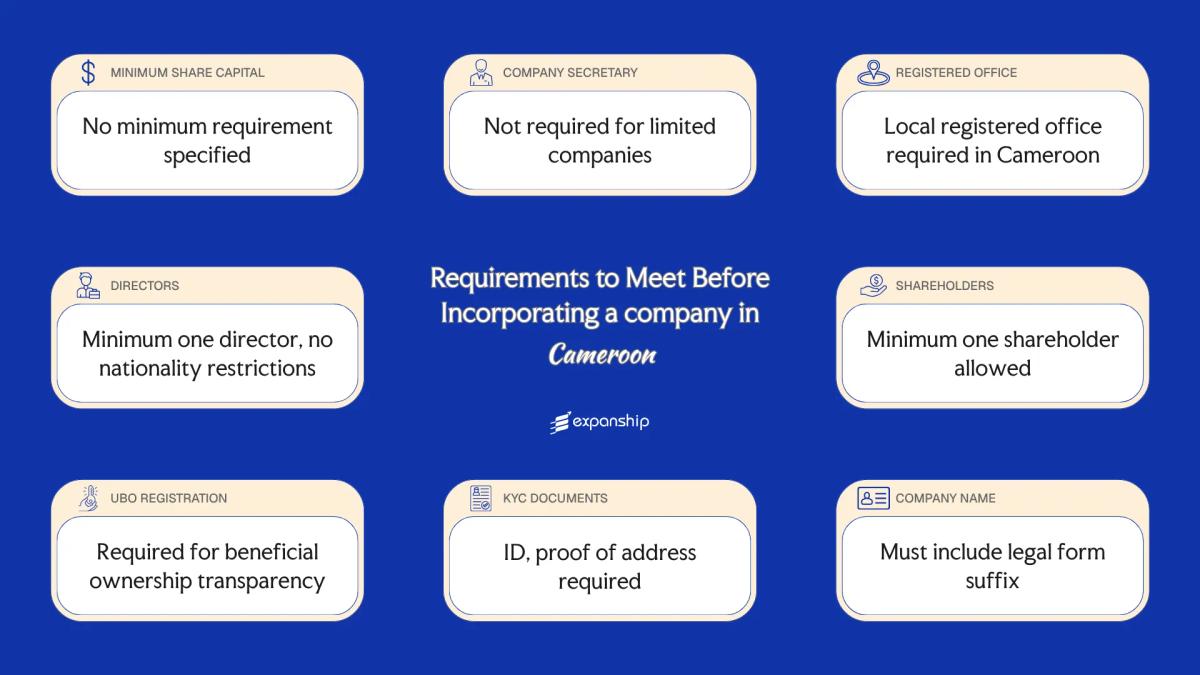
- Entities incorporating in Cameroon must comply with the OHADA Uniform Act on Commercial Companies and Economic Interest Groups, which sets out the structural and statutory requirements governing company formation across all OHADA member states, including minimum capital thresholds that vary by legal form between the Société à Responsabilité Limitée and the Société Anonyme.
- All incorporation applications must be submitted through the Centre de Formalités de Création d'Entreprises (CFCE), the designated registration body operating under the oversight of the Ministry of Finance and the relevant commercial judiciary.
- Beneficial ownership information must be disclosed in accordance with Cameroon's anti-money laundering legislation, making UBO transparency a statutory obligation rather than a voluntary compliance measure.
- Foreign investors are required to satisfy Know Your Customer (KYC) documentary requirements and secure a physical registered office address within Cameroon before a registration application can be completed.
Company incorporation requirements in Cameroon are governed by the OHADA Uniform Act on Commercial Companies and Economic Interest Groups, adopted under the treaty framework of the Organisation for the Harmonisation of Business Law in Africa. The Centre de Formalités de Création d'Entreprises (CFCE) serves as the primary registration body, operating under the oversight of the Ministry of Finance and the judiciary responsible for commercial matters.
This article covers the structural, documentary, and statutory requirements applicable to entity formation under that framework.
Failure to satisfy these requirements results in rejection of the registration application or, where an entity operates without proper formation, exposure to legal invalidity of corporate acts.
Specific requirements vary depending on the legal form chosen, whether a Société à Responsabilité Limitée or Société Anonyme, and may differ further for regulated industries. Investors should consult the OHADA Uniform Act directly for the applicable provisions.
This article is most relevant to foreign investors and business owners seeking to establish a formal legal presence through a locally registered entity.
Minimum Share Capital Requirements in Cameroon
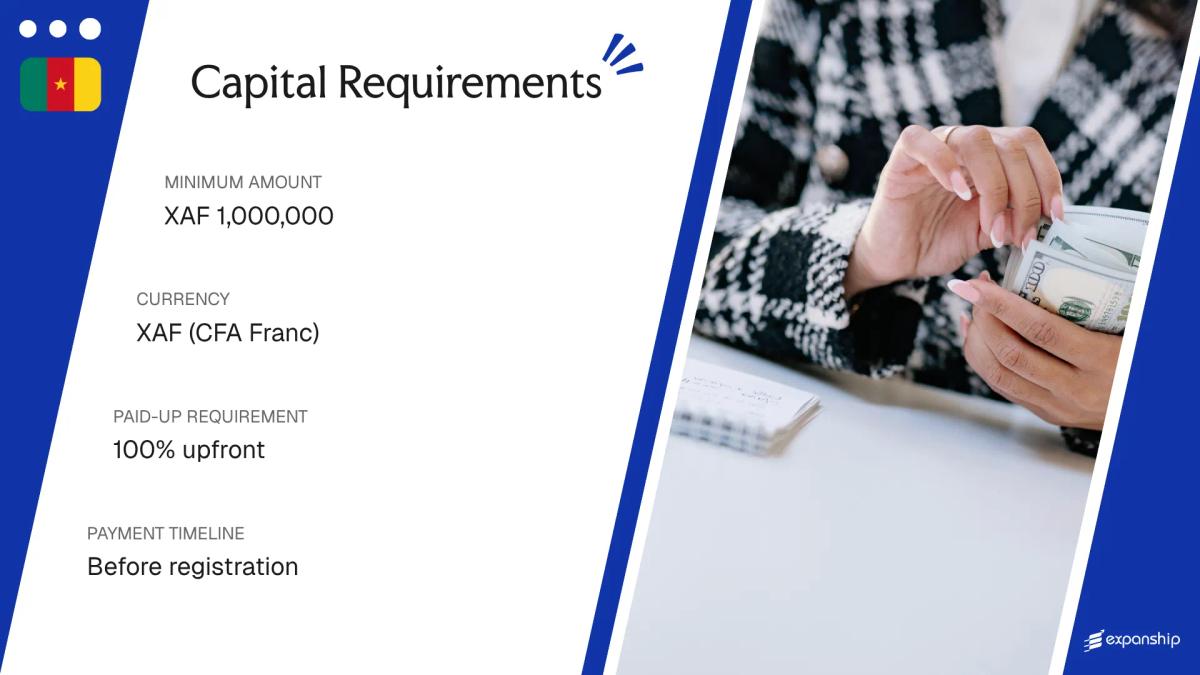
Governed by the OHADA Uniform Act on Commercial Companies and Economic Interest Groups (AUSC), minimum share capital requirements in Cameroon differ based on the legal form chosen for incorporation. The OHADA framework, which Cameroon adopted as a member state, sets binding thresholds that the Centre de Formalités de Création d'Entreprises (CFCE) enforces during registration.
Shares in OHADA-compliant entities are issued at par value. Capital must be deposited in a blocked bank account before the notary formalises the deed of incorporation, and the bank issues a certificate confirming the deposit to the CFCE as part of the filing package.
| Parameter | Detail |
|---|---|
| Minimum Authorized Share Capital | XAF 100,000 for SARL; XAF 10,000,000 for SA |
| Maximum Authorized Share Capital | No statutory maximum |
| Minimum Paid-Up Capital | XAF 100,000 for SARL; XAF 2,500,000 for SA at incorporation |
| Paid-Up Requirement at Incorporation | SARL: 100% upfront; SA: at least 25% of subscribed capital |
| Accepted Currency | Central African CFA franc (XAF) |
| Accepted Forms of Contribution | Cash contributions; contributions in kind (subject to auditor valuation) |
| Timeframe to Deposit Capital | Prior to signing the notarial deed of incorporation |
The blocked bank account certificate must be obtained before the notary executes the incorporation deed. Registration cannot proceed without it, regardless of entity type.
Company Secretary Requirements in Cameroon
Under the OHADA Uniform Act on Commercial Companies, Cameroon does not impose a statutory requirement for a formally designated company secretary as a mandatory corporate officer. That said, certain administrative and compliance functions must still be fulfilled within the company's governance structure.
For a Société Anonyme (SA), the board of directors collectively bears responsibility for statutory record-keeping, preparing minutes of shareholder meetings, and maintaining the company's registers. Smaller entities such as the Société à Responsabilité Limitée (SARL) assign these obligations directly to the gérant. Meeting OHADA secretary compliance in Cameroon means ensuring these duties are discharged by a qualified and accountable individual within the firm.
Where a company chooses to appoint a dedicated secretary, the following general criteria apply to eligibility:
- No statutory residency requirement mandates that the secretary be domiciled in Cameroon.
- Both natural persons and legal entities may fulfil this administrative role, subject to the company's constitutive documents.
- The individual must have legal capacity to act on behalf of a business under OHADA rules.
- No specific professional licensing is required under the OHADA framework for this role.

Incorporate a Company in Cameroon
Set up your business entity in Cameroon with full compliance support across OHADA requirements and local regulatory obligations.
Registered Office Requirements in Cameroon
Registered office requirements in Cameroon are governed by the OHADA Uniform Act on Commercial Companies and Economic Interest Groups, which mandates that every company maintain a physical address within the territory where it is officially registered.
- A physical street address is required; a P.O. box alone does not satisfy the registered office obligation.
- The address must be located within Cameroon, corresponding to the jurisdiction of the competent court (tribunal de grande instance) handling the company's registration.
- Virtual offices are not formally recognised as compliant registered office addresses under OHADA rules.
- Supporting documentation, such as a title deed or lease agreement, must confirm the company's right to occupy the premises.
- The registered address is publicly recorded in the Registre du Commerce et du Crédit Mobilier (RCCM) and is therefore accessible to third parties.
- Any change of address requires formal notification to the RCCM and triggers an amendment to the company's registration details.
- Operating with a non-compliant or fictitious address can expose the entity to administrative sanctions and may affect the legal validity of official correspondence served at that address.
Director Requirements in Cameroon
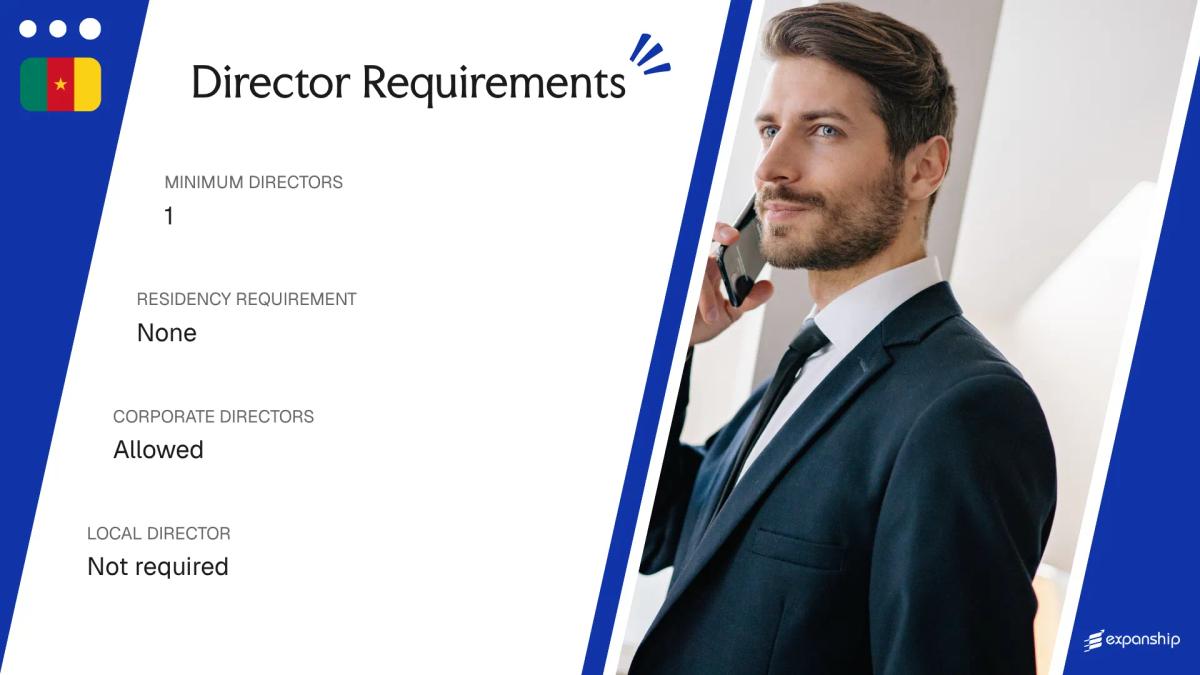
Under the OHADA Uniform Act on Commercial Companies (AUSC), director requirements in Cameroon apply to both the Société Anonyme (SA) and the Société à Responsabilité Limitée (SARL), with the latter's managing director referred to as a gérant. Upon appointment, directors assume statutory duties including the obligation to act in the company's interest, manage affairs with due diligence, and bear personal liability for violations of the AUSC or the company's articles of association.
| Parameter | Detail |
|---|---|
| Minimum Number of Directors | One director is required for a SARL (gérant); an SA requires at least three board members. |
| Maximum Number of Directors | An SA may have up to twelve board members under the AUSC. |
| Local/Resident Director Required | No statutory requirement for a locally resident director exists under the AUSC. |
| Nationality Restrictions | No nationality restrictions are imposed; foreign nationals may serve as directors. |
| Minimum Age Requirement | Directors must be of legal majority age, which is 21 years under Cameroonian law. |
| Corporate Directors Permitted | Corporate directors are not permitted; only natural persons may serve as directors under the AUSC. |
| Director Must Be a Shareholder | A gérant in a SARL is not required to be a shareholder; SA board members may be required to hold qualification shares per the articles. |
| Publicly Listed on Registry | Director information is filed with the RCCM (Registre du Commerce et du Crédit Mobilier) and is accessible on the public record. |
| Disqualification Conditions | Persons convicted of commercial fraud, bankruptcy offences, or other crimes specified under the AUSC are disqualified from directorship. |
Under the AUSC, a single individual can simultaneously hold the roles of sole director and general manager in an SA structured with a sole administrator, effectively concentrating executive and supervisory authority in one person.
Shareholder Requirements in Cameroon
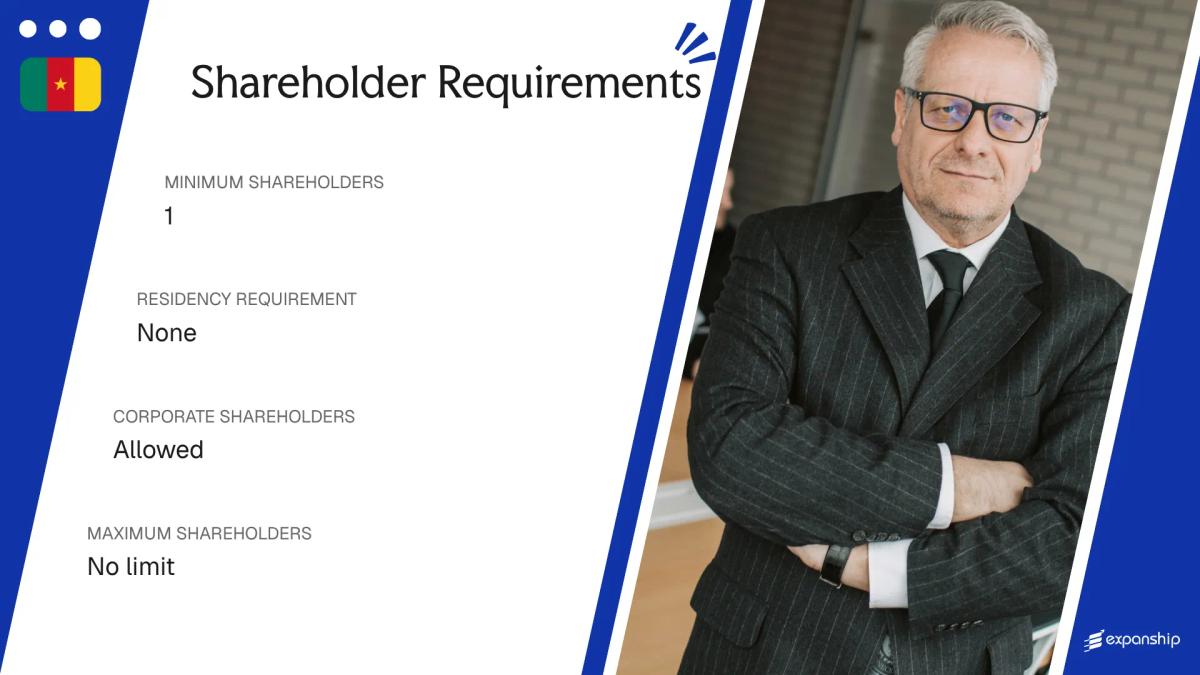
Under the OHADA Uniform Act on Commercial Companies, a Société à Responsabilité Limitée (SARL) requires a minimum of one shareholder and permits up to 100. A single-member SARL, known as a SARLU, is a recognized structure for sole shareholder arrangements.
Nationality and Residency Restrictions
Shareholder requirements in Cameroon do not impose nationality or residency conditions on shareholders. Foreign nationals and non-resident individuals may hold equity without restrictions tied to local presence.
Corporate Shareholders
Corporate entities are permitted to act as shareholders in a Cameroonian company. No specific conditions restrict corporate shareholders beyond standard OHADA registration and identity documentation requirements.
Shareholder Liability
In a SARL, each shareholder's liability is limited to their capital contribution. Extended personal liability may arise in cases of fraud, asset commingling, or abuse of the corporate form under OHADA provisions.
Register of Shareholders
A register of shareholders must be maintained at the company's registered office. This record is not publicly accessible but must reflect any changes in ownership and remain available for regulatory inspection.
Shareholder Compliance Support for Your Cameroon Entity
Get guidance on structuring ownership, maintaining your shareholder register, and meeting OHADA compliance obligations for your Cameroon incorporation.
UBO / Beneficial Ownership Disclosure Requirements in Cameroon
Beneficial ownership disclosure Cameroon obligations derive from the OHADA Uniform Act on Commercial Companies and Economic Interest Groups, which applies across all OHADA member states including Cameroon, alongside national anti-money laundering legislation.
- Identify any natural person who ultimately owns or controls 25% or more of the company's shares or voting rights.
- Declare that individual's identity, nationality, and address to the Centre de Formalités de Création d'Entreprises (CFCE) at the time of incorporation.
- Record beneficial ownership information in the company's internal statutory registers.
- Report any subsequent changes in beneficial ownership to the CFCE within the period prescribed by applicable regulations.
| Parameter | Detail |
|---|---|
| Ownership Threshold for UBO Status | 25% of shares or voting rights |
| Filing Authority | Centre de Formalités de Création d'Entreprises (CFCE) |
| Disclosure Deadline at Incorporation | At the time of company registration |
| Publicly Accessible Register | No fully public register established |
| Penalties for Non-Disclosure | Sanctions under national AML legislation; specific penalties subject to regulatory determination |
| Ongoing Update Obligation | Required upon any change in beneficial ownership |
KYC / Document Requirements in Cameroon
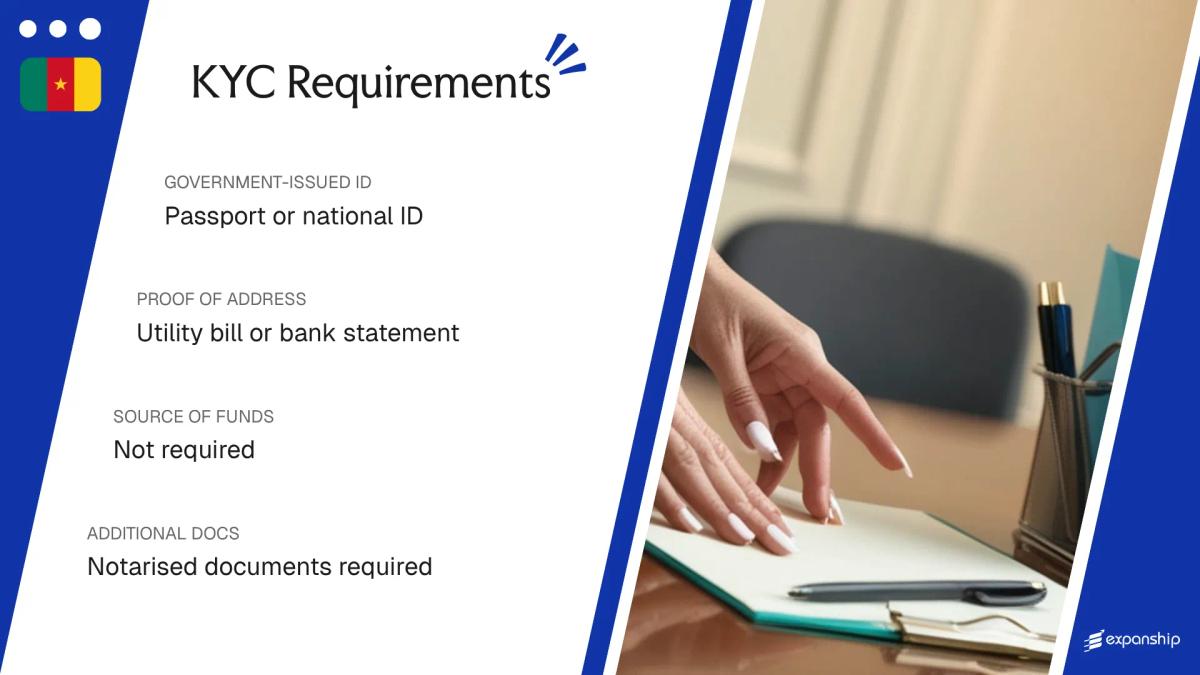
KYC document requirements in Cameroon are governed by the CEMAC AML/CFT framework, including Regulation No. 01/03/CEMAC/UMAC/CM and its implementing texts, which bind all entities registered within the CEMAC monetary zone. The ANIF, Cameroon's Financial Intelligence Unit, oversees compliance with these obligations at the incorporation stage.
Individual / Personal Documents
- Valid government-issued photo ID (passport or national identity card) for each individual director, shareholder, or beneficial owner
- Proof of residential address dated within three months, such as a utility bill or bank statement
- Completed and signed KYC declaration or subscriber information form as required by the registrar
- Two recent passport-sized photographs may be requested depending on the filing agent or notary
Corporate Documents
- Certified copy of the corporate shareholder's or director's certificate of incorporation
- Constitutional documents, including articles of association or equivalent instrument, evidencing the entity's legal structure
- Current register of directors and register of shareholders for the corporate entity
- Proof of registered office address for the corporate entity, such as a recent official correspondence or lease agreement
Source of Funds Documentation
- Recent bank statements (typically covering the prior three to six months) for capital introduction
- Audited financial statements where the subscribing entity has been operational for more than one financial year
- A written declaration of the origin of funds may be required where bank documentation is insufficient
Notarisation and Apostille Requirements
- Foreign-issued documents generally require notarisation by a competent authority in the country of origin
- Apostille certification under the Hague Convention applies where the issuing country is a signatory; Cameroon is a party to the Convention
- All documents not in French or English must be accompanied by a certified translation into one of Cameroon's official languages
Incomplete or uncertified identity documentation for corporate shareholders is the most frequently cited reason for registration delays at the CFCE (Centre de Formalités de Création d'Entreprises).
Company Name Requirements in Cameroon
Proposed company name requirements Cameroon are assessed during the commercial registration process, where the registrar verifies that the chosen name is available and does not conflict with an existing registered entity. Names are evaluated on a first-come, first-served basis.
French or English may be used, reflecting Cameroon's bilingual status. The legal form must appear in the name as a suffix, such as SA or SARL, depending on the entity type chosen.
Certain words are prohibited or require prior authorisation. Terms implying government affiliation, banking, or insurance functions generally fall under restricted categories.
Name reservation is available prior to full registration. The reservation period and application procedure are handled through the relevant commercial registry office.
Compliance Services for Companies in Cameroon
Stay compliant with Cameroon's regulatory requirements, from annual filings to ongoing statutory obligations.
Conclusion
Cameroon company incorporation requirements are governed primarily by the OHADA Uniform Act on Commercial Companies, supplemented by domestic procedural rules enforced through the Centre de Formalités de Création d'Entreprises. Among the most consequential requirements covered are the share capital thresholds tied to entity type and the beneficial ownership disclosure obligations under anti-money laundering legislation. Once these requirements are understood, a foreign investor moves into the operational phase — securing a physical registered office, opening a corporate bank account, and registering with the relevant tax authority.
Expanship's Corporate Services for Cameroon Expansion
Expanship's corporate services Cameroon expansion support is structured around the specific regulatory environment you encounter when incorporating under OHADA law and registering with the RCCM and tax authorities. From share capital structuring to registered office provision, the operational requirements in Cameroon involve coordination across multiple institutions. Expanship reduces the administrative load of managing those requirements in parallel.
Our service scope across the incorporation and post-incorporation period includes:
- Preparing and filing all company registration documents with the RCCM and relevant Cameroonian authorities
- Providing a registered agent and a compliant local office address for your entity
- Handling government filings and liaising directly with regulatory bodies on your behalf
- Managing ongoing compliance obligations after your business is incorporated
- Facilitating introductions to banking institutions suitable for your corporate structure
- Coordinating tax registration and engagement with local fiscal authorities
To discuss your incorporation requirements, contact Expanship Cameroon.
Frequently Asked Questions (FAQ)
The OHADA Uniform Act sets the minimum share capital for a SARL at XAF 1,000,000, and it must be fully subscribed at the time of incorporation. Unlike some jurisdictions that permit partial payment at formation, Cameroon requires the entire amount to be deposited before registration with the Centre de Formalités de Création d'Entreprises (CFCE).
Failure to comply with beneficial ownership disclosure obligations can result in administrative sanctions and potential criminal liability under Cameroon's anti-money laundering framework. The ANIF (Agence Nationale d'Investigation Financière) is the supervisory body responsible for enforcement, and non-disclosure can also expose directors personally to regulatory action.
A foreign national can serve as a director in Cameroon, but doing so may require a valid residency permit or professional card issued by Cameroonian authorities, depending on whether the individual is resident in Cameroon. Regulatory scrutiny on foreign-controlled entities has increased in line with OHADA governance standards, so the practical pathway depends on the director's residency status.
The OHADA Uniform Act does not impose a mandatory company secretary requirement in the same way common law jurisdictions do. Governance responsibilities that would typically fall to a secretary in other systems are instead allocated to the gérant in a SARL or the board in a Société Anonyme (SA), making the appointment of a formal secretary a matter of internal governance rather than statutory obligation.
Foreign shareholders are generally required to provide certified copies of their passport or national identity document, proof of address dated within three months, and corporate documents if the shareholder is itself a legal entity, including a certificate of incorporation and constitutional documents with certified translations into French or English. The CFCE processes these submissions, and notarised or apostilled documents are commonly required depending on the country of origin.
Cameroon recognises both French and English as official languages, and company documents may be filed in either language at the CFCE. In practice, the majority of commercial activity and regulatory correspondence occurs in French, particularly in Yaoundé and Douala where most registrations are processed, so having documentation prepared or translated into French reduces the risk of administrative delays.
Legal Disclaimer
The information provided in this article is for general informational purposes only and does not constitute legal, tax, or professional advice. While we strive to ensure the accuracy and timeliness of the content, laws and regulations are subject to change, and the application of laws can vary widely based on specific facts and circumstances.
Readers should not act upon this information without seeking professional counsel tailored to their individual situation. Expanship and its authors disclaim any liability for actions taken or not taken based on the content of this article.
For specific advice regarding your business setup, compliance requirements, or any legal matters, please consult with qualified legal and tax professionals in the relevant jurisdiction.