
Key Takeaways
- Cameroon's dual legal system — combining OHADA Uniform Act obligations with national Cameroonian statutes — requires companies to maintain compliance across two overlapping legal frameworks simultaneously, increasing both legal costs and the risk of inadvertent non-compliance.
- Foreign investors in sectors such as mining, agriculture, and media face restricted ownership ceilings that limit equity control and complicate the structuring of multinational subsidiaries or offshore holding arrangements.
- Registration through the Centre de Formalités de Création d'Entreprises (CFCE) is subject to bureaucratic delays that extend the time-to-operate beyond what OHADA's streamlined incorporation principles were designed to achieve in practice.
- Beyond standard corporate income tax, Cameroonian entities are exposed to multiple overlapping levies — including municipal taxes, sectoral contributions, and withholding obligations — that collectively impose a heavier fiscal burden than the headline rate alone suggests.
Cameroon operates under an evolving regulatory framework shaped by OHADA law — the Organisation for the Harmonisation of Business Law in Africa — alongside national statutes enforced through bodies such as the Centre de Formalités de Création d'Entreprises (CFCE). The disadvantages of incorporating in Cameroon span procedural, financial, legal, and operational dimensions, each examined separately across this article.
The drawbacks of setting up a company in Cameroon are not uniform. A foreign investor establishing a société anonyme faces a different set of constraints than one forming a société à responsabilité limitée, and sector-specific regulations add further variation.
This article is most relevant to foreign investors, multinational subsidiaries, and offshore holding structures seeking entry into Central African markets through a Cameroonian entity. The primary legislative reference governing commercial entities is the OHADA Uniform Act, which directly governs company formation, governance, and dissolution across member states including Cameroon.
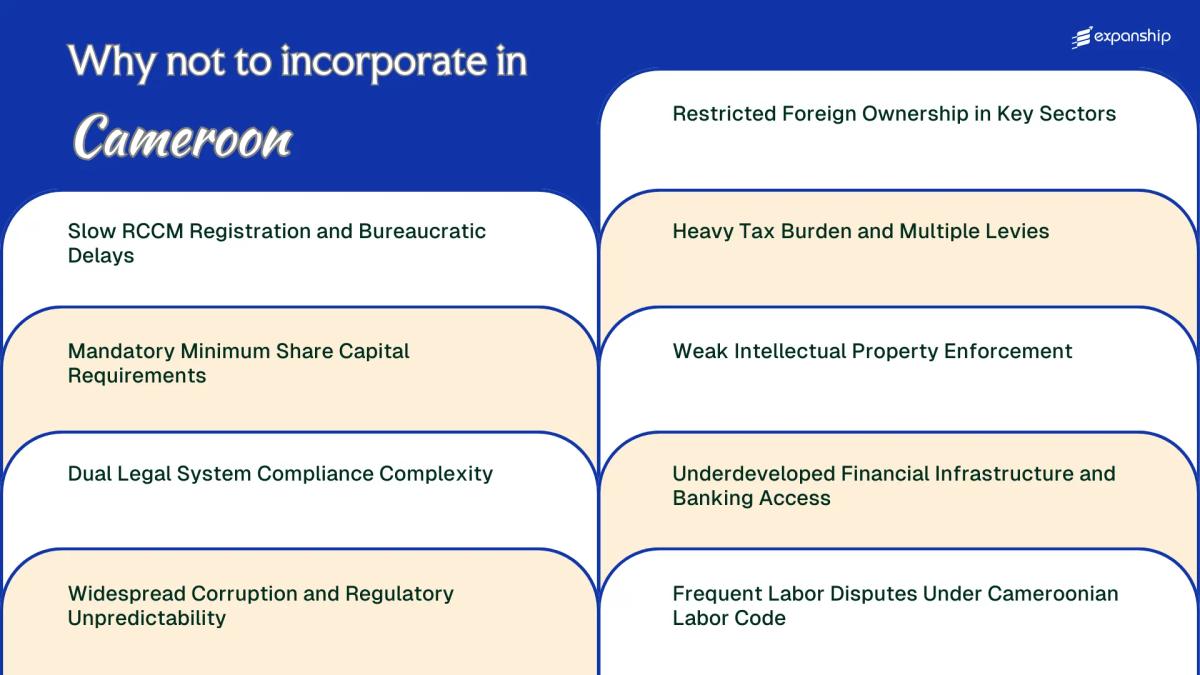
Slow RCCM Registration and Bureaucratic Delays
RCCM registration delays in Cameroon affect operational timelines more severely than founders typically anticipate. The process is administered through the Registre du Commerce et du Crédit Mobilier, which operates under the OHADA Uniform Act on General Commercial Law.
Structural Bottlenecks in the RCCM Process
Clerks at the Greffe du Tribunal de Grande Instance handle RCCM filings manually in many jurisdictions across the country, creating processing backlogs that routinely extend registration timelines to several weeks, even for straightforward company formations. Your business cannot legally operate, open a corporate bank account, or sign binding commercial contracts until registration is complete, meaning that every week of delay translates directly into lost revenue and mounting pre-operational costs.
Some urban centers, particularly Douala and Yaoundé, have seen incremental digitization efforts, but implementation remains inconsistent across regions.
What Delayed Registration Means for Foreign Entrants
For a foreign investor managing costs remotely, an unpredictable timeline makes it nearly impossible to align staffing, lease agreements, or supplier commitments with an actual start date. The slow company incorporation process creates a structural mismatch between planning assumptions and on-the-ground reality.
Indefinite RCCM processing timelines mean your entity has no legal standing during the delay period, exposing pre-operational activities to significant contractual and liability risks.
Mandatory Minimum Share Capital Requirements
Cameroon minimum share capital restrictions create an immediate financial barrier before your business generates a single franc of revenue. Under the OHADA Uniform Act on Commercial Companies, a Société à Responsabilité Limitée requires a minimum share capital of XAF 1,000,000, while a Société Anonyme demands at least XAF 10,000,000. For an SA seeking public subscription, that threshold rises to XAF 25,000,000.
These amounts must be deposited and verified before registration proceeds, tying up working capital at the earliest and most cash-sensitive stage of your operation.
The SA minimum capital requirement creates particularly acute friction for foreign investors:
- Funds remain blocked in a notarial escrow account until incorporation is complete, denying you access during an already slow registration process
- The SA threshold effectively prices out small-to-mid-size foreign entrants who might otherwise test the market with a lighter initial structure
- Any shortfall in declared capital can invalidate the incorporation process entirely, forcing costly restarts
- SARL share capital requirements Cameroon still demand full upfront payment, unlike some OHADA member states that permit staged capital contributions
Private SARL entities are partially exempt from the more demanding SA thresholds, though the underlying capital immobilization problem applies across both structures.

Company Incorporation in Cameroon
Understand the capital requirements and legal obligations before registering your business in Cameroon.
Dual Legal System Compliance Complexity
Dual legal system risks Cameroon business owners face stem from an unusual structural split: the country operates under both French civil law in eight regions and English common law in the Northwest and Southwest regions. For a foreign entity, this creates immediate uncertainty about which procedural rules, evidentiary standards, and judicial interpretations apply to your operations.
OHADA law (Organisation pour l'Harmonisation en Afrique du Droit des Affaires) governs commercial matters across member states and is applied nationally. Yet OHADA's French-origin drafting and its reliance on Francophone legal doctrine means that Anglophone lawyers and courts often interpret its provisions through a different legal lens, producing inconsistent outcomes in contract enforcement and dispute resolution depending on where your firm is registered or sued.
| Compliance Variable | Francophone Zones (8 Regions) | Anglophone Zones (NW & SW) |
|---|---|---|
| Primary legal tradition | French Civil Law | English Common Law |
| OHADA application | Direct and dominant | Applied with common law overlay |
| Court language of procedure | French | English |
| Contract interpretation standard | Civil code principles | Common law precedent |
| Legal counsel requirement | Notary-dependent for many acts | Solicitor/barrister model |
Contracts drafted under one tradition may face enforceability challenges if litigated in a court operating under the other. This forces your business to engage bilingual legal counsel familiar with both systems, a specialist profile that is scarce and commands significantly higher fees than standard local counsel. The ongoing Anglophone crisis has further disrupted court operations in the Northwest and Southwest regions, compounding procedural delays that directly affect your ability to enforce agreements or resolve commercial disputes on predictable timelines.
Widespread Corruption and Regulatory Unpredictability
Corruption risks doing business in Cameroon rank among the most cited operational concerns by foreign investors. Transparency International's Corruption Perceptions Index consistently places the country in the lower half of its global rankings, reflecting structural governance deficits that extend into commercial activity.
Informal payments are frequently reported at municipal licensing offices, tax inspection points, and customs clearance. This is not incidental — it affects routine business operations, not just one-off permit applications.
Regulatory unpredictability compounds the problem. Ministerial decrees can alter sector-specific operating conditions with little advance notice, and enforcement of existing rules is inconsistent across regions. A firm operating in Douala may face different administrative interpretations of the same regulation than one based in Yaoundé.
The National Anti-Corruption Commission (CONAC), established under Law No. 2006/016, holds investigative and advisory powers but limited enforcement authority over private sector disputes. Its presence does not reliably protect foreign entities from solicitation at the operational level.
- CONAC reporting obligations apply to corruption witnessed in commercial contexts
- Ministerial discretion over licensing can affect approvals without formal legal recourse
- Foreign firms remain subject to local tax audits that carry discretionary assessment powers
- Regulatory requirements may be applied selectively depending on the supervising authority
Cameroon has two separate anti-corruption legal frameworks — one civil law-based and one rooted in common law — yet neither system provides a unified commercial remedy path for foreign businesses that experience extortion during licensing.
Restricted Foreign Ownership in Key Sectors
Foreign ownership restrictions across Cameroon sectors affect which industries your business can enter, how much equity you can hold, and whether a local partner becomes a legal requirement rather than a strategic choice.
Where Restrictions Apply
Under the Investment Charter (Law No. 2002/004) and sector-specific legislation, foreign equity participation is capped or conditioned in areas including broadcasting, telecommunications, and certain extractive industries. These limitations are not always published in a single consolidated register, so identifying the exact threshold for your sector requires navigating multiple regulatory bodies, including MINMIDT and sector-specific agencies.
Why This Burdens Foreign Investors
Mandatory joint ventures with local partners dilute your control over strategic decisions, profit distribution, and exit terms. For limitations on foreign investors in Cameroon, the absence of a standardized foreign investment screening framework means restrictions can be applied inconsistently, creating uncertainty that directly affects capital commitment timelines. Minority equity positions also reduce your firm's ability to enforce governance standards, which compounds risks already present in the regulatory environment.
Managing Foreign Ownership Restrictions in Cameroon
If your business operates in a restricted sector, understanding your equity ceiling and structuring requirements before incorporation can prevent costly restructuring later.
Heavy Tax Burden and Multiple Levies
The heavy tax burden incorporated companies face in Cameroon reflects a layered system administered by the Directorate General of Taxation (DGI), where multiple levies apply simultaneously and compound the effective cost of doing business.
- Corporate income tax is levied at 33% on net profits, a rate that exceeds many comparable African jurisdictions and directly reduces post-tax returns for foreign investors.
- The minimum flat tax (impôt minimum forfaitaire) applies even when your company records no profit, meaning you owe tax regardless of actual business performance.
- Value Added Tax at 19.25% applies to most goods and services, adding a recurring compliance and cash-flow obligation on top of income-based levies.
- The patente (business licence tax) is assessed annually based on your firm's turnover and sector, creating a variable cost that is difficult to forecast during early-stage operations.
- Multiple tax levies across municipal, regional, and national tiers under Cameroon's General Tax Code mean your entity may face audits and filing obligations from more than one authority simultaneously.
Weak Intellectual Property Enforcement
Weak intellectual property enforcement in Cameroon creates measurable exposure for foreign businesses that rely on proprietary assets. The country is a member state of the Organisation Africaine de la Propriété Intellectuelle (OAPI), which provides a regional trademark and patent registration framework, but registration alone does not translate into effective protection at the national level.
Enforcement of OAPI-registered rights depends on domestic courts and customs authorities, both of which have limited technical capacity in IP matters. Cases involving counterfeiting or trademark infringement move slowly through the judiciary, and outcomes are inconsistent.
Your registered trademark can be actively exploited by local competitors while litigation remains unresolved for years. This exposure is particularly significant in consumer goods, software, and pharmaceutical sectors.
- Counterfeit goods circulate widely in informal markets with minimal customs intervention
- Civil IP proceedings lack specialist IP judges at the trial court level
- Criminal enforcement actions are rarely initiated without sustained pressure from rights holders
A foreign software firm operating in Cameroon may spend upward of $15,000–$30,000 USD in local legal fees pursuing a single infringement case, with no guarantee of injunctive relief within a commercially useful timeframe.
Underdeveloped Financial Infrastructure and Banking Access
Banking access challenges Cameroon businesses face are structural, not incidental. The country's banking sector is regulated by the Banque des États de l'Afrique Centrale (BEAC) and supervised nationally by the Commission Bancaire de l'Afrique Centrale (COBAC), but the system remains concentrated among a small number of commercial banks with limited branch penetration outside Douala and Yaoundé.
Opening a corporate account as a foreign-owned entity typically involves extended due diligence periods, high minimum deposit requirements, and documentation demands that vary by institution without a standardized process. This unpredictability translates directly into delayed operations for any firm that needs an active account to receive client payments or disburse payroll.
Cross-border transactions face additional friction under BEAC's foreign exchange controls, which restrict capital transfers and require regulatory approval for certain outflows. For a foreign parent company expecting to repatriate dividends or intercompany payments, these controls create timing and liquidity problems that are difficult to plan around.
- Correspondent banking relationships are limited, raising transaction costs for international wire transfers.
- Mobile and digital banking options for corporate accounts remain underdeveloped compared to West African peers like Senegal or Côte d'Ivoire.
BEAC foreign exchange regulations require prior authorization for transfers above defined thresholds, meaning your ability to move funds out of the country is subject to regulatory discretion, not just internal treasury decisions.
Frequent Labor Disputes Under Cameroonian Labor Code
Labor disputes risks Cameroon incorporation presents are rooted in the Labor Code (Law No. 92/007 of 14 August 1992), which imposes significant procedural obligations on employers that can generate recurring conflicts with workers.
Termination is a primary source of friction. The Code mandates specific notice periods, severance calculations, and prior authorization for collective dismissals, meaning any procedural misstep exposes your firm to formal grievance proceedings before the Labor Inspectorate.
Union activity is legally protected and organizationally active. Disputes mediated through the Labor Inspectorate can extend for months before reaching arbitration, directly stalling operations and generating legal costs.
Foreign-owned entities face an additional layer of exposure through mandatory hiring quotas favoring national workers. Non-compliance with these staffing ratios compounds the risk of workforce disputes and Cameroonian Labor Code compliance challenges that foreign management structures are often unprepared to handle.
Overcoming Cameroon's Incorporation Challenges
Overcoming incorporation challenges in Cameroon requires structural preparation before any registration process begins. No single fix resolves the full range of obstacles; addressing them demands a coordinated approach across legal, financial, and compliance dimensions.
- Verify sector-specific foreign ownership ceilings under the Investment Charter (Law No. 2002/004) before selecting a business activity or entity type.
- Register the company through the Centre de Formalités des Entreprises (CFCE) to consolidate filings that would otherwise require separate agency visits.
- Establish banking arrangements in advance, accounting for account opening timelines that routinely extend beyond standard processing periods.
- File for intellectual property protection with the Organisation Africaine de la Propriété Intellectuelle (OAPI) at the time of incorporation, not after operations begin.
- Determine at formation whether your entity falls under OHADA Uniform Acts or anglophone common law procedures, as procedural obligations differ materially.
These steps reduce exposure but do not eliminate the underlying structural constraints embedded in the Cameroonian regulatory framework. The RCCM registration system, tax administration under the Direction Générale des Impôts, and labor obligations under the Labour Code remain fixed institutional realities that all registered entities must operate within.
Cameroon's Business Potential in Perspective
Cameroon's documented disadvantages are real and affect day-to-day operations. Yet the country remains a credible destination for foreign incorporation, particularly given its position as a regional hub in Central Africa with access to CEMAC markets and a population exceeding 28 million.
| Pros | Cons |
|---|---|
| CEMAC membership grants access to five additional Central African markets under a shared customs zone | RCCM registration is subject to significant bureaucratic delays that extend incorporation timelines |
| Cameroon's bilingual legal system can accommodate businesses from both civil and common law jurisdictions | Operating across Francophone and Anglophone regions requires compliance with two distinct legal traditions simultaneously |
| The OHADA treaty provides a regionally harmonized commercial law framework | Foreign ownership is restricted or prohibited outright in sectors including land acquisition and certain natural resources |
| A formal labor code establishes clear employment terms that can support structured workforce planning | Multiple overlapping tax levies, including the business license tax and various municipal duties, increase the effective cost of doing business |
| The country's size and geographic diversity support multi-sector business activity | Intellectual property protections under OAPI membership are weakly enforced domestically |
Corruption documented by Transparency International and banking infrastructure gaps add further friction that directly affects capital access and regulatory predictability for foreign-owned entities.
Compliance Services for Companies in Cameroon
Maintain your Cameroonian entity in good standing with local regulatory, tax, and reporting requirements.
Conclusion
The cons of incorporating a company in Cameroon are measurable and well-documented across registration, taxation, and enforcement frameworks. Dual legal system compliance, the tax burden imposed across multiple levies, and the persistent corruption index rankings present concrete operational friction for foreign businesses. These are structural conditions, not temporary inefficiencies. For firms assessing whether incorporating in Cameroon is worth the risks, informed preparation — rather than assumption — determines outcomes. Professional guidance specific to OHADA regulations and local administrative procedures remains the most reliable path forward.
Expanship's Support for Your Cameroon Expansion
Cameroon expansion challenges support services touch every stage of the incorporation process, from RCCM registration through the Centre de Formalités de Création d'Entreprises to ongoing compliance under both OHADA regulations and Cameroonian domestic law. Expanship works alongside your business to reduce the administrative weight of these obligations, handling documentation, filings, and regulatory coordination so your team can focus on operations rather than procedural bottlenecks.
Our support across Cameroon company formation compliance assistance covers the full incorporation lifecycle:
- Your company registration and all supporting document preparation are handled end to end.
- A registered agent and local office address are provided to meet statutory requirements.
- We manage government filings and liaise directly with the relevant regulatory bodies on your behalf.
- Post-incorporation compliance obligations are monitored and maintained on an ongoing basis.
- Banking introduction assistance is available to help your entity establish a local account.
- Tax registration and coordination with local fiscal authorities are included in our scope.
Reach out to Expanship Cameroon to discuss your incorporation requirements.
Frequently Asked Questions (FAQ)
The dual system affects any business that operates across both Anglophone and Francophone regions, or that hires staff from both. Cameroon applies OHADA law uniformly for commercial entities, but procedural rules, court processes, and administrative interactions differ between the Common Law courts in the Northwest and Southwest regions and the Civil Law courts elsewhere. A dispute that starts in one region may need to be re-litigated under different procedural rules if jurisdiction shifts.
Under the OHADA Uniform Act on Commercial Companies, a Société à Responsabilité Limitée (SARL) requires a minimum share capital of XAF 1,000,000, which must be fully paid up at incorporation. While that figure is modest in absolute terms, the requirement to deposit verified funds with a notary before registration adds both cost and processing time. Additional notarial fees are calculated as a percentage of the declared capital, which increases the total upfront financial burden.
Non-compliance with the Labor Code of 1992 can result in fines, mandatory reinstatement orders, and damage awards issued through the labor tribunal. Employers who fail to follow the prescribed dismissal procedures, including mandatory notice periods and severance calculations, are routinely ordered to pay compensation equivalent to several months of salary. The labor courts in Cameroon tend to rule in favor of employees, which compounds the financial exposure for foreign-owned firms unfamiliar with local procedural requirements.
Enforcement in Cameroon is weaker than in several OHADA peers that have invested more in IP tribunal capacity. While Cameroon is a member of the African Intellectual Property Organization (OAPI), and OAPI registration does provide regional protection across member states, domestic enforcement mechanisms are slow and under-resourced. Court proceedings to stop infringement can take years, and interim injunctions are difficult to obtain in practice.
Without an active corporate bank account, your Cameroonian entity cannot receive client payments, settle tax obligations, or meet payroll requirements under the Labor Code. Several international banks have reduced their correspondent relationships in Cameroon due to de-risking policies, which means newly incorporated foreign-owned firms sometimes wait months before a local bank completes its know-your-customer process and opens an operational account. During that period, the company is legally registered but functionally unable to operate.
Restricted sectors in Cameroon, including certain natural resource extraction and public utility activities, impose ownership caps that apply regardless of corporate structure. Routing investment through an intermediary holding company does not remove the underlying restriction if the beneficial owner is identified as foreign, and Cameroonian regulatory authorities do examine ultimate beneficial ownership during licensing reviews. Attempting to circumvent these restrictions through nominee arrangements carries legal risk and can result in license denial or revocation.
Tax assessments from the Direction Générale des Impôts are frequently inconsistent, with different inspectors applying different interpretations of the same provision across audit cycles. Cameroon imposes multiple levies beyond corporate income tax, including the business license tax (patente), communal taxes, and sector-specific duties, and the interaction between these obligations is not always clearly administered. Foreign businesses report that reassessments arrive with limited supporting rationale, and formal appeals through the tax tribunal are slow, often taking over a year to resolve.
Legal Disclaimer
The information provided in this article is for general informational purposes only and does not constitute legal, tax, or professional advice. While we strive to ensure the accuracy and timeliness of the content, laws and regulations are subject to change, and the application of laws can vary widely based on specific facts and circumstances.
Readers should not act upon this information without seeking professional counsel tailored to their individual situation. Expanship and its authors disclaim any liability for actions taken or not taken based on the content of this article.
For specific advice regarding your business setup, compliance requirements, or any legal matters, please consult with qualified legal and tax professionals in the relevant jurisdiction.