

Key Takeaways
- Foreign investors establishing a Chilean entity must select among legally distinct structures — including the Sociedad por Acciones (SpA), Sociedad de Responsabilidad Limitada (SRL), or Sociedad Anónima (SA) — each carrying different governance and compliance obligations under the Ley de Sociedades framework.
- SpAs operating in Chile are not subject to a statutory minimum share capital requirement, though the chosen capital amount must be specified in the formation documents submitted through the Empresa en un Día platform or the Registro de Comercio.
- All registered entities in Chile must maintain a local registered address, as this constitutes a mandatory formation requirement rather than an administrative preference, and its absence will result in rejection of the registration application.
- Beneficial ownership and KYC documentation obligations apply at the point of incorporation and are administered through regulatory bodies including the Comisión para el Mercado Financiero, placing disclosure requirements on both resident and non-resident shareholders.
Incorporation requirements in Chile are governed primarily by the Ley de Sociedades framework administered through the Registro de Comercio, with entity formation formally processed through the Servicio de Registro Civil e Identificación or, for certain entity types, through the platform Empresa en un Día operated under the Ministerio de Economía.
This article addresses the structural, documentary, and regulatory requirements that apply across the formation process, from capital and governance to identity verification and naming conventions.
Failure to satisfy these requirements results in rejection of the registration application or, where an entity begins operating without proper formation, exposure to civil and administrative liability under Chilean law.
Requirements vary depending on the entity type selected, such as a Sociedad por Acciones (SpA), Sociedad de Responsabilidad Limitada (SRL), or Sociedad Anónima (SA), as well as the sector in which the business operates.
This article is most relevant to foreign entrepreneurs, multinational entities, and non-resident investors seeking to establish a legal presence in the Chilean market for the first time.
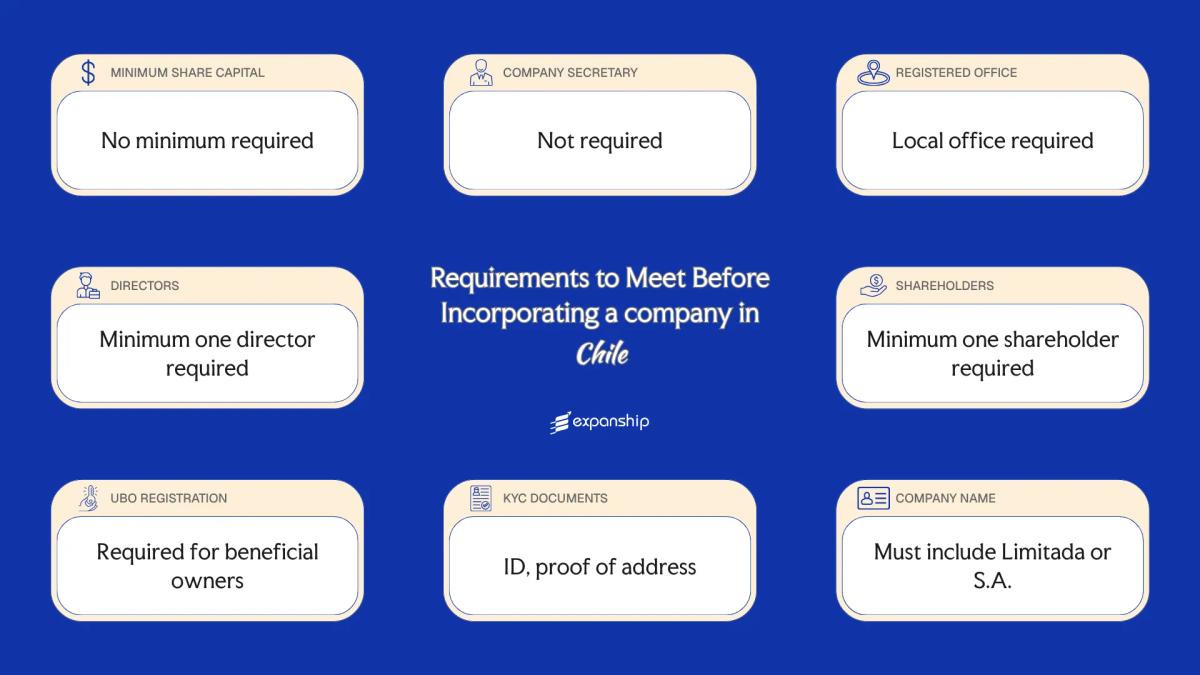
Minimum Share Capital Requirements in Chile
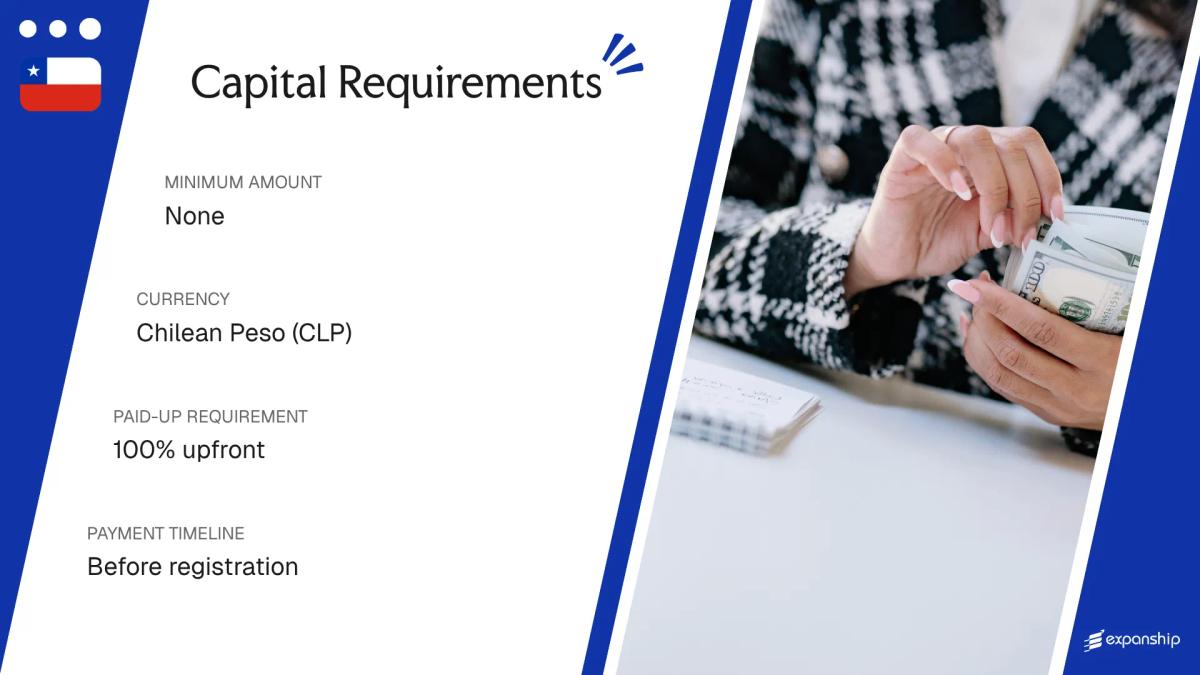
Neither the Sociedad por Acciones (SpA) nor the Sociedad Anónima (SA) is subject to a statutory minimum share capital figure under Chilean corporate law. Chile minimum share capital requirements operate on a no-par value share system, meaning shares are issued without a fixed nominal value, and the Registro de Comercio does not enforce a capital threshold at the point of incorporation.
Capital contributions are recorded in the company's articles of incorporation and must reflect a realistic valuation, but the obligation to actually pay in subscribed capital is governed by the shareholders' agreement rather than a fixed statutory deadline imposed by the Servicio de Impuestos Internos or the Conservador de Bienes Raíces.
| Parameter | Detail |
|---|---|
| Minimum Authorized Share Capital | No statutory requirement |
| Maximum Authorized Share Capital | No statutory requirement |
| Minimum Paid-Up Capital | No statutory requirement |
| Paid-Up Requirement at Incorporation | No statutory requirement; governed by shareholders' agreement |
| Accepted Currency | Chilean Peso (CLP); foreign currency permissible with conversion |
| Accepted Forms of Contribution | Cash, tangible assets, intangible assets, receivables |
| Timeframe to Deposit Capital | No statutory deadline; set by shareholders' agreement |
Even without a minimum requirement, your articles of incorporation must define the authorized capital and the number of shares issued. An omission here can invalidate the registration filing at the Registro de Comercio.
Company Secretary Requirements in Chile
Under Chilean corporate law, there is no mandatory requirement for a company secretary as a distinct corporate officer. The company secretary requirements Chile recognizes are relatively minimal compared to other jurisdictions, with governance obligations distributed among directors and legal representatives instead.
For most entity types, including the Sociedad por Acciones (SpA) and the Sociedad de Responsabilidad Limitada (SRL), a legal representative handles official correspondence and regulatory filings with bodies such as the Servicio de Impuestos Internos (SII) and the Registro de Comercio.
Where a secretarial function is performed, the responsible person or entity typically carries out duties such as:
- Maintaining the company's statutory books and minute records
- Certifying resolutions passed at shareholder or board meetings
- Coordinating filings with the Registro de Comercio and notarial requirements
- Acting as a point of contact for regulatory and tax authorities
Qualification criteria for those filling this role in practice include:
- No statutory licensing requirement applies under general corporate law
- Chilean residency is not mandated for the role itself
- Both natural persons and legal entities may perform secretarial functions
- Publicly listed companies supervised by the Comisión para el Mercado Financiero (CMF) may face additional internal governance standards

Incorporate a Company in Chile
Set up your legal entity in Chile with full compliance across statutory registration, tax enrollment, and regulatory filings.
Registered Office Requirements in Chile
Registered office requirements in Chile mandate that every company maintain a fixed, physical address within the country where official correspondence and legal notices can be received. Failure to maintain a compliant domicilio social Chile company records must reflect can result in administrative sanctions from the Registro de Empresas y Sociedades, including potential nullification of filings or fines under the Ley 20.659 framework.
- A physical street address is required; P.O. boxes do not satisfy the Chile legal address requirements under Ley 20.659.
- The address must be located within Chilean territory; foreign addresses are not accepted for the registered address obligations Chile imposes.
- Virtual office addresses may be used provided they correspond to a real, identifiable physical location and can receive legal correspondence.
- No ownership of the premises is required; a lease agreement or equivalent authorization to use the address is sufficient.
- The registered address is publicly listed in the Registro de Empresas y Sociedades and is accessible through the official government portal.
- Any change to the registered address must be formally notified to the Registro de Empresas y Sociedades through an updated filing, with the amendment recorded in the company's public record.
Director Requirements in Chile
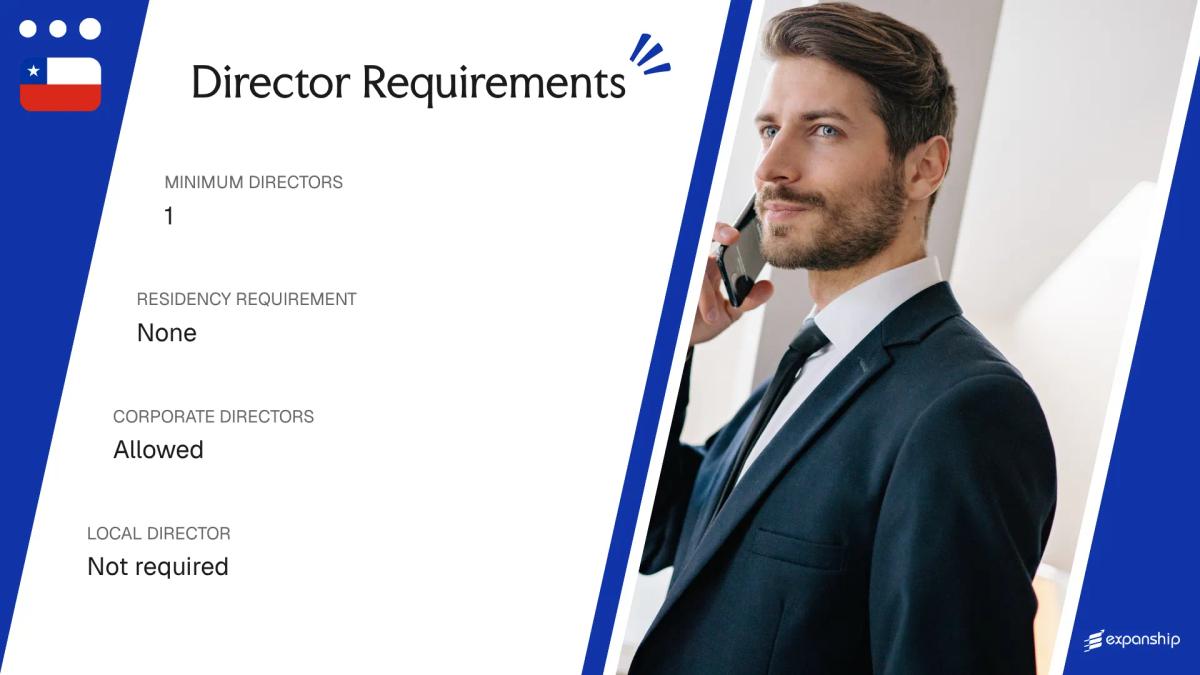
Director requirements in Chile are governed primarily by the Ley de Sociedades Anónimas (Law No. 18,046), which imposes statutory duties of loyalty and care on all appointed directors. Upon appointment, directors assume personal liability for resolutions adopted in breach of the law, the company's bylaws, or their fiduciary obligations to shareholders.
| Parameter | Detail |
|---|---|
| Minimum Number of Directors | A sociedad anónima abierta requires at least 5 directors; a sociedad anónima cerrada requires a minimum of 3 directors. |
| Maximum Number of Directors | No statutory maximum is prescribed under Law No. 18,046. |
| Local/Resident Director Required | No statutory residency requirement exists for directors of a Chilean SA. |
| Nationality Restrictions | No nationality restrictions apply; foreign nationals may serve as directors. |
| Minimum Age Requirement | Directors must be of legal age, which is 18 years under Chilean civil law. |
| Corporate Directors Permitted | Corporate entities are not permitted to serve as directors; only natural persons may hold the position. |
| Director Must Be a Shareholder | No requirement exists for a director to hold shares in the company. |
| Publicly Listed on Registry | Directors of sociedades anónimas abiertas are recorded with the Comisión para el Mercado Financiero (CMF). |
| Disqualification Conditions | Individuals declared bankrupt, convicted of certain crimes, or subject to CMF sanctions may be disqualified from serving. |
Despite having no residency requirement, Chilean law holds non-resident directors equally liable for board resolutions, meaning geographic absence provides no legal insulation from personal liability under Law No. 18,046.
Shareholder Requirements in Chile
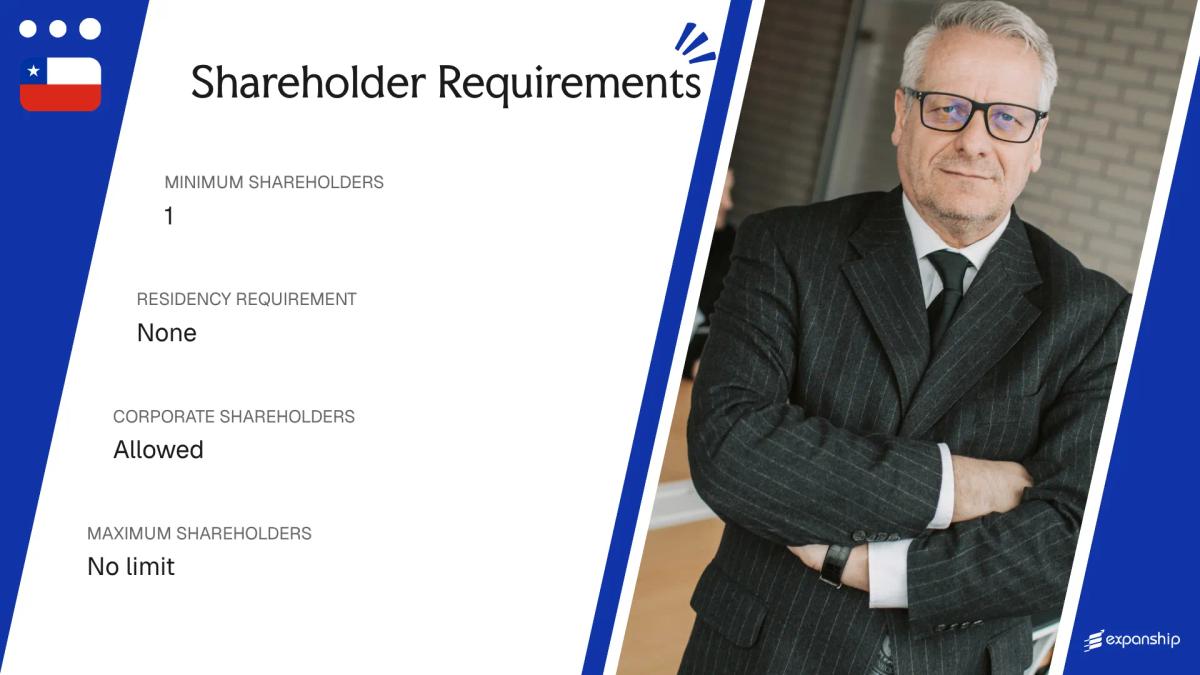
The Sociedad por Acciones (SpA) permits a single shareholder, making it the primary vehicle for sole-owner structures in Chile. There is no statutory maximum on the number of shareholders in an SpA, giving founders flexibility in structuring equity from the outset.
Nationality and Residency Restrictions
Shareholder requirements in Chile impose no nationality or residency conditions on shareholders of an SpA. Foreign individuals and entities may hold any percentage of equity without restriction.
Corporate Shareholders
Legal entities, including foreign corporations, may act as shareholders in a Chilean SpA. No additional licensing or local presence is required solely by reason of holding shares.
Shareholder Liability
Shareholders are liable only to the extent of their capital contribution. The SpA structure does not generally expose shareholders to personal liability for the obligations of the firm.
Register of Shareholders
An SpA must maintain an internal share registry recording ownership and any transfers. This register is not publicly filed with an external authority, though it must be kept current and made available during regulatory or judicial processes.
Shareholder Structuring Support for Your Chilean Entity
Get guidance on structuring compliant shareholding arrangements for your SpA or other Chilean business entity.
UBO / Beneficial Ownership Disclosure Requirements in Chile
Beneficial ownership disclosure Chile obligations are governed primarily by Law No. 20,393 on corporate criminal liability and reinforced through Financial Analysis Unit (UAF) regulations, which define a beneficial owner as any natural person who ultimately owns or controls 10% or more of a legal entity.
- Identify all natural persons holding 10% or more of the entity's capital or voting rights, directly or indirectly.
- Submit beneficial ownership information to the Chilean Internal Revenue Service (SII) through its online registry platform.
- Declare any chain of control structures that may obscure the ultimate natural person behind the entity.
- Notify the SII of any changes to beneficial ownership within the legally required timeframe following the change.
| Parameter | Detail |
|---|---|
| Ownership Threshold for UBO Status | 10% of capital or voting rights |
| Filing Authority | Chilean Internal Revenue Service (SII) |
| Disclosure Deadline at Incorporation | No statutory requirement specifying an exact post-incorporation deadline |
| Publicly Accessible Register | No |
| Penalties for Non-Disclosure | Administrative fines under SII regulations; potential criminal liability under Law No. 20,393 |
| Ongoing Update Obligation | Yes; changes must be reported to the SII upon modification |
KYC / Document Requirements in Chile
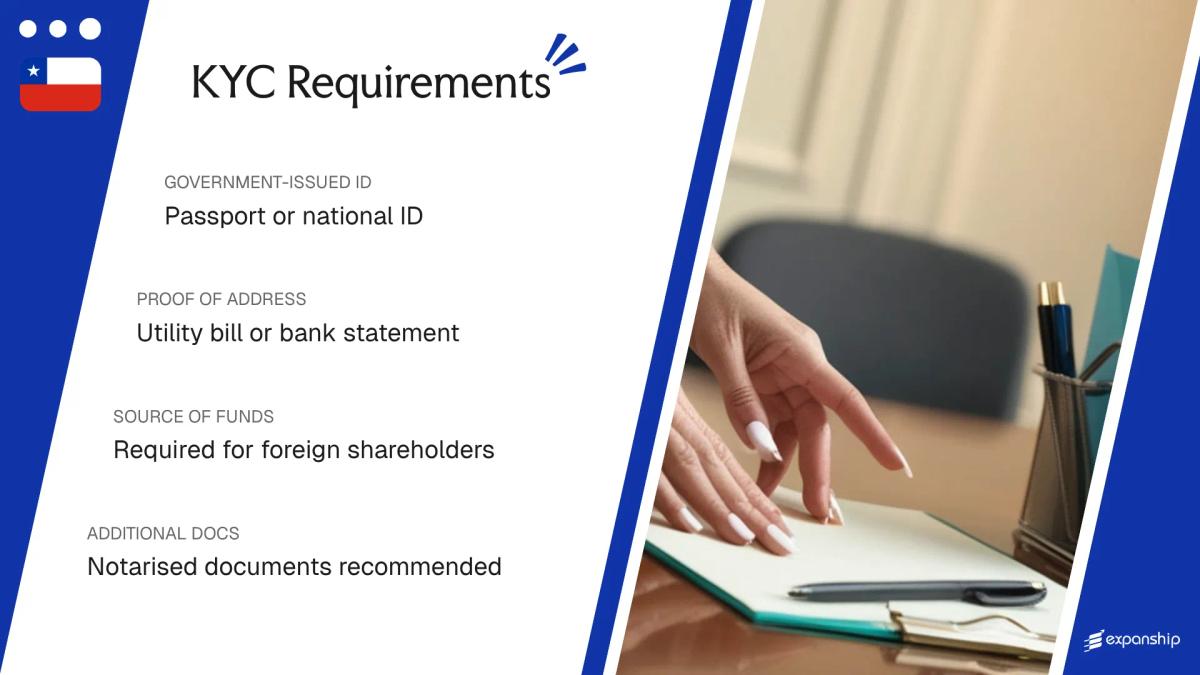
KYC requirements Chile company registration are governed by Law No. 19,913, which established the UAF (Unidad de Análisis Financiero) as the national financial intelligence authority overseeing anti-money laundering obligations at the point of entity formation.
Individual / Personal Documents
- Valid government-issued passport or national identity card for each director, shareholder, and beneficial owner
- Proof of residential address dated within three months, such as a utility bill or bank statement
- Signed and completed KYC declaration form confirming the individual's role and personal details
- Tax identification number from the individual's country of residence or domicile, where applicable
Corporate Documents
- Certificate of incorporation or equivalent constitutional document for any corporate shareholder or director
- Register of directors and register of shareholders issued by the relevant home jurisdiction authority
- Proof of registered office address for the corporate entity, confirmed by an official document
Source of Funds Documentation
- Recent bank statements covering a minimum of three months prior to incorporation
- Audited financial statements or equivalent where the corporate entity is the source of capital
- Written declaration describing the origin of funds if bank statements are insufficient
Notarisation and Apostille Requirements
- Foreign-issued identity and corporate documents generally require apostille certification under the Hague Convention
- Documents not in Spanish must be accompanied by a certified translation completed by an official translator recognised in Chile
- Notarisation by a Chilean notary public (Notario Público) may be required for documents executed abroad before use locally
Incomplete or untranslated foreign documents are the most common cause of incorporation delays at the Conservador de Bienes Raíces registration stage.
Company Name Requirements in Chile
Company name requirements in Chile are assessed during the incorporation process, with proposed names reviewed to confirm they are not already in use and do not conflict with existing registered entities. The name must be distinct enough to avoid confusion with any other legally constituted firm operating in the country.
All Chilean companies must include a legal suffix that reflects the entity type, such as "S.A." for a sociedad anónima or "SpA" for a sociedad por acciones. Names must be in Spanish, though foreign words are generally accepted when accompanied by an appropriate suffix.
Certain words are restricted from use without prior authorization from the relevant regulatory authority. Terms implying government affiliation, financial regulation, or professional licensing fall into this category, as do words that are considered misleading about the nature or scope of the business.
Name reservation is available prior to formal incorporation, allowing you to secure a proposed name while preparing the remaining documentation. Reservations are granted for a limited period, after which the name reverts to the available pool if the incorporation process has not been completed.
Compliance Services for Companies in Chile
Maintain your entity's good standing in Chile with ongoing compliance support, including annual filings, statutory record-keeping, and regulatory reporting.
Conclusion
Chile company incorporation requirements are governed primarily by the Corporations Act (Ley de Sociedades Anónimas) and the Commercial Code, administered through the Registro de Comercio and the Comisión para el Mercado Financiero. Among the requirements covered, the absence of a minimum share capital threshold for SpAs and the mandatory local registered address stand out as particularly consequential for foreign investors. Once these obligations are understood, the practical next step is engaging qualified local representation to execute registration through the Registro Civil and ensure ongoing statutory compliance.
Expanship's Corporate Services for Chile Expansion
Handling Chile company formation services involves navigating the SVS framework, fulfilling the notarial deed requirements for a SpA or SRL, and meeting the Registro de Comercio filing obligations — each step requiring precise documentation and local procedural knowledge. Expanship works alongside your team to manage the administrative weight of these requirements, so your attention stays on building the business rather than coordinating bureaucracy.
Beyond incorporation, Expanship supports your firm across the full setup process:
- Preparing and registering your company with the relevant Chilean authorities, including document drafting in Spanish.
- Providing a registered agent and a compliant local office address to satisfy domicile requirements.
- Liaising with the Registro de Comercio, SII, and other regulatory bodies for all government filings.
- Managing post-incorporation compliance obligations to keep your entity in good standing.
- Facilitating introductions to banking institutions familiar with foreign-owned Chilean entities.
- Handling tax registration with the SII and coordinating with local authorities as required.
To discuss how Expanship Chile can support your expansion, get in touch with our team.
Frequently Asked Questions (FAQ)
Foreign nationals can serve as directors of a Chilean SpA or Sociedad de Responsabilidad Limitada without holding Chilean residency. However, at least one director or legal representative (representante legal) must have a valid Chilean RUT (Rol Único Tributario) and a local address for service of process, which in practice requires either residency or a local appointee.
Chile's beneficial ownership disclosure obligations, established under Law No. 20,712 and reinforced by Financial Analysis Unit (UAF) regulations, are triggered when an individual directly or indirectly holds 10% or more of a company's equity or voting rights. The relevant information must be filed with the Servicio de Impuestos Internos (SII) and, depending on the sector, reported to the UAF as part of anti-money-laundering compliance.
Yes, the incorporation of most Chilean entities requires the execution of the constitutive deed (escritura pública or instrumento privado protocolizado) before a Chilean notary public. For a Sociedad por Acciones formed by a single founder online through the Registro de Empresas y Sociedades (RES) portal, the notarisation requirement is waived, but the electronic process still requires a valid Chilean electronic identity or RUT.
Failing to maintain a current registered address can result in the SII treating the company as non-locatable (contribuyente no ubicable), which triggers suspension of tax invoicing rights (timbraje de facturas) and can ultimately lead to administrative dissolution. Restoring active status requires filing an address update with the RES and regularising any outstanding tax obligations with the SII.
Yes, the requirements differ in scope. A foreign individual shareholder must provide a certified and apostilled copy of their passport, proof of address, and in some cases a certificate of good standing from their home jurisdiction. A foreign corporate shareholder must additionally supply apostilled constitutional documents, a certificate of incumbency confirming current directors, and evidence of the ultimate beneficial owner chain, all translated into Spanish by a certified translator.
A Sociedad por Acciones can be incorporated by a single shareholder, making it one of the few Chilean entity types that permits sole-shareholder ownership at formation. The number of shareholders can increase after incorporation without restriction, and the entity does not convert to a different legal form solely because additional shareholders join.
Legal Disclaimer
The information provided in this article is for general informational purposes only and does not constitute legal, tax, or professional advice. While we strive to ensure the accuracy and timeliness of the content, laws and regulations are subject to change, and the application of laws can vary widely based on specific facts and circumstances.
Readers should not act upon this information without seeking professional counsel tailored to their individual situation. Expanship and its authors disclaim any liability for actions taken or not taken based on the content of this article.
For specific advice regarding your business setup, compliance requirements, or any legal matters, please consult with qualified legal and tax professionals in the relevant jurisdiction.