
Key Takeaways
- Foreign investors incorporating in Chile must navigate compliance obligations administered across multiple regulatory bodies — including the SII, the CMF, and the Registro de Empresas y Sociedades — which collectively impose a layered administrative burden that increases time and cost for new entrants.
- Under the Código de Comercio and related statutes, SpA and SA structures carry capital requirements that reduce structural flexibility compared to jurisdictions with more permissive formation rules.
- Chile's mandatory public disclosure of shareholder information creates transparency obligations that multinational holding structures and privacy-sensitive investors may find operationally restrictive.
- High employer-side social security contribution obligations add a significant fixed cost component to Chilean payroll that foreign firms must account for when modelling the true cost of local hiring.
Chile operates under a heavily regulated corporate framework, governed by entities such as the Servicio de Impuestos Internos (SII), the Comisión para el Mercado Financiero (CMF), and the Registro de Empresas y Sociedades. For foreign investors assessing the drawbacks of company formation in Chile, that regulatory density translates into concrete compliance obligations that deserve careful evaluation before committing to a structure.
This article examines several specific categories of disadvantages — spanning tax administration, disclosure obligations, capital rules, and repatriation restrictions — as established under the Código de Comercio and related statutes.
The cons of registering a business in Chile will vary significantly depending on your chosen entity type, industry, and whether you intend to repatriate profits or rely on foreign financing. Not every challenge applies equally across structures.
This article is most relevant to foreign entrepreneurs, holding company operators, and multinational firms establishing a first legal presence in the country.
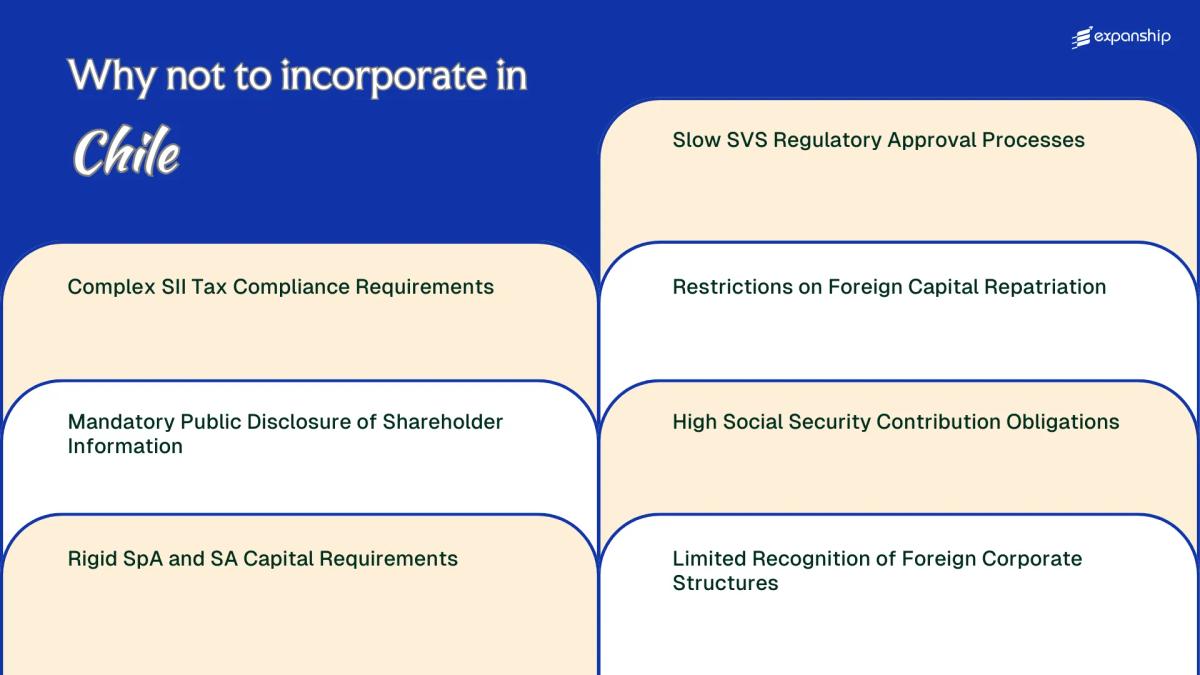
Complex SII Tax Compliance Requirements
Chile SII tax compliance problems begin before your business earns its first peso. Foreign companies must register with the Servicio de Impuestos Internos, obtain a RUT (Rol Único Tributario), and appoint a local legal representative with personal tax liability, all before conducting any taxable activity.
Electronic Filing Obligations and Reporting Frequency
SII mandates monthly VAT declarations through its online platform, alongside annual corporate income tax filings under the General Regime, which applies a 27% rate for companies with related-party foreign shareholders. The reporting calendar is rigid, and late filings trigger automatic penalties, meaning a foreign operator managing time zones and unfamiliar Spanish-language systems faces disproportionate administrative exposure compared to domestic entities with established local accounting teams.
Informational Disclosure Requirements to SII
Foreign-owned entities must submit detailed beneficial ownership disclosures and intercompany pricing documentation under Chilean transfer pricing rules aligned with OECD guidelines. Each cross-border transaction requires supporting documentation that must be retained and produced on request, creating ongoing compliance costs that accumulate annually regardless of transaction volume.
Failure to appoint a resident legal representative with active RUT registration can suspend your entity's ability to issue invoices through the SII electronic billing system, effectively halting operations.
Mandatory Public Disclosure of Shareholder Information
Chile shareholder disclosure requirements risks are a concrete concern for foreign investors who value confidentiality. Under the Commercial Registry (Registro de Comercio), corporate formation documents — including the articles of incorporation — are publicly filed and accessible, exposing shareholder identities to competitors, counterparties, and the general public.
For a Sociedad por Acciones (SpA) or a Sociedad Anónima (SA), shareholder data submitted at incorporation becomes part of the public record. This removes any structural option for ownership privacy at the entity level.
The practical burden this creates for your business includes:
- Competitors can identify your investors or parent company directly from public filings, removing any element of commercial discretion.
- Foreign principals whose names appear on Chilean registry documents may face reputational or regulatory exposure in their home jurisdictions.
- Any ownership restructuring requires updated public filings, making internal corporate changes visible to third parties in real time.
Closely held SAs with fewer than 500 shareholders are not subject to SVS (Comisión para el Mercado Financiero) continuous disclosure obligations, but the foundational registry transparency remains unchanged regardless of company size.

Company Incorporation in Chile
Understand the full compliance and disclosure obligations before establishing your corporate structure in Chile.
Rigid SpA and SA Capital Requirements
Chile SpA SA capital requirements present a structural constraint that affects how you fund and adjust your entity over time. Under Chilean corporate law, a Sociedad por Acciones (SpA) requires that its paid-in capital be stated explicitly in the company's statutes, and any subsequent modification requires a formal deed executed before a notary public.
| Requirement | Detail | Implication for Foreign Owners |
|---|---|---|
| Capital increase mechanism | Requires notarized deed amendment to company statutes | Legal fees and processing delay for each funding round |
| SA capital reduction | Subject to creditor objection period under Ley 18.046 | Cannot reduce capital freely; creditor claims can block the process |
| SpA valuation of non-cash contributions | Must be agreed upon by shareholders and documented formally | No independent flexibility; disputes can stall capitalization |
| SA minimum shareholder count | At least two shareholders required at formation | Single-owner structures require specific legal workarounds |
For a Sociedad Anónima (SA), capital reductions are governed by Ley 18.046 and require a statutory shareholders' meeting resolution, followed by a mandatory creditor protection period during which objections can delay or block the reduction entirely.
The rigidity extends to how capital can be contributed in non-cash form. Valuation disputes over asset contributions can delay your entity's formation timeline without a straightforward administrative resolution mechanism.
Closed SAs operating outside SVS oversight do have slightly less procedural exposure than open SAs, but the core capital amendment requirements under civil and corporate law apply regardless of entity classification.
Slow SVS Regulatory Approval Processes
SVS regulatory approval delays in Chile remain a persistent friction point for foreign businesses seeking to operate in regulated sectors. The Comisión para el Mercado Financiero (CMF), which absorbed the former Superintendencia de Valores y Seguros (SVS), oversees securities, insurance, and financial market authorizations under Ley N° 21.000. Any firm requiring registration as a foreign securities issuer, fund manager, or licensed financial intermediary must submit to a review process with timelines that are neither fixed by statute nor publicly benchmarked.
Unlike jurisdictions with mandated decision windows, the CMF operates without hard regulatory deadlines for many authorization categories. Your business can remain in a legal holding pattern for months, unable to market products or accept client funds, while the review proceeds.
Documentation requirements add to the delay. Submissions must be in Spanish, certified, and in several cases apostilled, which extends preparation time before the process even begins.
- No statutory maximum review period exists for many CMF authorization categories
- All foreign entity documentation must be translated, notarized, and apostilled prior to submission
- Incomplete submissions restart the review clock without formal notification of deficiencies
- Regulated activities cannot commence until written authorization is issued by the CMF
- Foreign fund structures may require additional classification under local securities regulations before approval is granted
The CMF publishes its authorization procedures and applicable legal frameworks through the official CMF portal.
Chile's CMF can request supplementary information mid-review with no obligation to specify a new resolution date, meaning a single information request can indefinitely suspend your approval timeline.
Restrictions on Foreign Capital Repatriation
Chile foreign capital repatriation restrictions are less severe than in many emerging markets, but the transition away from Decree Law 600 (DL 600) removed formal guarantees that foreign investors had relied on for decades.
What Changed When DL 600 Was Repealed
DL 600, the Foreign Investment Statute that governed inbound capital since 1974, was replaced by Law 20.848 in 2016, which established the Foreign Investment Promotion Agency (InvestChile) as the new regulatory framework. Under DL 600, investors held contractual rights locking in tax rates and repatriation terms; Law 20.848 does not replicate those contractual stability guarantees, leaving your firm subject to whatever tax and remittance conditions apply at the time of distribution.
Practical Exposure for Foreign Investors
Profit distributions to non-resident shareholders are subject to the Additional Tax, currently set at 35%, offset by corporate tax already paid, meaning the net withholding burden depends on the prevailing First Category Tax rate at the time of remittance. If the corporate rate changes between the year profits are earned and the year they are distributed, your effective repatriation cost shifts accordingly, creating planning uncertainty that fixed-rate treaty jurisdictions do not impose. Double taxation treaties can reduce this withholding rate, but coverage is not universal across all investor home jurisdictions.
Support for Foreign Investment Challenges in Chile
Get guidance on profit remittance obligations, withholding tax exposure, and regulatory requirements under Chile's current foreign investment framework.
High Social Security Contribution Obligations
Chile social security contribution burdens fall on both employer and employee, and the combined obligations add meaningful payroll costs that foreign-owned firms frequently underestimate before entering the market.
- Employers must contribute approximately 1.5% to 3% of gross salary toward the Seguro de Accidentes del Trabajo (workplace accident insurance), with the exact rate determined by industry risk classification under Law 16.744.
- Employees contribute roughly 10% of taxable salary to an AFP (Administradora de Fondos de Pensiones) pension fund, and while this is technically a worker deduction, your payroll administration must handle withholding and remittance accurately or face SII penalties.
- An additional mandatory health contribution of 7% of salary is directed to either FONASA or a private ISAPRE insurer, creating a compliance obligation that requires your firm to track each employee's chosen scheme.
- The cumulative payroll burden, when SIS contributions and unemployment insurance under the AFC system are included, can push total employer-side costs noticeably above the base salary figure.
Limited Recognition of Foreign Corporate Structures
Chile foreign corporate structure recognition limits create direct operational friction for groups that rely on holding arrangements common in other jurisdictions. Trusts, limited partnerships structured under Anglo-Saxon law, and certain hybrid entities do not have direct equivalents under Chilean corporate law, which means local authorities frequently decline to treat them as straightforwardly as their home-jurisdiction counterparts.
The Servicio de Impuestos Internos (SII) and the Registro de Comercio apply Chilean legal categories when assessing foreign entities. If your offshore structure does not map cleanly onto a Sociedad Anónima or SpA framework, the entity may face reclassification risk, affecting how income is attributed and taxed at the Chilean level.
Foreign companies establishing a presence through a branch (agencia) under Article 447 of the Código de Comercio must appoint a local representative with full legal authority. This requirement exists regardless of how the parent entity operates in its home jurisdiction, adding a layer of structural dependency that does not exist in many comparable markets.
A foreign holding company using a Delaware LLC to receive dividends from a Chilean SpA subsidiary could find the LLC treated as transparent or reclassified by the SII, triggering attribution of Chilean-source income directly to the ultimate individual shareholders rather than at the entity level, with corresponding withholding tax consequences under Law 20,780.
Overcoming These Incorporation Challenges
Overcoming these incorporation challenges in Chile requires a structured approach, not reactive fixes. The regulatory bodies involved, from the SII to the SVS, operate within defined statutory frameworks that reward preparation over improvisation.
- Register under the correct tax category with the SII from incorporation to avoid retrospective penalties tied to Chile's tiered income tax system.
- Structure your SpA or SA capital contributions to meet statutory minimums before filing, reducing the risk of rejection or delay during the formation process.
- Prepare shareholder disclosure documentation in advance, given that this information becomes part of the public commercial registry record.
- Establish a compliant payroll structure that accounts for AFP and Fonasa contribution obligations before hiring local employees.
- Engage with the SVS approval process early if your business activity falls under supervised categories, as timelines are not discretionary.
These steps address the structural friction points built into Chile's corporate formation and compliance architecture. The regulatory requirements are fixed by law, and the degree to which your business absorbs or manages compliance costs depends largely on pre-incorporation planning.
Chile's Overall Investment Appeal
Despite the compliance burdens, disclosure obligations, and capital rigidities covered throughout this blog, Chile retains a credible position as a destination for foreign investment in Latin America. Its legal system is grounded in codified commercial law, its macroeconomic record is comparatively stable, and the foreign investment framework under Law 20,848 provides defined protections for overseas capital.
| Pros | Cons |
|---|---|
| Law 20,848 guarantees foreign investors the right to repatriate capital and profits | SII tax compliance involves complex parallel accounting and attributed income obligations |
| Chile maintains a broad network of double taxation treaties that reduce withholding exposure | Shareholder information is publicly accessible through the Registro de Comercio, limiting ownership privacy |
| The SpA structure allows a single foreign shareholder to incorporate without a local partner | SVS regulatory approvals for supervised entities involve extended processing timelines |
| Stable investment-grade sovereign credit rating supports business predictability | Social security contributions, including AFP and health levies, add significant payroll overhead |
| Bilateral investment treaties with numerous countries provide dispute resolution access | Foreign corporate structures receive limited direct recognition under Chilean commercial law |
Ultimately, the Chile business environment risks and opportunities exist in parallel. The same regulatory density that creates compliance friction also reflects an institutional maturity absent in many regional peers.
Compliance Services for Companies in Chile
Stay current with SII filings, annual reporting obligations, and regulatory requirements under Chilean commercial law.
Conclusion
Chile's position as a structured, rules-bound jurisdiction comes with real operational costs for foreign investors. The Chile company formation disadvantages summary across this blog points to three areas that consistently generate friction: SII tax compliance obligations that demand ongoing specialist attention, the SII and SVS disclosure requirements that expose shareholder and financial data publicly, and social security contribution rates that materially affect payroll planning. Firms without established local infrastructure tend to absorb these costs most acutely. Structural and procedural constraints do not disappear over time — they require deliberate planning before and after registration.
Expanship's Chile Expansion Support
Expanship's Chile expansion corporate services support is designed to reduce the operational burden that comes with meeting the SII's tax obligations, satisfying the SVS's approval requirements, and maintaining ongoing compliance under Chilean corporate law. These are not minor administrative tasks, and having local expertise behind your filing processes makes a measurable difference.
Expanship supports your business at every stage of establishing and maintaining a presence in Chile.
- Your company registration and document preparation are handled with reference to Chilean statutory requirements.
- A registered agent and local office address are provided to satisfy legal domicile obligations.
- Government filing and direct liaison with bodies such as the SII and SVS are managed on your behalf.
- Post-incorporation compliance, including annual reporting and ongoing regulatory obligations, is actively managed.
- Banking introductions are facilitated to support your operational setup in Chile.
- Tax registration and coordination with Chilean local authorities are included from the outset.
Reach out to Expanship Chile to discuss your incorporation requirements.
Frequently Asked Questions (FAQ)
Public disclosure requirements vary by entity type. Sociedades Anónimas Abiertas (open corporations) registered with the Comisión para el Mercado Financiero (CMF) face the most extensive disclosure obligations, including shareholder registers accessible to the public. Sociedades por Acciones (SpAs) have somewhat narrower disclosure requirements, but the public deed process used for incorporation still places foundational ownership information in the public record through the Registro de Comercio.
Failure to comply with Chile's mandatory DTE electronic invoicing system can result in fines issued directly by the SII, with penalties calculated per infraction and potentially compounded if the violation continues. In serious cases, the SII has authority to temporarily suspend a business's tax identification number, which effectively halts legal commercial operations. Repeated non-compliance can trigger a formal audit, exposing prior-period transactions to reassessment.
Employer social security obligations in Chile typically add roughly 20 to 23 percent on top of an employee's gross salary when combining mandatory AFP pension contributions, health contributions to either Fonasa or an Isapre, and occupational accident insurance premiums under the Ley de Accidentes del Trabajo. The exact figure shifts depending on the insurer selected and the employee's risk classification. For a foreign firm building a local team, these costs must be factored into workforce budgets from the outset, as they are non-negotiable statutory obligations.
Foreign founders face procedural friction that Chilean nationals do not, specifically the requirement to obtain a Chilean RUT (tax identification number) and, in many cases, to appoint a locally resident legal representative before the entity can be registered. The process of obtaining a RUT from the SII as a non-resident can add several weeks to the incorporation timeline. Certain regulated sectors also require CMF approval or prior authorization, which extends the process further regardless of the business's country of origin.
Chile generally permits capital repatriation, but the timing and mechanism depend on how the original investment was registered. Foreign investments brought in under Law 20,848 (the Foreign Investment Promotion Law) have clearer repatriation rights, but investments not properly registered at entry may face administrative complications when attempting to convert and transfer funds abroad. Currency conversion through the Mercado Cambiario Formal is required for transactions above certain thresholds, and delays or documentation gaps can hold up transfers for weeks.
CMF oversight applies specifically to entities operating in securities markets, insurance, banking, and other regulated financial activities, not to standard commercial companies. However, if your business model touches any of those sectors, even peripherally, the SVS-era regulations that the CMF absorbed still govern approval timelines that can extend the incorporation process by months. Companies incorporating as a standard SpA for non-regulated commercial activity bypass CMF approval entirely, making entity type selection a decision with direct consequences for your setup timeline.
Chilean law does not have a direct equivalent to a U.S. LLC, and foreign structures are not automatically recognized in a form that maps cleanly onto local entity types. A foreign company can register a branch (agencia) in Chile, but the branch does not create a separate legal entity, meaning the parent company bears full liability for its Chilean operations. This limited structural recognition means most foreign investors opt for a locally incorporated SpA rather than attempting to operate through a branch, which carries its own tax and liability implications under the Chilean Commercial Code.
Legal Disclaimer
The information provided in this article is for general informational purposes only and does not constitute legal, tax, or professional advice. While we strive to ensure the accuracy and timeliness of the content, laws and regulations are subject to change, and the application of laws can vary widely based on specific facts and circumstances.
Readers should not act upon this information without seeking professional counsel tailored to their individual situation. Expanship and its authors disclaim any liability for actions taken or not taken based on the content of this article.
For specific advice regarding your business setup, compliance requirements, or any legal matters, please consult with qualified legal and tax professionals in the relevant jurisdiction.