

Key Takeaways
- Companies incorporating in Burundi must comply with the OHADA Uniform Act relating to Commercial Companies and Economic Interest Groups, which establishes the foundational legal requirements governing entity formation across all member states including Burundi.
- Maintaining a physical registered office within Burundi is an ongoing compliance obligation that persists beyond the initial registration filing and cannot be satisfied by a foreign address.
- Foreign nationals and local investors alike are required to disclose beneficial ownership information to Burundian authorities, with this obligation extending into the post-incorporation compliance lifecycle.
- The Agence de Promotion des Investissements and the Centre de Formalités des Entreprises are the designated regulatory bodies through which company registration and ongoing compliance obligations must be fulfilled in Burundi.
Entity formation in Burundi is governed by the OHADA Uniform Act relating to Commercial Companies and Economic Interest Groups, which Burundi adopted upon joining the OHADA treaty framework. The Agence de Promotion des Investissements, along with the Centre de Formalités des Entreprises, oversees business registration and company compliance at the national level.
Meeting the incorporation requirements in Burundi spans several distinct categories, from capital thresholds and directorship rules to documentation and naming conventions.
Failure to satisfy these requirements results in rejection of the registration application or an inability to operate as a legally recognised entity. Specific requirements under the company registration requirements Burundi framework may differ depending on entity type, the industry sector, and whether the applicant is a foreign national or locally resident investor.
Foreign entrepreneurs and cross-border investors setting up a company in Burundi will find this article most directly applicable to their situation.
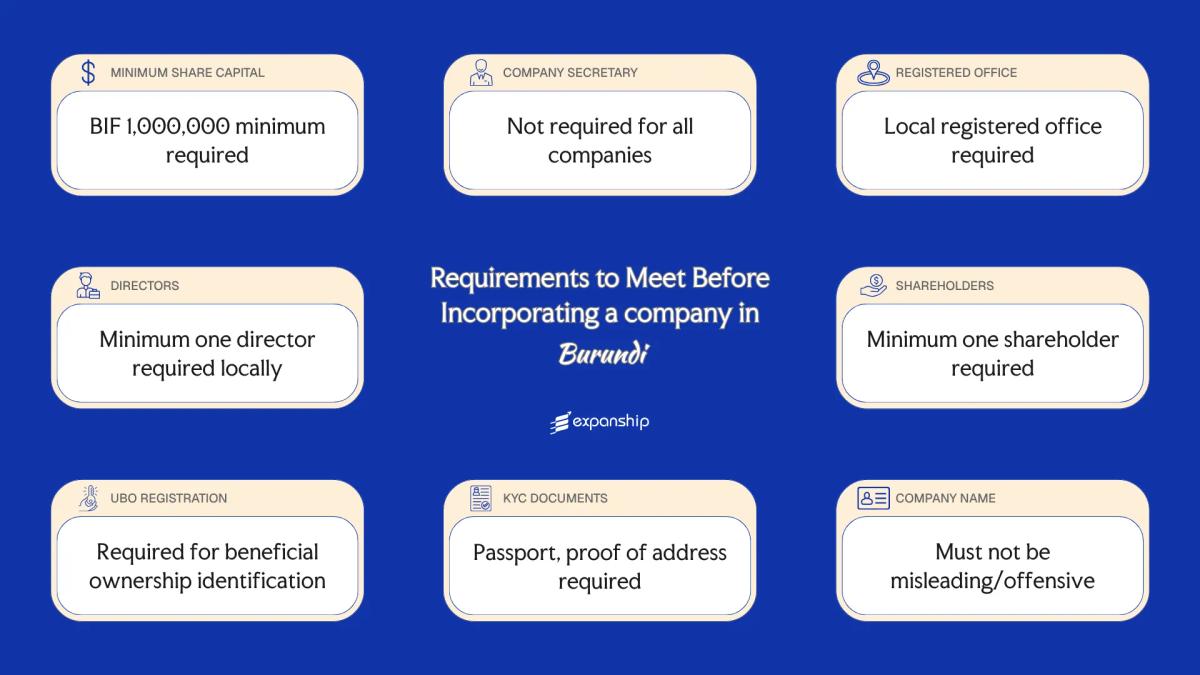
Minimum Share Capital Requirements in Burundi

Minimum share capital requirements in Burundi vary by legal form and are governed by the OHADA Uniform Act on Commercial Companies, which Burundi adopted as a member state of the Organisation for the Harmonisation of Business Law in Africa. For a Société à Responsabilité Limitée, the OHADA framework removed a fixed statutory minimum, though the entity's constitutive documents must still define an authorized capital structure.
Capital contributions are verified by the Agence de Promotion des Investissements du Burundi and recorded through the Centre de Formalisation des Entreprises at incorporation. Once deposited and confirmed, the capital requirement functions as a one-time structural obligation rather than an ongoing statutory threshold subject to periodic review.
| Parameter | Detail |
|---|---|
| Minimum Authorized Share Capital | No statutory minimum under the OHADA Uniform Act for an SARL |
| Maximum Authorized Share Capital | No statutory maximum |
| Minimum Paid-Up Capital | No statutory minimum |
| Paid-Up Requirement at Incorporation | At least one-quarter of cash contributions must be paid up at incorporation under OHADA rules |
| Accepted Currency | Burundian Franc (BIF) |
| Accepted Forms of Contribution | Cash contributions and contributions in kind |
| Timeframe to Deposit Capital | Remaining balance of cash contributions must be paid within two years of incorporation |
Even without a statutory floor, your company's articles of association must specify an authorized capital amount. Omitting this detail can cause rejection at the Centre de Formalisation des Entreprises during the registration review.
Company Secretary Requirements in Burundi
Under Burundian corporate law, company secretary requirements do not follow the same formalized structure found in some common law jurisdictions. No mandatory company secretary is required for a standard société à responsabilité limitée (SARL) or société anonyme (SA) incorporated under the OHADA Uniform Act on Commercial Companies, which Burundi adopted.
That said, corporate secretary obligations in Burundi typically fall to a designated officer or director responsible for maintaining statutory records and ensuring secretary compliance rules are met under OHADA governance standards.
Qualification criteria for who may serve in this administrative capacity:
- No statutory minimum age is specified beyond general legal capacity under civil law
- The role may be fulfilled by a natural person or a designated internal officer of the company
- No professional licensing or bar membership is required to serve in this capacity
- Non-residents are generally eligible, as residency is not mandated for this role
- Corporate entities may fulfill this function depending on the company's constitutional documents

Incorporate a Company in Burundi
Set up your business entity in Burundi with guidance on OHADA compliance, statutory obligations, and documentation requirements.
Registered Office Requirements in Burundi
Registered office requirements in Burundi apply from the moment of incorporation, and any non-compliant address can expose your entity to administrative penalties or suspension of legal standing by the Agence de Promotion des Investissements (API) or the relevant commercial registry authority.
- A physical address within Burundi is required; a P.O. box alone does not satisfy the registered office obligation.
- Virtual office arrangements are generally not recognized as a compliant registered address under Burundian company law.
- The address must be located within the country's territory; a foreign address cannot serve as the legal office for a locally registered firm.
- Supporting documentation, such as a lease agreement or proof of property ownership, is typically required to substantiate the declared address.
- The registered address is recorded in the Registre du Commerce et du Crédit Mobilier (RCCM) and is accessible as part of the public commercial record.
- Any change to the registered address must be formally notified to the RCCM; failure to update the registry can result in official correspondence being deemed validly delivered to the old address, creating legal exposure for your business.
Director Requirements in Burundi

Under Burundi's OHADA-aligned commercial law framework, meeting the director requirements Burundi company law prescribes is a condition of valid incorporation and ongoing legal operation. Upon appointment, a gérant or director assumes personal liability for management decisions, statutory filings, and any acts that breach the Acte Uniforme relatif au droit des sociétés commerciales et du groupement d'intérêt économique (AUSCGIE).
| Parameter | Detail |
|---|---|
| Minimum Number of Directors | One director (gérant) is required for a SARL; an SA requires at least three board members. |
| Maximum Number of Directors | No statutory maximum is prescribed for a SARL; an SA's board size may be defined in the articles of association. |
| Local/Resident Director Required | No statutory residency requirement exists under current OHADA rules as applied in Burundi. |
| Nationality Restrictions | No nationality restrictions apply; foreign nationals may serve as directors. |
| Minimum Age Requirement | Directors must be of legal majority age, which is 18 years under Burundian civil law. |
| Corporate Directors Permitted | Corporate directors are not permitted; only natural persons may serve as gérant or board member. |
| Director Must Be a Shareholder | No statutory requirement for a director to hold shares in the company. |
| Publicly Listed on Registry | Director identities are recorded with the Registre du Commerce et du Crédit Mobilier (RCCM). |
| Disqualification Conditions | Persons subject to a judicial ban on commercial activity or convicted of certain financial offences are disqualified from directorship. |
Despite Burundi being a civil law jurisdiction, there is no statutory requirement under OHADA rules for even a single director of a SARL to be resident or physically present in the country at any point during the company's operation.
Shareholder Requirements in Burundi
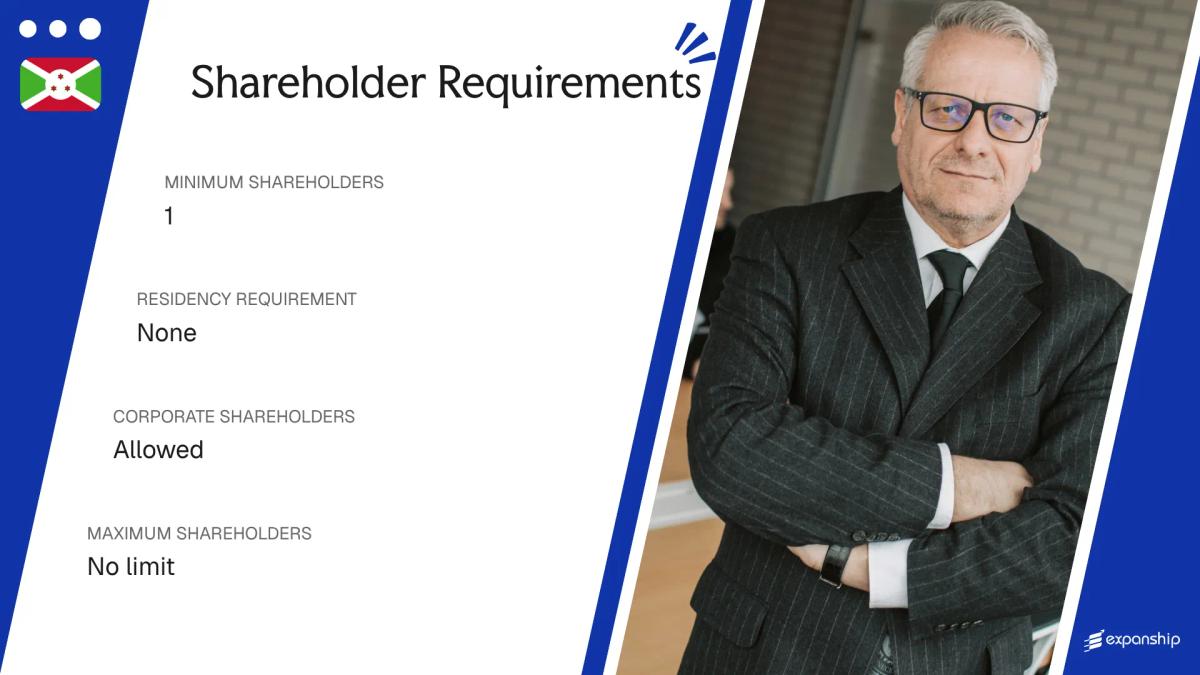
Under Burundian company law, a Société à Responsabilité Limitée (SARL) requires a minimum of one shareholder, permitting a sole shareholder structure. No statutory maximum applies to the number of shareholders in most standard commercial entity types.
Nationality and Residency Restrictions
Meeting shareholder requirements Burundi incorporation rules impose no nationality or residency conditions on shareholders. Foreign nationals may hold up to 100% of shares in most sectors, though certain regulated industries may carry specific ownership thresholds under sector-specific legislation.
Corporate Shareholders
Corporate entities are permitted to act as shareholders in a Burundian company. No general prohibition exists on foreign-incorporated firms holding shares, though the corporate shareholder must typically provide valid constitutional documents during registration.
Shareholder Liability
In a SARL, liability is limited to each associé's capital contribution. Piercing of that limitation is generally reserved for cases involving fraud or statutory non-compliance.
Register of Shareholders
A register of shareholders must be maintained at the company's registered office. Filing obligations and public accessibility are governed through the Agence de Promotion des Investissements (API), which oversees business registration records.
Structure Your Shareholder Setup for Burundi Registration
Get tailored guidance on shareholder structuring, documentation, and compliance obligations for your Burundi entity formation.
UBO / Beneficial Ownership Disclosure Requirements in Burundi
Burundi has introduced beneficial ownership disclosure obligations as part of its anti-money laundering framework, aligning with FATF recommendations. Under the OHADA uniform acts applicable in Burundi and supplementary national legislation, a beneficial owner is generally defined as any natural person who ultimately owns or controls 25% or more of a company's shares or voting rights.
- At incorporation, declare all ultimate beneficial owners to the Agence de Régulation et de Contrôle des Assurances (ARCA) or the relevant commercial registry authority.
- Submit a beneficial ownership declaration form identifying each UBO by name, nationality, date of birth, and ownership percentage.
- File supporting identity documentation alongside the declaration at the time of registration.
- Report any subsequent changes to UBO information within a prescribed period following the change.
| Parameter | Detail |
|---|---|
| Ownership Threshold for UBO Status | 25% of shares or voting rights |
| Filing Authority | Commercial Registry (Registre du Commerce) |
| Disclosure Deadline at Incorporation | At time of registration |
| Publicly Accessible Register | No statutory public access requirement |
| Penalties for Non-Disclosure | Administrative penalties under applicable AML legislation |
| Ongoing Update Obligation | Required upon material change in ownership or control |
KYC / Document Requirements in Burundi
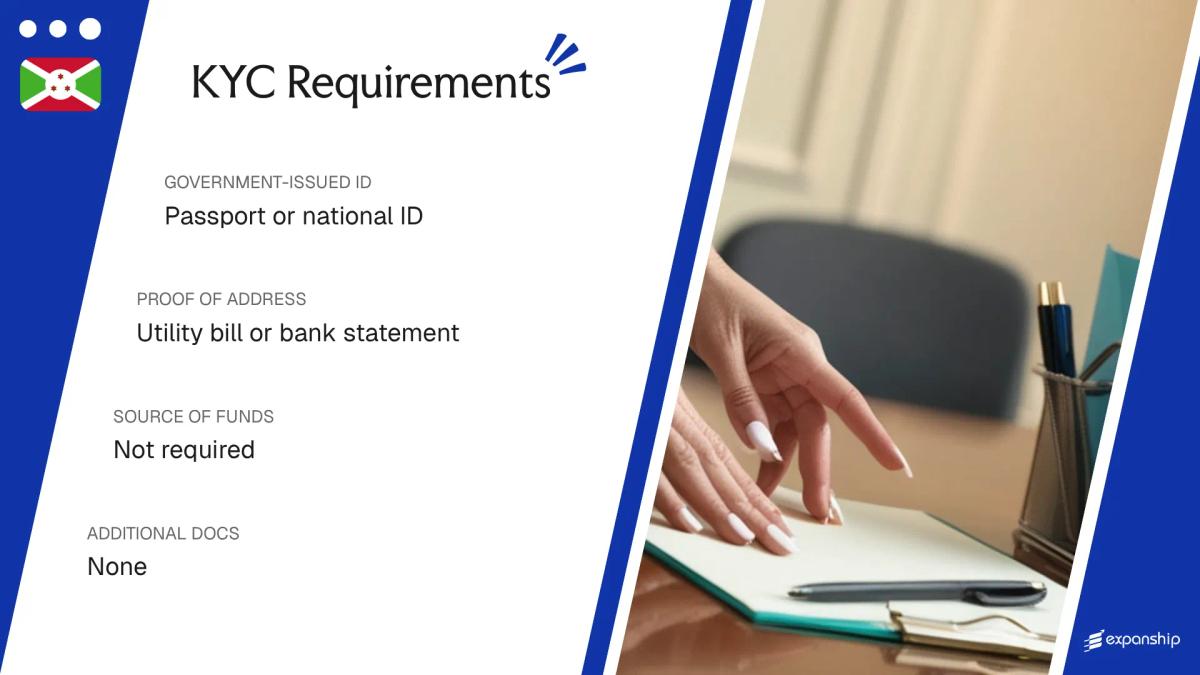
KYC document requirements Burundi are governed primarily by the Law No. 1/28 of 3 December 2008 on the Prevention and Repression of Money Laundering and Terrorist Financing, which is overseen by the CENTIF, Burundi's Financial Intelligence Unit.
Individual / Personal Documents
- Valid government-issued passport or national identity card for each individual director, shareholder, or beneficial owner
- Recent proof of residential address, such as a utility bill or bank statement, dated within three months
- Completed and signed KYC declaration or identification form as required by the registering authority
- Passport-sized photograph may be required depending on the notary or incorporation agent handling the file
Corporate Documents
- Certificate of incorporation or equivalent constitutional registration document for any corporate shareholder or director
- Certified copy of the entity's articles of association or equivalent constitutional document
- Current register of directors and register of shareholders for the corporate entity
- Proof of registered office address for the corporate shareholder, such as an official utility bill or lease agreement
Source of Funds Documentation
- Recent bank statements covering a minimum of three months to evidence the origin of capital
- Audited financial statements or equivalent if the introducing entity is an established business
- Written declaration of source of funds where bank documentation is unavailable or insufficient
Notarisation and Apostille Requirements
- Foreign-issued documents generally require notarisation by a qualified notary in the country of origin
- Burundi is not a party to the Hague Apostille Convention, so documents may require full legalisation through consular channels
- Official translation into French is required for any document issued in a language other than French or Kirundi
The most common reason for incorporation delay is submission of address proof documents that exceed the three-month validity threshold accepted by the registration authorities.
Company Name Requirements in Burundi
Proposed company name requirements Burundi follow a prior approval process administered at the point of incorporation. Names are assessed for availability and compliance before registration is confirmed.
Structurally, the name must include a legal suffix indicating the entity type, such as "SARL" for a société à responsabilité limitée or "SA" for a société anonyme. French is the operative language for legal naming purposes.
Certain words are prohibited or restricted. Terms implying government affiliation, regulated professional bodies, or national institutions require prior authorisation from the relevant authority before the name can be accepted.
Name reservation is generally available and must be applied for through the registration authority prior to incorporation. The reservation holds the name for a defined period, during which no other entity may register under the same or a confusingly similar designation.
Compliance Services for Companies in Burundi
Keep your Burundi entity in good standing with filing deadlines, annual obligations, and regulatory requirements managed on your behalf.
Conclusion
Burundi company incorporation requirements span several legal and administrative layers, governed primarily through the Organisation pour l'Harmonisation en Afrique du Droit des Affaires (OHADA) framework and overseen domestically by the Agence de Promotion des Investissements (API). Among the most consequential requirements are the mandatory local registered office and the beneficial ownership disclosure obligations, both of which carry ongoing compliance duties beyond initial registration. Once your understanding of these requirements is in place, the practical next step is engaging with the registration process itself and building out the operational and compliance infrastructure your entity will need to function lawfully.
Expanship's Corporate Services for Your Burundi Expansion
Burundi's incorporation framework, governed by the OHADA Uniform Act on Commercial Companies, places specific compliance obligations on foreign and domestic businesses alike — from capital structuring and director appointments to registered office maintenance and UBO disclosure. Expanship's Burundi corporate services are designed to reduce the administrative weight of meeting these requirements, so your team can focus on building operations rather than managing filings.
Beyond initial registration, our support spans the full setup process:
- We prepare and submit all company formation documents with the Registre du Commerce et du Crédit Mobilier (RCCM).
- Registered agent and physical office provision in Bujumbura is available for entities that lack a local presence.
- Our team liaises directly with government bodies and regulatory authorities on your behalf.
- Post-incorporation compliance, including annual obligations, is managed to keep your entity in good standing.
- We provide introductions to banking institutions operating in Burundi.
- Tax registration and coordination with the Office Burundais des Recettes (OBR) is handled as part of our service.
Reach out through Expanship Burundi to discuss your incorporation requirements.
Frequently Asked Questions (FAQ)
No, the two structures carry different capital thresholds under the OHADA Uniform Act. A Société Anonyme requires significantly higher paid-up capital than an SARL, which has a lower statutory minimum. Your choice of entity type will directly affect how much capital must be deposited before registration can be completed.
Failure to maintain a physical registered office in Burundi can result in the company being struck from the Trade and Personal Property Credit Register (RCCM), which effectively invalidates its legal standing. Correspondence from regulatory authorities and courts is directed to the registered address, so any lapse creates immediate compliance exposure. The obligation to maintain a valid local address is continuous, not a one-time registration requirement.
Yes, Burundian law does not require directors to be nationals or residents of the country, meaning a foreign national can be appointed as sole director. However, practical considerations such as signing authority and interaction with local authorities may make appointing a local representative advisable. The director's identity and background will still need to be verified through the standard KYC process during registration.
Beneficial ownership disclosure is generally triggered at a 25% ownership or control threshold, consistent with FATF standards that Burundi has committed to aligning with. Any individual who meets or exceeds that threshold must be identified and their details submitted to the relevant authority. This applies to both direct and indirect ownership structures, so layered holding arrangements do not exempt a UBO from disclosure obligations.
Submitting false documentation during incorporation is treated as fraud under Burundian law and can expose directors and shareholders to criminal liability, in addition to the rejection or annulment of the registration. The RCCM and API have the authority to flag discrepancies and refer matters to prosecutorial authorities. Incomplete submissions typically result in the application being suspended until the correct documents are provided, delaying the entire process.
Yes, a company name must be checked for availability and reserved through the RCCM before the full incorporation dossier is submitted. This prevents two entities from operating under identical or deceptively similar names within the jurisdiction. The reservation does not guarantee final approval, as the name must also comply with the content restrictions set out under the OHADA framework, including prohibitions on misleading or state-referencing terminology.
Legal Disclaimer
The information provided in this article is for general informational purposes only and does not constitute legal, tax, or professional advice. While we strive to ensure the accuracy and timeliness of the content, laws and regulations are subject to change, and the application of laws can vary widely based on specific facts and circumstances.
Readers should not act upon this information without seeking professional counsel tailored to their individual situation. Expanship and its authors disclaim any liability for actions taken or not taken based on the content of this article.
For specific advice regarding your business setup, compliance requirements, or any legal matters, please consult with qualified legal and tax professionals in the relevant jurisdiction.