
Key Takeaways
- Burundi's adoption of the OHADA Uniform Act on Commercial Companies provides a legal foundation for incorporation, but foreign investors must still navigate significant gaps between codified law and actual enforcement at the institutional level.
- Mandatory local capital requirements for SARL formation create an upfront financial barrier that can disproportionately affect small and mid-sized foreign enterprises entering the market.
- Corruption risk across government institutions, including at the ARCOS registration authority, adds unpredictable costs and delays to an already administratively burdensome incorporation process.
- Weak intellectual property enforcement and frequent policy instability compound one another, leaving foreign businesses with limited legal recourse if regulatory conditions shift after market entry.
Burundi operates under an evolving regulatory framework, with company formation governed primarily by the OHADA Uniform Act on Commercial Companies, which Burundi adopted as part of its regional treaty obligations. The OHADA Uniform Act sets the foundational legal structure for business entities registered in the country.
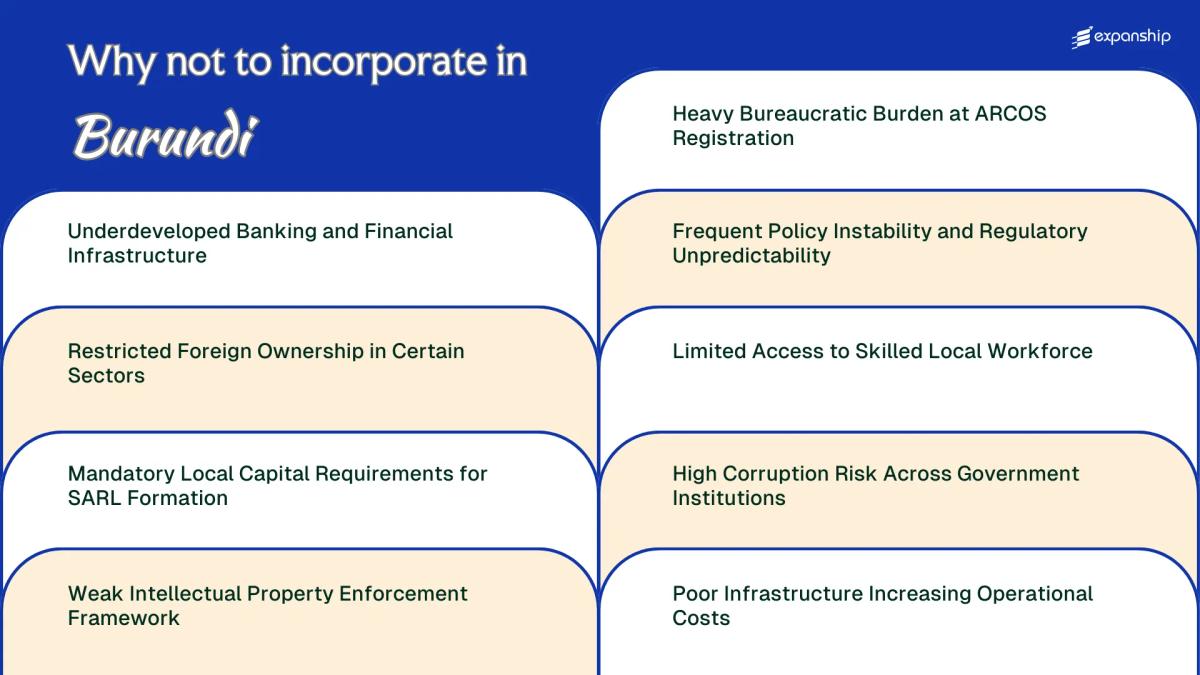
The disadvantages of incorporating in Burundi span several areas, from financial infrastructure to enforcement gaps and administrative friction.
How severely these disadvantages affect your business depends on its legal structure, sector of operation, and whether you require repatriation of capital or rely on local service providers. A trading company faces a different risk profile than a manufacturing entity or a financial services firm.
Foreign investors entering sub-Saharan frontier markets — particularly those unfamiliar with OHADA-based jurisdictions — are most likely to encounter the risks of business registration in Burundi discussed throughout this article.
Underdeveloped Banking and Financial Infrastructure
Burundi banking infrastructure problems for business are among the most operationally disruptive factors a foreign company will encounter after incorporation. Banking penetration remains low, with a significant portion of the population unbanked and formal financial services concentrated in Bujumbura.
Limited Correspondent Banking and Payment Delays
Few local banks maintain correspondent relationships with major international institutions, which means cross-border wire transfers frequently experience delays of several days or experience outright rejection. For a foreign entity that depends on timely capital movements to fund operations or pay overseas suppliers, this structural gap translates directly into cash flow disruption.
Foreign companies also find it difficult to open multi-currency accounts locally, restricting their ability to manage foreign exchange exposure. The Banque de la République du Burundi (BRB) governs exchange controls, and compliance requirements for transferring funds abroad add procedural friction that raises transaction costs.
Restricted Access to Trade and Credit Facilities
Financial access challenges in Burundi extend to the near-absence of trade finance instruments such as letters of credit and bank guarantees from local institutions. Your business will likely need to source these instruments from foreign banks, which increases financing costs considerably.
Credit facilities for operating capital are limited and carry high interest rates, reflecting the shallow depth of the local financial market.
Banking risks for foreign companies in Burundi include the real possibility that routine international transfers are delayed or blocked entirely, directly undermining your firm's ability to meet contractual obligations on time.
Restricted Foreign Ownership in Certain Sectors
Foreign ownership restrictions in Burundi apply across several economically significant sectors, directly limiting the scope of what your company can own or control. These restrictions are embedded in sectoral legislation rather than a single unified investment code, which makes identifying your exposure more difficult and more costly to resolve through local legal counsel.
Land ownership is one of the most consequential limitations. Foreign entities generally cannot hold freehold title to land under Burundian law, forcing businesses to operate through long-term leases, which carry renewal risk and weaker legal standing than outright ownership.
Sectors most commonly subject to Burundi FDI ownership limitations include:
- Restrictions on majority foreign shareholding in agricultural land-linked enterprises can prevent your firm from securing the physical assets that underpin production operations.
- Foreign investors in media and broadcasting face ownership caps that require local partners, reducing your operational control and complicating profit distribution.
- Mining concession frameworks impose local participation requirements, adding partner dependency and diluting equity returns before the business generates revenue.
Mining and natural resource extraction are governed under the Mining Code, which conditions concession access on local equity participation. This reduces your effective return on capital relative to jurisdictions where full foreign ownership of extractive assets is permitted.

Company Incorporation in Burundi
Understand ownership structures and sectoral restrictions before you incorporate in Burundi.
Mandatory Local Capital Requirements for SARL Formation
Burundi SARL capital requirements risks are a concrete barrier that foreign investors frequently underestimate at the outset. Under the OHADA Uniform Act on Commercial Companies, which Burundi applies as a member state, forming a Société à Responsabilité Limitée requires meeting minimum share capital thresholds that must be fully subscribed at incorporation. Capital cannot be partially deferred, which forces your business to commit liquid funds before a single transaction occurs.
| Requirement | Detail | Implication for Foreign Investor |
|---|---|---|
| Minimum share capital | BIF 1,000,000 (approx. USD 350) nominal floor | Low threshold masks full paid-up obligation at registration |
| Capital payment timing | 100% must be paid up at incorporation | No phased contribution permitted; full liquidity required upfront |
| Proof of deposit | Required before ARCOS registration proceeds | Delays incorporation if banking access is slow or restricted |
| Currency restrictions | Capital typically deposited in BIF | Exchange rate exposure from conversion of foreign currency |
The paid-up requirement creates a direct cash-flow constraint. Foreign founders must convert hard currency into Burundian francs before registration at ARCOS, exposing them to exchange rate losses that erode the real value of the deposited capital.
Minimum share capital requirements for a Burundi company may appear modest in absolute terms, yet the mandatory deposit process ties funds in a blocked account until ARCOS issues the incorporation certificate. Given documented delays in that registration process, capital can remain inaccessible for weeks. Sector-specific regulations may impose additional capital thresholds beyond the OHADA baseline, compounding this restriction further.
Weak Intellectual Property Enforcement Framework
Weak intellectual property protection in Burundi is a structural concern that affects technology companies, branded consumer goods businesses, and any firm that relies on proprietary processes or creative assets. The country is a member of the African Regional Intellectual Property Organization (ARIPO), which provides a regional filing mechanism, but membership does not guarantee effective domestic enforcement.
The domestic legal framework for IP protection remains underdeveloped in practice. Courts lack specialized IP adjudication capacity, meaning infringement disputes are handled by general civil courts with limited technical expertise.
For your business, this creates a situation where obtaining a registered trademark or patent does not translate into reliable deterrence. Enforcement depends on initiating civil proceedings that are slow, costly, and uncertain in outcome.
- IP registrations obtained through ARIPO do not automatically trigger enforcement action within Burundi's borders.
- Civil court proceedings for infringement have no dedicated IP tribunal or fast-track mechanism.
- Counterfeit goods and trademark violations are not systematically intercepted at customs without a prior recordal filing.
- Criminal IP enforcement exists in statute but is rarely applied in practice.
Burundi has no standalone national IP office; all filings are processed externally through ARIPO, meaning domestic enforcement relies entirely on general courts with no IP specialization.
Heavy Bureaucratic Burden at ARCOS Registration
ARCOS registration bureaucracy in Burundi adds significant friction to the incorporation process, with procedural inefficiencies at the Agence de Régulation et de Contrôle des Assurances (ARCOS) and the broader one-stop shop window creating delays that push timelines well beyond the nominal estimates.
Structural Inefficiencies in the Registration Process
Processing times at the commercial registry frequently extend beyond the official targets due to manual document handling, inter-agency coordination failures, and inconsistent interpretation of submission requirements by individual officers. For a foreign entity, this unpredictability makes it difficult to commit to operational start dates or honor contractual obligations that depend on legal entity formation.
The lack of a fully digitised filing system means physical document submission remains standard, requiring your representatives to be present in Bujumbura.
Practical Consequences for Foreign Incorporators
Burundi business registration delays compound costs directly: legal representatives, local agents, and notarial fees accrue during extended waiting periods. Each additional week of delay carries a real financial cost before the business has generated a single franc of revenue.
ARCOS incorporation challenges are further intensified for foreign-owned entities, which face additional document authentication and translation requirements that domestic applicants do not.
Resolving Registration Bottlenecks in Burundi
Our team manages ARCOS filings, document coordination, and local representation to reduce incorporation delays for foreign-owned entities.
Frequent Policy Instability and Regulatory Unpredictability
Burundi regulatory instability risks for companies are compounded by a political environment that has produced abrupt shifts in investment rules, tax policy, and sector-specific regulations with little advance notice to affected businesses.
- The government has revised its Investment Code multiple times since 2008, meaning commitments made under one legal framework can be altered before your business reaches operational maturity.
- Regulatory decrees issued by ministries sometimes contradict existing legislation, forcing firms to seek legal clarification at their own expense before they can proceed with compliant operations.
- Post-2015 political tensions triggered capital controls and emergency economic measures that directly disrupted foreign firms' ability to repatriate profits or access foreign currency.
- The Agence de Promotion des Investissements (API) lacks the institutional independence needed to shield approved investment terms from executive-level policy reversals.
- Tax rates and exemption conditions applicable to foreign entities have shifted between budget cycles, making multi-year financial projections unreliable for planning purposes.
Limited Access to Skilled Local Workforce
Skilled workforce limitations in Burundi present a structural challenge that directly affects your ability to staff a locally incorporated entity. Adult literacy rates remain among the lowest in sub-Saharan Africa, and tertiary enrollment is thin, producing a narrow pipeline of qualified professionals in fields such as finance, engineering, and corporate law.
For foreign firms operating an SARL or SA, this creates a practical dependency on expatriate hires. Sourcing international staff adds payroll costs, relocation expenses, and immigration compliance obligations under Burundian labor law, all of which raise the baseline cost of running operations.
The talent shortage risks are not evenly distributed. Roles requiring technical or managerial expertise are the hardest to fill locally, meaning your firm absorbs higher recruitment costs before it generates revenue.
- Senior finance and compliance roles are rarely available through the local market
- Sector-specific technical skills, particularly in manufacturing and ICT, are chronically scarce
- Mid-level management candidates with formal training are limited in supply
A foreign-owned SARL requiring three locally sourced professionals with accounting qualifications may face a recruitment cycle exceeding six months, during which interim expatriate staffing at an estimated cost of USD 4,000–6,000 per month per hire becomes the only operational alternative.
High Corruption Risk Across Government Institutions
Corruption risks incorporating in Burundi are among the most significant structural obstacles foreign businesses face. Transparency International's Corruption Perceptions Index consistently ranks the country near the bottom globally, reflecting systemic irregularities across public administration, licensing authorities, and judicial institutions.
Bribery demands can surface at multiple points in the corporate lifecycle. From obtaining operating permits to clearing goods through customs, unofficial payments are frequently reported as preconditions for routine government services, adding unpredictable costs that cannot be budgeted in advance.
The judicial system compounds this exposure. Contract enforcement through Burundian courts carries a credible risk of biased rulings, meaning that legal protections your firm holds on paper may not translate into recoverable outcomes in practice.
Foreign companies operating in extractive or infrastructure sectors face heightened scrutiny and solicitation from government counterparts. Paying bribes to foreign officials also exposes your business to extraterritorial anti-corruption laws, including the U.S. Foreign Corrupt Practices Act and the UK Bribery Act 2010, regardless of where the payment occurs.
If an employee or local agent makes an unofficial payment on your company's behalf, even without your direct authorization, your firm may still face criminal liability under extraterritorial anti-corruption legislation applicable in your home jurisdiction.
Poor Infrastructure Increasing Operational Costs
Poor infrastructure costs doing business in Burundi far more than comparable East African markets. Unreliable electricity supply forces most foreign firms to invest in diesel generators, adding significant recurring expenditure that erodes margins from the outset.
Road conditions across much of the country are poor, and the absence of a railway network means goods transport depends almost entirely on road haulage. For businesses that import inputs or distribute products domestically, this translates into higher freight costs and longer lead times.
Internet connectivity remains limited and inconsistent outside Bujumbura. Remote work infrastructure and digital operations that foreign businesses routinely rely on elsewhere simply cannot be assumed here.
- Diesel generator dependency adds fuel and maintenance overhead not accounted for in standard operating budgets.
- Road freight inefficiencies increase supply chain costs relative to better-connected regional hubs like Nairobi or Dar es Salaam.
- Connectivity gaps restrict the use of cloud-based systems and remote operational models that reduce costs in other jurisdictions.
Strategies to Overcome Incorporation Challenges
Overcoming Burundi incorporation challenges requires a structured approach built around the country's specific regulatory and institutional constraints. No single measure addresses all the risks, but several targeted steps can reduce exposure across multiple problem areas.
- Register your entity through ARCOS and verify sector-specific foreign ownership restrictions under the Investment Code before committing to a corporate structure.
- Satisfy the SARL minimum capital requirement by depositing funds with a locally licensed bank prior to notarial deed execution.
- File intellectual property rights with the African Regional Intellectual Property Organization (ARIPO), to which Burundi is a member, as domestic enforcement mechanisms remain unreliable.
- Establish a formal anti-corruption compliance policy aligned with Burundi's anti-corruption statutes before commencing operations.
- Source workforce needs regionally or through expatriate arrangements where local skills gaps cannot be filled domestically.
- Conduct pre-entry due diligence on current exchange control regulations governing foreign currency repatriation.
These steps operate within a regulatory environment where policy changes can occur outside normal legislative cycles. Mitigating risks of doing business in Burundi requires ongoing monitoring of ARCOS directives and Investment Promotion Authority guidance, not only front-end structuring.
Burundi's Overall Investment Viability
Burundi investment viability risks and drawbacks are substantial, yet the country is not without a credible rationale for incorporation. For firms targeting the East African Community market, operating in extractive sectors, or building a presence ahead of infrastructure development, the jurisdiction presents genuine entry points.
| Pros | Cons |
|---|---|
| EAC membership provides access to a regional trade bloc | ARCOS registration carries a heavy bureaucratic burden with unpredictable timelines |
| Investment Code offers legal protections for foreign investors | Corruption risk across government institutions increases the cost and uncertainty of doing business |
| Natural resource sectors present early-mover opportunities | Policy instability and regulatory unpredictability undermine long-term planning |
| Low cost of entry relative to more developed regional markets | Underdeveloped banking infrastructure limits access to credit and financial services |
| French and Kirundi legal documentation are standardized | Weak IP enforcement leaves proprietary assets exposed without recourse |
Assessing whether Burundi is worth incorporating in for foreign firms comes down to risk tolerance and time horizon. The business environment challenges documented across this assessment are systemic, not incidental, and they apply regardless of sector or company size.
Compliance Services for Companies in Burundi
Maintaining good standing in Burundi requires ongoing attention to filing obligations, regulatory updates, and local statutory requirements. This service covers the compliance needs of foreign-owned entities registered under Burundian law.
Conclusion
The cons of company formation in Burundi stem from structural conditions that affect day-to-day operations as much as initial registration. Governance instability, persistent corruption across public institutions, and an underdeveloped banking sector collectively create friction that goes beyond paperwork. ARCOS registration delays compound these difficulties, extending timelines that are already subject to regulatory unpredictability. For foreign investors weighing their options, the challenges are material and well-documented. Specialist guidance tailored to Burundian regulatory processes remains one of the more practical ways to manage exposure before committing to an operational structure.
Expanship's Services for Expanding into Burundi
Expanship company formation services Burundi are structured around the practical realities businesses face when entering this market, from managing ARCOS registration requirements to maintaining post-incorporation compliance under Burundi's shifting regulatory environment.
From initial entity structuring through to ongoing obligations, Expanship handles the administrative and procedural workload involved in establishing and maintaining a presence here. Services include:
- Preparing and filing company registration documents with the relevant Burundian authorities.
- Providing a registered agent and local office address for your entity.
- Liaising directly with government bodies and regulatory offices on your behalf.
- Managing post-incorporation compliance obligations as they arise.
- Facilitating introductions to local banking institutions to support account opening.
- Handling tax registration and coordination with local fiscal authorities.
To discuss your specific requirements, contact Expanship Burundi.
Frequently Asked Questions (FAQ)
No, restrictions are sector-specific, but they cover several commercially significant areas including agriculture, land ownership, and certain service industries. Foreign investors operating in restricted sectors are typically required to enter joint ventures with local partners, which limits operational control. The precise restrictions are governed under Burundian investment law and can shift based on ministerial policy without advance notice.
An SARL that does not meet the statutory minimum capital threshold cannot be validly registered at ARCOS, the Agency for the Regulation of the Concessions and Operating Services. Without valid registration, your entity has no legal standing to sign contracts, open corporate bank accounts, or employ staff under a formal structure. Capital requirements must be verified and deposited before incorporation proceeds.
Enforcement in Burundi is materially weaker than in Kenya or Rwanda, both of which have dedicated IP tribunals and more active customs seizure programs. Burundi is a member of OAPI — the African Intellectual Property Organization — which provides a registration framework, but domestic enforcement mechanisms remain underfunded and slow. Trademark or patent holders who face infringement often have limited practical recourse through local courts.
The cost premium varies by sector, but businesses relying on physical logistics face significant overhead from unreliable road networks, frequent power outages, and limited internet connectivity. Companies often invest in private generators, alternative logistics routes, and redundant communication systems just to maintain baseline operations. These are recurring costs that are rarely factored into initial incorporation projections.
Yes, an existing registration does not insulate your business from retrospective regulatory changes. Burundi has a history of shifting licensing conditions, foreign exchange controls, and sector-specific rules without extended transition periods. A firm that was fully compliant under one regulatory framework can find itself in breach following ministerial revisions that take effect quickly and with little formal consultation.
ARCOS registration in Burundi involves multiple sequential steps, manual document handling, and coordination across several government departments, making it considerably slower than digitized systems in Rwanda or Mauritius. Processing times can extend well beyond official estimates due to understaffing and procedural backlogs. Foreign applicants who lack local legal representation frequently face additional delays caused by documentation rejections that experienced local counsel could anticipate.
Skilled labor shortages are most acute in financial services, technology, engineering, and senior management roles. Burundi's tertiary education sector produces relatively few graduates in technical disciplines, and many skilled nationals emigrate to regional economic hubs. Companies in sectors that require specialized expertise often face the additional cost and administrative complexity of applying for work permits to bring in expatriate staff.
Legal Disclaimer
The information provided in this article is for general informational purposes only and does not constitute legal, tax, or professional advice. While we strive to ensure the accuracy and timeliness of the content, laws and regulations are subject to change, and the application of laws can vary widely based on specific facts and circumstances.
Readers should not act upon this information without seeking professional counsel tailored to their individual situation. Expanship and its authors disclaim any liability for actions taken or not taken based on the content of this article.
For specific advice regarding your business setup, compliance requirements, or any legal matters, please consult with qualified legal and tax professionals in the relevant jurisdiction.