

Key Takeaways
- All Bulgarian companies must register with the Commercial Register maintained by the Registry Agency under the Ministry of Justice, as mandated by the Commercial Act (Търговски закон), and failure to complete registration correctly results in application rejection or post-incorporation administrative penalties.
- An OOD in Bulgaria carries no minimum paid-up capital requirement beyond the statutory BGN 2 share capital floor, which directly affects how foreign investors structure their initial equity contributions.
- Directors of a Bulgarian entity face no residency or nationality restrictions under the Commercial Act, meaning non-resident individuals may hold director positions without triggering additional regulatory hurdles at the point of incorporation.
- Beneficial ownership information must be submitted to the Registry Agency as part of the UBO registration obligation, and non-compliance identified after incorporation exposes the entity to administrative sanctions under Bulgarian law.
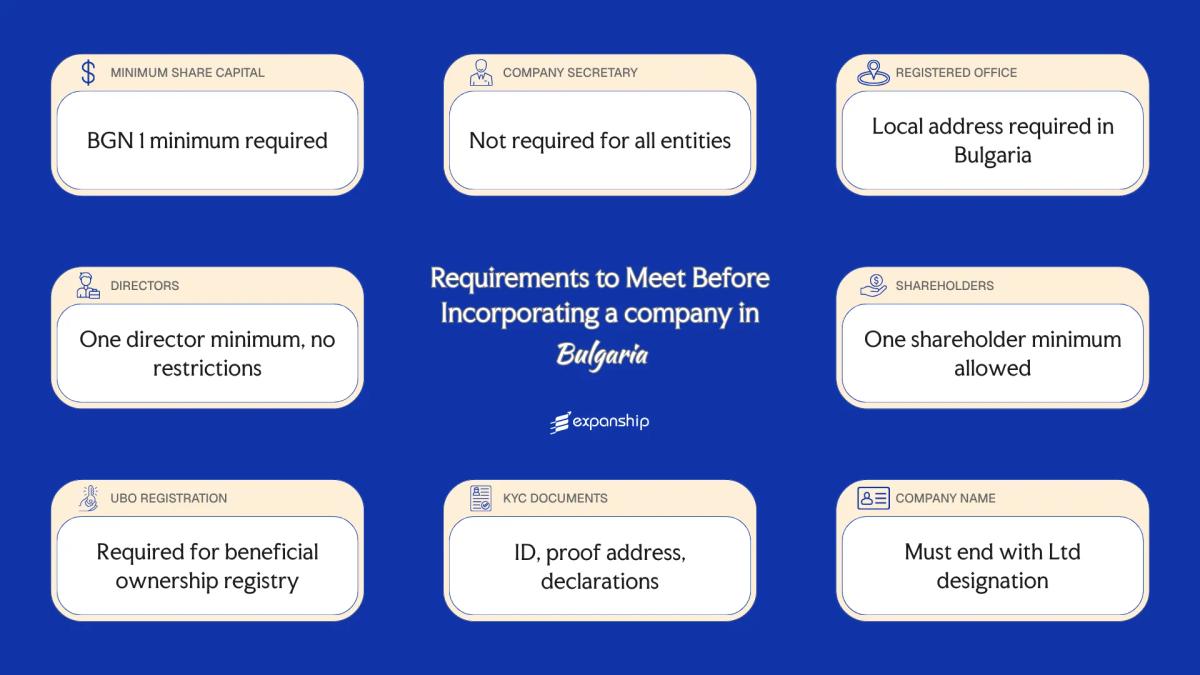
Bulgaria's company formation requirements are governed by the Commercial Act (Търговски закон), with the Commercial Register and Register of Non-Profit Legal Entities, administered by the Registry Agency under the Ministry of Justice, serving as the central authority for business registration.
This article covers the structural, documentary, and compliance requirements that apply across the formation process under Bulgarian law.
Failure to satisfy these requirements results in rejection of the registration application or, where non-compliance is identified post-incorporation, exposure to administrative penalties and potential deregistration.
Requirements differ depending on the legal form selected, whether the business operates in a regulated sector, and the residency status of the founding shareholders or directors.
Foreign investors and non-resident business owners establishing a Bulgarian entity for the first time will find this article directly relevant to understanding what the registration process formally demands.
Minimum Share Capital Requirements in Bulgaria
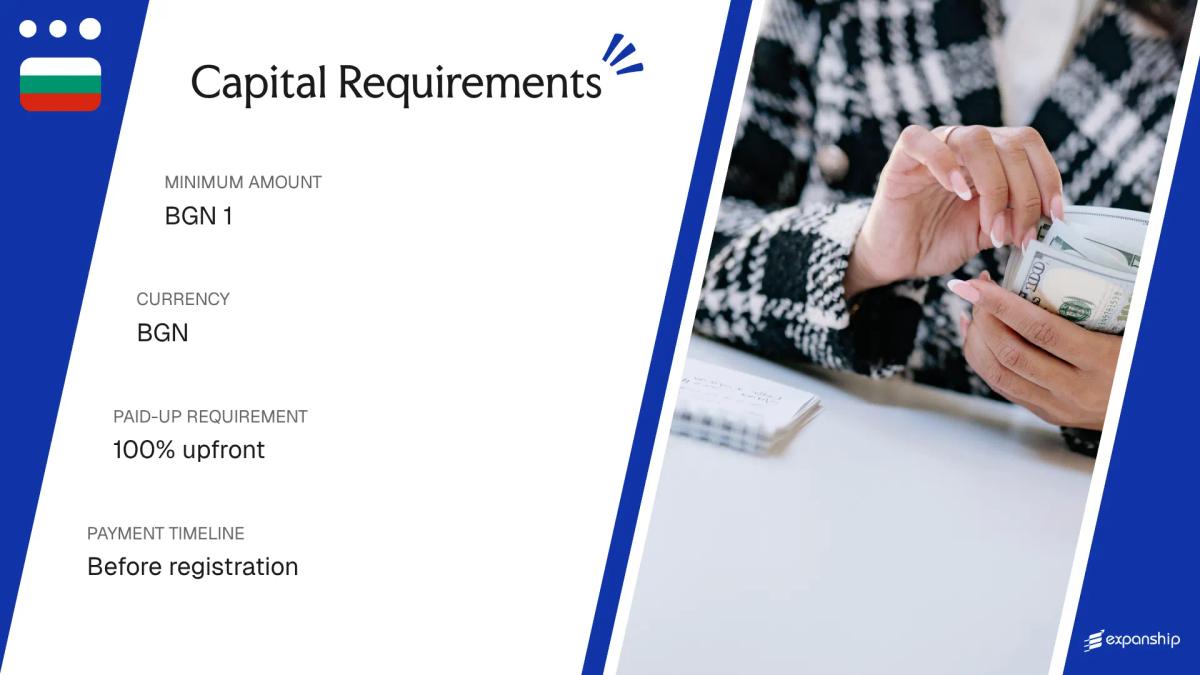
Bulgaria minimum share capital requirements differ by legal form and are governed by the Commercial Act (Търговски закон). For a limited liability company (OOD), the law sets a nominal minimum, while joint-stock companies (AD) face a substantially higher threshold.
Capital is deposited into a bank account opened in the company's name prior to registration, and the deposit confirmation is submitted to the Commercial Register (Търговски регистър) at the Registry Agency as part of the incorporation filing.
| Parameter | Detail |
|---|---|
| Minimum Authorized Share Capital | BGN 2 for an OOD; BGN 50,000 for an AD |
| Maximum Authorized Share Capital | No statutory requirement |
| Minimum Paid-Up Capital | BGN 2 for an OOD; BGN 25,000 for an AD at incorporation |
| Paid-Up Requirement at Incorporation | At least 70% of each shareholder's contribution must be paid up before registration |
| Accepted Currency | Bulgarian Lev (BGN) |
| Accepted Forms of Contribution | Cash or non-cash (in-kind) contributions; in-kind contributions require independent valuation |
| Timeframe to Deposit Capital | Prior to submission of the incorporation application to the Commercial Register |
The bank confirmation of capital deposit must be obtained before filing with the Commercial Register. Registration will not proceed without it, regardless of the amount involved.
Company Secretary Requirements in Bulgaria
Under Bulgarian commercial law, there is no statutory requirement for a company secretary as a distinct corporate officer. The OOD (Дружество с ограничена отговорност), the most common private limited liability entity used by foreign investors, does not mandate this role under the Commercial Act (Търговски закон).
Certain administrative and compliance functions that a company secretary would typically handle in other jurisdictions are instead assigned to the manager (управител) of the OOD. That individual bears responsibility for maintaining the firm's statutory books, ensuring filings are submitted to the Commercial Register (Търговски регистър) at the Registry Agency, and keeping corporate records accurate and current.
Where businesses voluntarily appoint someone to handle Bulgaria company secretary requirements in a practical capacity, the following general eligibility conditions apply:
- No formal licensing or certification is required to perform secretarial functions.
- Both natural persons and legal entities may be appointed in an administrative capacity.
- There is no residency requirement; non-residents may serve.
- The role carries no statutory title or registration obligation under the Commercial Act.
- Corporate secretary obligations are contractual rather than regulatory in nature.

Incorporate a Company in Bulgaria
Set up your Bulgarian OOD with full Commercial Register compliance, handled end to end.
Registered Office Requirements in Bulgaria
Every Bulgarian company must maintain a registered address that satisfies Bulgaria registered office requirements under the Commercial Act, and this address serves as the official point of contact for correspondence from the Registry Agency and other public authorities.
- A physical address is required; P.O. boxes are not accepted as a registered office.
- The address must be located within Bulgaria, specifically within the district court jurisdiction where the company is registered.
- Virtual office addresses are generally permitted, provided they correspond to a real, identifiable premises.
- Supporting documentation such as a lease agreement or proof of ownership must be available to substantiate use of the address.
- The registered address is publicly listed in the Commercial Register, maintained by the Registry Agency under the Ministry of Justice.
- Any change to the registered address must be formally notified to the Commercial Register by filing an application for amendment; failure to update the record can result in missed statutory notices being treated as duly served.
- Operating with an outdated or non-compliant address can expose the entity to administrative consequences, including invalid service of legal process and potential liability where official correspondence goes unacknowledged.
Director Requirements in Bulgaria
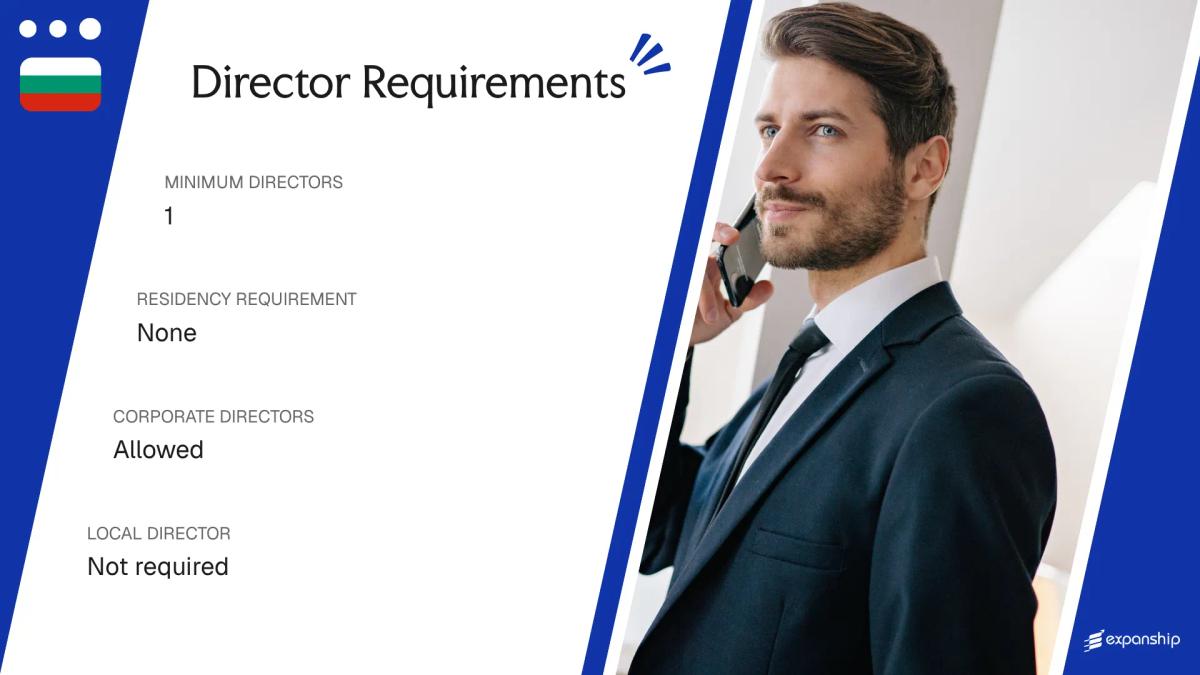
Under Bulgarian commercial law, specifically the Commerce Act (Търговски закон), a director of an OOD (дружество с ограничена отговорност) assumes direct statutory liability for managing the company's affairs with due diligence, representing the entity before third parties, and ensuring compliance with tax, accounting, and corporate obligations. Failure to fulfil these duties can result in personal liability for damages caused to the company or its creditors.
| Parameter | Detail |
|---|---|
| Minimum Number of Directors | One director is required. |
| Maximum Number of Directors | No statutory maximum is prescribed under the Commerce Act. |
| Local/Resident Director Required | No residency or local director requirement exists. |
| Nationality Restrictions | No nationality restrictions are imposed on directors. |
| Minimum Age Requirement | Directors must be at least 18 years of age. |
| Corporate Directors Permitted | Corporate directors are not permitted; only natural persons may serve. |
| Director Must Be a Shareholder | No statutory requirement for a director to hold shares in the company. |
| Publicly Listed on Registry | Directors are publicly listed in the Bulgarian Commercial Register (Търговски регистър). |
| Disqualification Conditions | Persons convicted of certain criminal offences or subject to a court-imposed ban on holding managerial positions are disqualified from serving. |
Unlike many EU jurisdictions, Bulgaria does not require a locally resident or Bulgarian-national director, meaning a company can be incorporated and fully managed by foreign nationals based entirely abroad.
Shareholder Requirements in Bulgaria
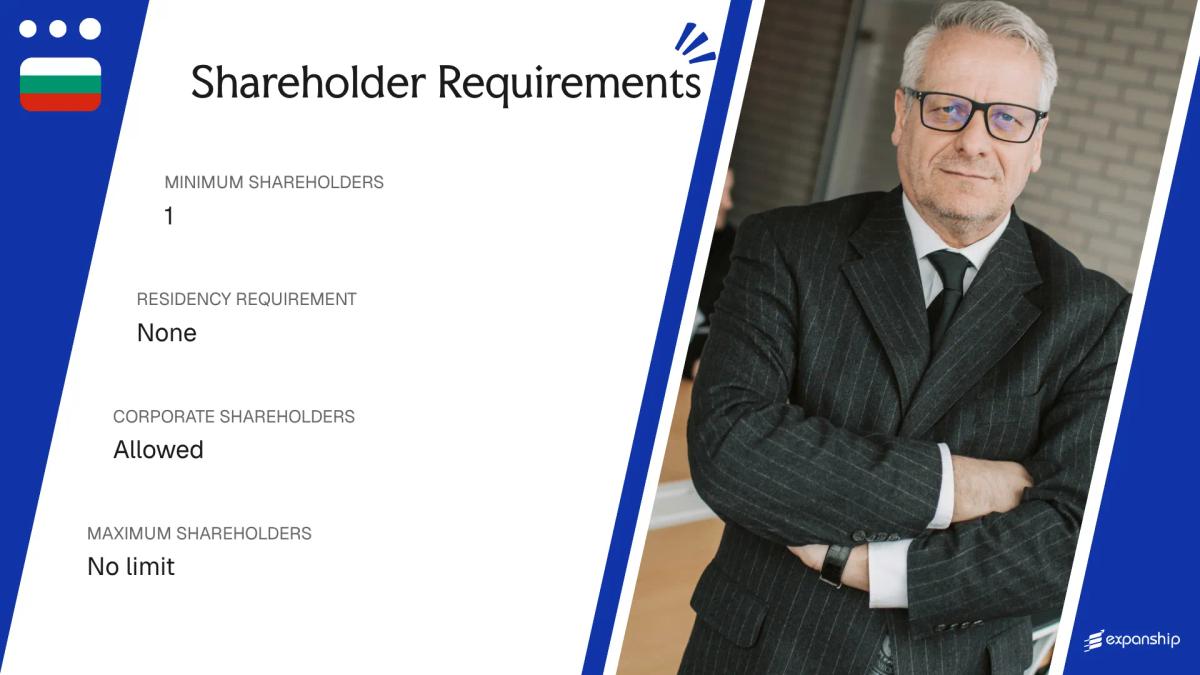
An OOD (Дружество с ограничена отговорност) requires at least one shareholder, with no statutory maximum. A sole-shareholder structure is fully permitted, in which case the entity is classified as an EOOD (Еднолично дружество с ограничена отговорност).
Nationality and Residency Restrictions
Bulgaria shareholder requirements impose no nationality or residency conditions on shareholders. Foreign nationals and non-resident individuals may hold 100% ownership in a Bulgarian entity without restriction.
Corporate Shareholders
Corporate entities are permitted to act as shareholders in an OOD. No special conditions are attached solely on the basis of corporate shareholding, though the corporate shareholder must provide standard documentation during incorporation.
Shareholder Liability
Shareholder liability is limited to each member's capital contribution as recorded in the company's founding documents. Under the Commercial Act, this limitation holds in ordinary circumstances, with extended liability arising only in cases of established abuse of the corporate form.
Register of Shareholders
An OOD must maintain an internal register of shareholders recording ownership interests. This register is not publicly accessible, but changes in shareholding must be filed with the Bulgarian Trade Register (Търговски регистър) to take legal effect.
Get Guidance on Bulgaria Incorporation Requirements
Speak with a specialist about meeting shareholder and ownership obligations when forming a company in Bulgaria.
UBO / Beneficial Ownership Registration Requirements in Bulgaria
Bulgaria UBO registration requirements are governed by the Measures Against Money Laundering Act (MAMLA), which transposes the EU's Fourth and Fifth Anti-Money Laundering Directives into national law. A beneficial owner is defined as any natural person who ultimately owns or controls more than 25% of the shares or voting rights in a legal entity.
- Identify all natural persons holding, directly or indirectly, more than 25% ownership or control in the company.
- Prepare the required UBO declaration in accordance with MAMLA.
- Submit UBO data to the Commercial Register, maintained by the Registry Agency, upon incorporation or within 7 days of any change.
- Certify annually that the recorded UBO information remains current, even if no changes have occurred.
| Parameter | Detail |
|---|---|
| Ownership Threshold for UBO Status | More than 25% of shares or voting rights |
| Filing Authority | Registry Agency (Commercial Register) |
| Disclosure Deadline at Incorporation | At the time of registration |
| Publicly Accessible Register | Yes |
| Penalties for Non-Disclosure | Fines applicable under MAMLA; amounts vary by violation |
| Ongoing Update Obligation | Yes; updates required within 7 days of any change, plus annual confirmation |
KYC / Document Requirements in Bulgaria
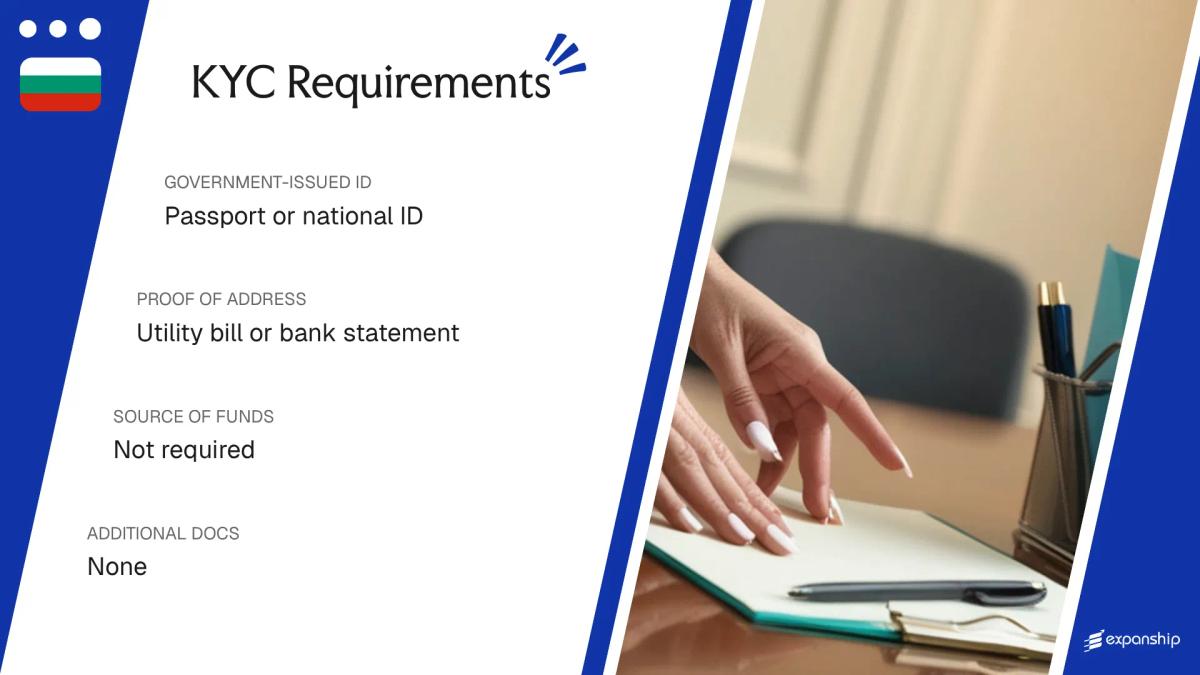
Bulgaria KYC document requirements apply at the point of incorporation under the Measures Against Money Laundering Act (MAMLA), which governs due diligence obligations for all entities registered through the Bulgarian Commercial Register administered by the Registry Agency.
Individual / Personal Documents
- Valid government-issued photo ID (passport or national identity card) for each individual director, shareholder, or beneficial owner
- Proof of residential address dated within the last three months (utility bill or bank statement)
- Completed and signed KYC/AML declaration or questionnaire as required by the filing agent or notary
- Tax identification number or equivalent where the individual is a foreign national
Corporate Documents
- Certificate of incorporation or equivalent constitutional document for the corporate shareholder or director
- Current register of directors and register of shareholders from the home jurisdiction
- Proof of registered address for the corporate entity (official correspondence or utility document)
- Certificate of good standing where the home jurisdiction issues such documents
Source of Funds Documentation
- Recent bank statements (typically covering the last three to six months) evidencing available capital
- Audited financial statements where the shareholder is an established corporate entity
- Written explanation of the origin of funds if the capital source is not evident from bank records
Notarisation and Apostille Requirements
- Foreign-issued identity documents may require a certified translation into Bulgarian by a sworn translator
- Corporate documents originating outside Bulgaria generally require apostille certification under the Hague Convention
- Notarised copies of constitutional documents are typically required when a corporate entity acts as a shareholder
The most common cause of registration delay is submission of corporate documents from the shareholder's home jurisdiction without apostille certification or certified Bulgarian translation.
Company Name Requirements in Bulgaria
Bulgaria company name requirements are assessed at the point of registration through the Commercial Register, which verifies that a proposed name is unique and does not duplicate or closely resemble an already-registered entity. Names are evaluated on a first-come, first-served basis.
All company names must be in the Bulgarian language using the Cyrillic alphabet, though a transliteration into Latin script may appear alongside it. A limited liability company must include the suffix "ООД" or its full form "Дружество с ограничена отговорност."
Certain words are restricted and require regulatory pre-approval before inclusion in a business name — terms implying state authority, financial licensing, or national significance fall into this category. Words that are misleading, contrary to public order, or offensive are outright prohibited.
Name reservation is available through the Commercial Register and provides temporary protection of the chosen name prior to formal incorporation. The reservation period is limited, and the application is submitted electronically via the register's portal.
Compliance Services for Companies in Bulgaria
Ongoing compliance obligations for Bulgarian companies include annual financial reporting, UBO registration, and statutory filings with the Commercial Register.
Conclusion
Bulgaria incorporation requirements span several distinct legal obligations under the Commerce Act, covering share capital, directorship, registered office, shareholder structure, and UBO registration with the Registry Agency. Among these, the absence of a minimum paid-up capital threshold for an OOD and the lack of residency restrictions on directors are two points that often shape how foreign investors approach entity structuring. Once these requirements are understood, the practical next step is execution — engaging local registered address providers, preparing notarised documentation, and filing with the Commercial Register.
Expanship's Bulgaria Company Formation Services
Expanship's Bulgaria company formation services are designed to reduce the administrative burden of meeting the specific requirements covered in this guide, from structuring your OOD's share capital and registered office to managing UBO registration with the Bulgarian Commercial Register. Your firm handles these steps under Bulgarian law, so your focus stays on building the business rather than on procedural compliance.
Beyond incorporation, Expanship offers a range of services to support your presence in Bulgaria:
- We prepare and file all company registration documents with the relevant Bulgarian authorities on your behalf.
- We provide registered agent and office facilities to meet local address requirements.
- We manage government filings and liaise directly with regulatory bodies throughout the process.
- We support ongoing post-incorporation compliance obligations as your business develops.
- We facilitate introductions to local banking institutions to assist with account opening.
- We handle tax registration and coordinate with local authorities on your behalf.
Reach out to Expanship Bulgaria to discuss your incorporation requirements.
Frequently Asked Questions (FAQ)
A foreign national can serve as both the sole director and sole shareholder of a Bulgarian OOD. Bulgarian law imposes no nationality or residency requirement on directors or shareholders, making the entity accessible to non-resident founders. The director will, however, need a valid identification document and, in most cases, a Bulgarian personal identification number (ЕГН or ЛНЧ) to execute registration formalities.
Failure to register beneficial ownership information with the Bulgarian Commercial Register, as required under the Measures Against Money Laundering Act (ZMIP), can result in administrative penalties against the company and its management. The obligation applies to all legal entities registered in Bulgaria, with no exemption based on company size or foreign ownership structure. Penalties can be imposed on both the entity and the individual manager responsible for the omission.
A notary is required specifically for the certification of the manager's specimen signature, which must be submitted to the Commercial Register as part of the incorporation package. This is a mandatory step under the Bulgarian Commercial Act and cannot be bypassed by remote or electronic means in most standard cases. The notarisation can be performed either in Bulgaria or before a Bulgarian consulate abroad if the signatory is not present in the country.
A residential address can serve as the registered office of a Bulgarian company, provided the address is located within Bulgaria and the company is entitled to use it. The Commercial Register does not require the address to be commercial or dedicated office space. Proof of the right to use the premises, such as a lease agreement or owner's consent declaration, must be submitted during registration.
The Bulgarian Commercial Act requires that the company name be registered in Bulgarian. A transliteration into Latin script can be registered alongside the Bulgarian form, but it cannot replace it. Using a name exclusively in a foreign language or script is not permitted for registration purposes in the Commercial Register.
A foreign individual shareholder is generally required to provide a certified copy of a valid passport or national identity document, along with proof of residential address. Depending on the source of capital and the nature of the business, additional documentation supporting the origin of funds may be requested. These requirements align with Bulgaria's obligations under the EU Anti-Money Laundering Directives, transposed through ZMIP.
Legal Disclaimer
The information provided in this article is for general informational purposes only and does not constitute legal, tax, or professional advice. While we strive to ensure the accuracy and timeliness of the content, laws and regulations are subject to change, and the application of laws can vary widely based on specific facts and circumstances.
Readers should not act upon this information without seeking professional counsel tailored to their individual situation. Expanship and its authors disclaim any liability for actions taken or not taken based on the content of this article.
For specific advice regarding your business setup, compliance requirements, or any legal matters, please consult with qualified legal and tax professionals in the relevant jurisdiction.