
Key Takeaways
- Bulgaria's Commercial Act imposes statutory documentation requirements exclusively in Bulgarian, creating a translational and legal compliance burden for non-Bulgarian-speaking founders managing an OOD.
- Foreign SMEs and tech startups incorporated in Bulgaria may find themselves structurally excluded from certain EU venture funding mechanisms due to the jurisdiction's limited integration with established startup ecosystems in Western Europe.
- Delays at the Bulgarian Commercial Register can extend incorporation and amendment timelines beyond the periods founders typically encounter in comparable EU jurisdictions, adding operational uncertainty during critical early stages.
- Bulgaria's intellectual property enforcement environment remains underdeveloped relative to most EU peers, exposing IP-dependent businesses to greater practical risk despite the country's formal compliance with EU-level frameworks.
Bulgaria operates under a moderately regulated corporate framework, governed primarily by the Commercial Act, which sets out the formation and ongoing obligations for entities including the commonly used OOD structure.
The disadvantages of incorporating in Bulgaria span several distinct areas, from registration procedures and language requirements to capital market limitations and enforcement gaps.
Not every drawback will apply equally to your business. A foreign holding company, a tech startup seeking EU grants, and a trading firm each face different friction points under the same legal system.
This article is most relevant to non-EU founders, foreign SME owners, and international investors who are establishing an OOD or similar entity and may underestimate the operational and compliance demands that surface after registration.
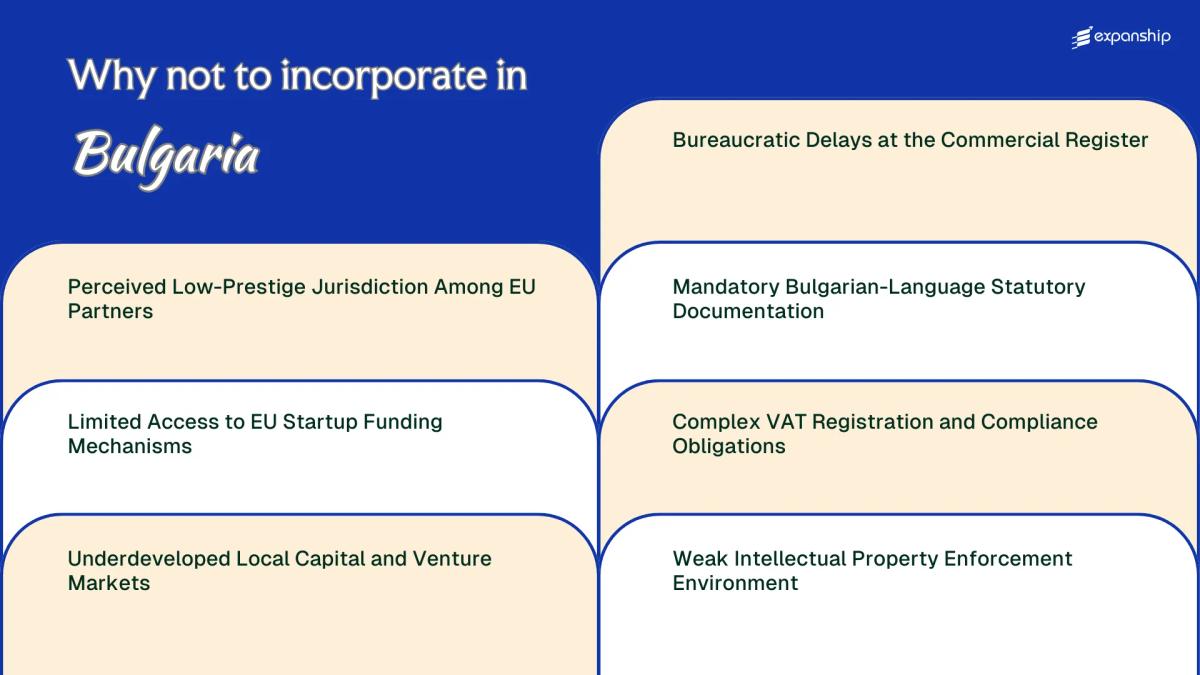
Perceived Low-Prestige Jurisdiction Among EU Partners
Among EU member states, Bulgaria low prestige jurisdiction EU perceptions are a documented commercial reality, not merely a subjective concern. Foreign-owned OODs routinely encounter skepticism from Western European counterparties that associate the country with elevated fraud risk and weak governance standards.
How Partner Perception Affects Commercial Relationships
European banks, institutional clients, and enterprise procurement teams often apply enhanced due diligence to Bulgarian-registered entities under anti-money laundering frameworks, including requirements stemming from the EU's AMLD directives. This additional scrutiny translates directly into delayed account openings, stricter document requests, and in some cases outright refusal by correspondent banking networks.
The Bulgarian National Bank has itself acknowledged systemic deficiencies that contributed to the collapse of Corporate Commercial Bank (KTB) in 2014, an event that reinforced negative perceptions among foreign financial institutions.
Credibility Costs for B2B and Investor Relations
Bulgaria company reputation problems extend beyond banking. Incorporating in Bulgaria EU partner perception challenges can surface during supplier onboarding, investor term sheet negotiations, or when applying for contracts with public sector entities in Germany, France, or the Netherlands.
A Bulgarian-registered firm may face automatic exclusion from vendor lists or financing rounds where counterparties apply jurisdiction-based risk filters without conducting individual company assessments.
Limited Access to EU Startup Funding Mechanisms
Bulgaria EU startup funding limitations affect incorporated entities in ways that are structural, not incidental. Several of the EU's most significant funding instruments apply eligibility criteria that a Bulgarian-registered company may struggle to meet in practice.
The European Innovation Council (EIC) and the European Investment Fund (EIF) both assess founding team location, prior funding history, and ecosystem credibility as part of their evaluation. Startups incorporated in Sofia frequently lack the investor co-financing track record that evaluators expect from applicants in more established EU tech hubs.
Horizon Europe grants, while technically open to Bulgarian-registered entities, require consortium partnerships with recognized research institutions. Finding qualifying partners willing to anchor applications with a Bulgarian firm adds time and negotiation costs that reduce your effective access.
Specific burdens this creates include:
- EIC Accelerator applications require proof of private investment, which is harder to demonstrate given Bulgaria's thin venture market
- Grant co-financing requirements force founders to pre-fund operational costs before reimbursement cycles complete
- Horizon Europe consortia partners from Western EU members sometimes discount Bulgarian firms during proposal-stage negotiations, weakening your application position
- EIF-backed fund managers operating locally manage smaller ticket sizes, restricting early-stage check availability
Entities incorporated in Ireland or the Netherlands face fewer informal barriers when approaching the same instruments.

Company Incorporation in Bulgaria
Understand the full regulatory and structural implications before incorporating a company in Bulgaria.
Underdeveloped Local Capital and Venture Markets
Bulgaria venture capital market drawbacks are structural, not cyclical. The domestic private equity and venture ecosystem remains shallow compared to Western EU peers, with total VC investment volumes consistently ranking among the lowest in the bloc relative to GDP.
For a foreign-owned entity seeking growth capital locally, the scarcity of institutional investors active in early and mid-stage funding creates a genuine financing gap. Sofia's startup ecosystem has produced some notable exits, but the local investor base is thin, and ticket sizes from domestic funds rarely exceed what most scaling businesses require.
| Constraint | Specific Limitation | Impact on Foreign-Owned Entity |
|---|---|---|
| Active domestic VC funds | Very few funds with consistent deal activity | Limited competition among investors narrows terms |
| Typical local VC ticket size | Generally under €500,000 for early-stage rounds | Insufficient for capital-intensive growth phases |
| Stock exchange depth | BSE-Sofia lists fewer than 400 securities | Thin public market makes IPO exit impractical |
| EU co-investment programs | Access conditioned on local fund partnership | Foreign firms without local ties face structural exclusion |
The Bulgarian Stock Exchange (BSE-Sofia) does not offer a meaningful exit route for most private businesses. Without a liquid secondary market, investor appetite for illiquid equity stakes in locally incorporated firms is reduced further.
Access to EU-backed instruments, including those administered through the Bulgarian Development Bank, typically requires co-investment from accredited local intermediaries. Your firm cannot access these instruments directly, which adds a dependency layer that increases both cost and timeline.
Bureaucratic Delays at the Commercial Register
Bulgaria Commercial Register delays are among the more tangible friction points for foreign founders, particularly those expecting the registration timelines common in Estonia or the Netherlands. The Commercial Register is administered by the Registry Agency (Агенция по вписванията) under the Ministry of Justice, and while online submission is available through the BRRA (Булстат) portal, processing times are inconsistent.
Standard registration of an OOD (LLC equivalent) is nominally a 3-business-day process. In practice, backlogs at regional offices and document verification queues extend this timeline, sometimes to several weeks, especially when applications are returned for corrections.
Returned applications reset the clock entirely. For a foreign director or shareholder submitting notarized documents from abroad, even minor formatting discrepancies trigger rejection without substantive feedback, creating repeated cycles of resubmission.
- Applications rejected for errors restart the full processing period from zero
- The Registry Agency requires all documents to pass formal compliance checks before acceptance
- Apostille-certified foreign documents must meet Bulgarian procedural standards, not just international form requirements
- No guaranteed processing deadline is legally enforceable for standard registrations
- The Registry Agency handles both rejection notices and re-filings, with no expedited escalation path for foreign applicants
Bulgaria has no statutory penalty mechanism that compensates applicants when the Registry Agency exceeds its own published processing timeframes.
Mandatory Bulgarian-Language Statutory Documentation
All statutory documents for a Bulgarian OOD must be drafted and filed in Bulgarian, as required under the Commercial Act (Targovski Zakon) and enforced through the Registry Agency's Commercial Register.
The Language Restriction and Its Legal Basis
Foreign directors and shareholders cannot submit articles of association, shareholder resolutions, or founding declarations in any other language. Any document produced abroad must be translated by a certified translator and, in many cases, notarized before the Registry Agency will accept it.
What This Costs a Foreign Business Owner
Each translation and notarization cycle adds both time and direct expense to your formation process, and errors in translated legal terminology can trigger rejections that restart the clock entirely. Ongoing compliance documents, including annual general meeting minutes and any amendments to your articles, carry the same obligation, meaning the cost is not a one-time burden. Foreign-owned firms with multilingual boards face this requirement on every statutory filing, regardless of how routine the change.
Support for Statutory Documentation Compliance in Bulgaria
Get guidance on meeting Bulgaria's Bulgarian-language statutory requirements, from certified translations to Registry Agency filings, without procedural delays.
Complex VAT Registration and Compliance Obligations
Bulgaria VAT registration compliance problems create disproportionate administrative burdens for foreign-owned entities, particularly those operating below the mandatory registration threshold. Under the Zakon za Danak varhu Dobavenata Stoynost (ZDDS), the standard registration threshold is BGN 100,000 in taxable turnover over the preceding 12 months.
- Crossing the BGN 100,000 threshold triggers a mandatory registration obligation within seven days, leaving little operational buffer for fast-growing firms.
- Your business must submit periodic VAT returns, typically monthly, requiring consistent access to qualified Bulgarian accounting support.
- Intra-EU transactions can trigger VAT registration requirements regardless of domestic turnover, catching foreign directors off guard.
- The National Revenue Agency (NRA) conducts VAT audits that can extend back five years, exposing firms to retrospective liability.
- Deregistration is not automatic and requires a separate formal procedure with the NRA, adding cost when winding down or restructuring.
Weak Intellectual Property Enforcement Environment
Bulgaria intellectual property enforcement risks are a genuine operational concern for foreign businesses holding patents, trademarks, or copyrighted assets. The Patent Office of the Republic of Bulgaria (Patent Office) handles domestic IP registration, but registration alone does not guarantee practical protection.
Enforcement depends heavily on the civil court system, which carries significant case backlogs. A trademark infringement dispute can take years to resolve through the courts, exposing your brand to prolonged unauthorized use without timely remedy.
Counterfeit goods and software piracy have historically been documented concerns. The U.S. Trade Representative has previously placed Bulgaria on its Special 301 Watch List, citing deficiencies in IP enforcement capacity and border control effectiveness.
Even with an EU trademark registered through the EUIPO, local enforcement of that right still requires engaging Bulgarian courts or customs authorities. The practical gap between holding a registered right and enforcing it is wider here than in Western EU member states with more developed IP litigation infrastructure.
Hypothetical scenario: A software firm holding an EU trademark registers a product in Bulgaria and discovers an infringing local distributor. Filing a civil claim through the Sofia City Court, retaining local IP counsel, and waiting for a preliminary injunction could conservatively cost EUR 8,000 to EUR 15,000 in legal fees and take 18 to 36 months before a substantive ruling is issued, with no guarantee of asset recovery.
Strategies to Overcome These Drawbacks
Overcoming Bulgaria incorporation drawbacks requires a structural approach rather than ad hoc fixes. The challenges covered in this blog — from Commercial Register delays to VAT compliance obligations — are manageable when addressed through the correct procedural channels from the outset.
- Pre-translate all founding documents into Bulgarian and have them certified before submitting to the Trade Register to reduce processing delays caused by documentation deficiencies.
- Apply for VAT registration under the Bulgarian Tax and Social Insurance Procedure Code simultaneously with company formation, rather than waiting until taxable turnover thresholds are reached.
- Register any trademarks or software assets with the Patent Office of the Republic of Bulgaria before commencing commercial operations.
- Structure your OOD with a clearly documented share transfer mechanism in the Articles of Association to address investor confidence concerns in underdeveloped local capital markets.
- Engage a certified local accountant familiar with the National Revenue Agency's reporting requirements to manage ongoing statutory filings.
These steps operate within a unified regulatory framework governed primarily by the Commerce Act and administered through agencies under the Ministry of Justice and the Ministry of Finance. Addressing procedural requirements early reduces the cumulative compliance burden as your firm scales its operations in the jurisdiction.
Bulgaria's Overall Value for Investors
Despite the drawbacks covered in this blog, Bulgaria company formation cons vs benefits present a mixed but ultimately calculable picture. The jurisdiction offers genuine structural advantages — a flat 10% corporate tax rate, full EU membership, and low operating costs — that remain factually competitive for foreign businesses prepared to manage the documented friction points.
| Pros | Cons |
|---|---|
| Corporate income tax is fixed at 10%, one of the lowest rates within the EU. | The Commercial Register has a documented history of processing delays affecting registration timelines. |
| As an EU member state, Bulgarian entities can access the single market and EU legal frameworks. | The jurisdiction carries a lower-prestige perception among some Western European counterparties. |
| Minimum share capital for an OOD is BGN 2, reducing the financial barrier to incorporation. | All statutory documents must be filed in Bulgarian, creating an ongoing language compliance obligation. |
| Operating and labour costs remain below the EU average. | VAT registration and ongoing compliance carry administrative complexity under the Bulgarian Tax Insurance Procedure Code. |
| Sofia hosts a growing pool of technical and engineering graduates at competitive salary levels. | Intellectual property enforcement is weaker in practice compared to Western EU jurisdictions. |
Access to EU venture funding and developed capital markets remains limited relative to Western European hubs.
Corporate Compliance Services in Bulgaria
Manage your Bulgarian OOD's annual filing, tax reporting, and regulatory obligations under Bulgarian law.
Conclusion
A Bulgaria incorporation disadvantages summary must begin with an honest accounting: the country offers genuine structural advantages, but several friction points remain material for foreign founders. Delays at the Commercial Register, language requirements embedded in statutory documentation, and VAT compliance obligations add operational weight that planning alone cannot fully eliminate. These are not superficial concerns. Firms that underestimate them often encounter costs and timelines that exceed initial projections. Specialist support with direct experience of Bulgarian regulatory processes tends to reduce that gap substantially.
Expanship's Bulgaria Company Formation Support
Registering an OOD, dealing with the Търговски регистър (Commercial Register), and staying current with Bulgaria's VAT and statutory requirements all carry real administrative weight. Bulgaria company formation support from Expanship is structured around reducing that operational burden, from document preparation in Bulgarian to coordinating with the National Revenue Agency on tax registration.
Beyond incorporation, Expanship's service scope covers the full setup and maintenance cycle:
- Your company registration and statutory document preparation are handled with attention to Bulgarian legal requirements.
- A registered agent and local office address are provided to satisfy the OOD's legal seat obligation.
- Filings with the Commercial Register and relevant regulatory bodies are coordinated on your behalf.
- Post-incorporation compliance management keeps your entity in good standing under Bulgarian law.
- Banking introduction assistance connects your business with suitable local or regional financial institutions.
- Tax registration and liaison with the National Revenue Agency are managed as part of the setup process.
To discuss your situation, contact Expanship Bulgaria.
Frequently Asked Questions (FAQ)
Yes, it applies to all legal entity types registered under the Bulgarian Commercial Act, including the OOD (limited liability company) and the AD (joint-stock company). All founding documents, including the Articles of Association, must be drafted and submitted in Bulgarian to the Commercial Register maintained by the Registry Agency. Foreign-language versions have no legal standing in local proceedings, so certified translations are required for any document used outside Bulgaria.
Under the Value Added Tax Act (ZDDS), late registration or failure to charge VAT correctly can result in financial penalties starting at BGN 500 and reaching up to the full amount of the incorrectly handled tax liability. The National Revenue Agency (NRA) conducts audits and can issue mandatory VAT registration if your business exceeds the BGN 100,000 threshold without self-registering. Interest accrues on unpaid VAT from the date the obligation arose, not from the date of assessment.
Bulgaria's mandatory VAT registration threshold of BGN 100,000 (approximately EUR 51,130) is lower than the thresholds applied in several larger EU economies, meaning your business may be drawn into VAT compliance obligations earlier than expected. Germany, for instance, applies a EUR 22,000 small-business exemption but with different structural rules, while some jurisdictions allow voluntary registration below threshold with fewer administrative burdens. The Bulgarian VAT regime also requires registration within 14 days of exceeding the threshold, with no grace period built in.
Your company has no legal standing to sign contracts, open bank accounts, or issue invoices until registration is complete, so delays at the Registry Agency have direct operational consequences. Processing times that nominally take seven working days can extend significantly during high-volume periods or when applications are returned for correction. There is an expedited procedure available for a higher state fee, but it does not guarantee same-day processing and is subject to examiner availability.
EU-level trademark protection through the EUIPO applies across all member states including Bulgaria, but enforcement still depends on local courts and customs authorities acting on infringement. Bulgarian IP enforcement infrastructure, while formally compliant with EU directives, has historically been slower to act on cases involving counterfeit goods and digital infringement than courts in Germany, the Netherlands, or France. If your business model depends on active IP protection rather than passive registration, the practical enforcement gap in Bulgaria is a material risk.
It affects non-EU founders more acutely than EU-citizen shareholders, since several EIC and EIF-backed instruments require founding teams or majority ownership to be EU-domiciled. A Bulgarian OOD owned entirely by non-EU nationals may be formally eligible for some schemes but will face additional scrutiny during due diligence by fund managers applying geographic and beneficial ownership criteria. Bulgarian national programs administered through the Bulgarian Development Bank apply their own eligibility filters, which may further restrict access depending on sector and shareholder structure.
Legal Disclaimer
The information provided in this article is for general informational purposes only and does not constitute legal, tax, or professional advice. While we strive to ensure the accuracy and timeliness of the content, laws and regulations are subject to change, and the application of laws can vary widely based on specific facts and circumstances.
Readers should not act upon this information without seeking professional counsel tailored to their individual situation. Expanship and its authors disclaim any liability for actions taken or not taken based on the content of this article.
For specific advice regarding your business setup, compliance requirements, or any legal matters, please consult with qualified legal and tax professionals in the relevant jurisdiction.