

Key Takeaways
- Timor-Leste's flat 10% corporate income tax rate sits materially below regional averages, reducing the ongoing tax burden for foreign-owned entities operating through a registered Lda. structure.
- Foreign investors benefit from formal capital protections under Investment Law No. 14/2011, which establishes defined entitlements for qualifying entities and underpins the legal framework governing foreign direct investment in the country.
- The absence of withholding tax on qualifying dividend distributions compounds the fiscal efficiency of the 10% headline rate, making profit repatriation structurally more favorable than in many comparable jurisdictions.
- Registration through SERVE, Timor-Leste's dedicated one-stop-shop authority, provides a consolidated administrative pathway that reduces the procedural complexity typically associated with company formation in frontier markets.
Timor-Leste is a sovereign nation on the eastern half of the Timor island in Southeast Asia, bordered by Indonesia and the Timor Sea. It gained independence in 2002 and operates under a civil law framework that governs commercial activity, including foreign business registration.
Company registration falls under the authority of SERVE, the government's one-stop-shop for business licensing and commercial registration. Foreign businesses typically establish a presence through a Limitada (Lda.), the dominant private limited liability structure used across the country.
The benefits of incorporating in Timor-Leste draw from a low-tax fiscal environment, where corporate rates remain well below regional averages. Foreign direct investment is formally recognized and encouraged under Investment Law No. 14/2011, which extends specific protections and entitlements to qualifying foreign entities.
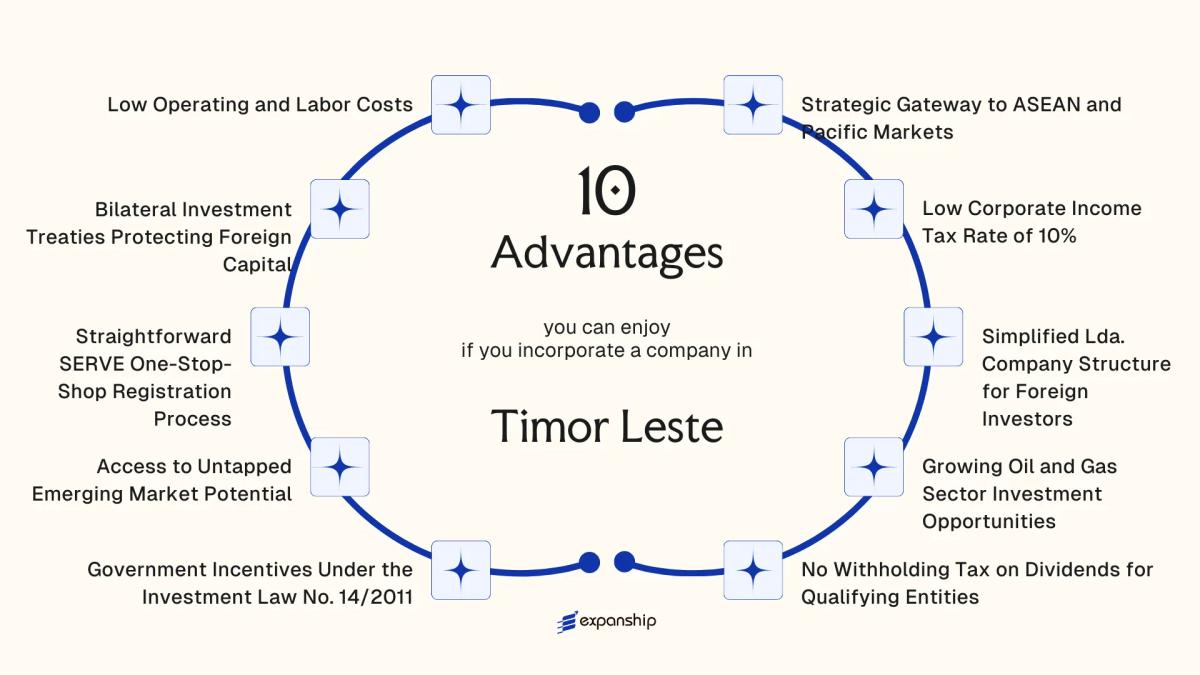
Full foreign ownership of a registered business is permitted in most sectors, reflecting the government's general openness to international capital. This article covers the key advantages your firm can access by forming a company here.
Strategic Gateway to ASEAN and Pacific Markets
Timor-Leste's pending ASEAN membership, formally supported by all ten member states, positions businesses registered there to access a trading bloc of over 670 million people. For a foreign company, this translates to preferential trade arrangements and market proximity that a purely offshore holding structure elsewhere cannot replicate.
Geographic Position as a Commercial Asset
Situated between the Indonesian archipelago and Australia, the country sits along active sea lanes connecting East Asia with the Pacific. A firm incorporated here gains a physical and legal presence at the intersection of two distinct growth regions, which carries real weight when negotiating distribution agreements or customs classifications.
Proximity to High-Growth Economies
Australia and Indonesia together represent over one trillion USD in combined GDP, and both share maritime borders with this jurisdiction. Regional expansion into these markets from a locally registered entity can support eligibility for bilateral trade frameworks that may not be available to companies incorporated in non-adjacent jurisdictions.
Your registered entity in Timor-Leste can serve as a legally anchored base for regional market entry into ASEAN and Pacific economies before full membership benefits are formally activated.
Low Corporate Income Tax Rate of 10%
Timor-Leste's standard corporate income tax rate is set at 10% under the country's tax legislation, administered by the Autoridade Tributária (Tax Authority). For foreign businesses, the Timor-Leste 10% corporate income tax advantage is concrete: the rate applies to net taxable income derived from business activities registered in the country, making the effective tax burden on profits considerably lower than in many comparable jurisdictions. The global average corporate tax rate sits around 23%, which puts this rate in a distinctly favourable position.
This flat structure reduces complexity in tax planning. There are no graduated corporate tax bands to calculate across — the same rate applies regardless of profit level, giving your business consistent, predictable tax exposure from the outset.
Several structural features reinforce the tax position for qualifying companies:
- Taxable income calculations follow defined deduction rules, meaning allowable business expenses reduce the base before the 10% rate applies
- The flat rate removes any penalty for growth, since higher profits do not trigger a higher rate
- Foreign investors operating through a properly registered entity face the same rate as domestic firms, with no tax surcharge based on origin of ownership
The 10% rate applies to resident companies on their Timor-Leste-sourced income. Non-resident entities generating income within the jurisdiction are subject to separate withholding provisions under the tax code.

Company Incorporation in Timor-Leste
Register your company in Timor-Leste and take advantage of the 10% flat corporate income tax rate with support from Expanship's incorporation specialists.
Simplified Lda. Company Structure for Foreign Investors
The Lda. (Limitada) is the standard private limited liability company structure available to foreign investors under Timor-Leste's Commercial Companies Law (Law No. 4/2017). Liability is capped at each shareholder's capital contribution, meaning your personal assets remain protected from business obligations incurred by the entity.
Foreign nationals can hold 100% ownership of an Lda., without a mandatory local partner requirement in most sectors. This direct ownership structure gives you full control over profit distribution, management decisions, and operational direction — without diluting equity to satisfy residency requirements.
| Feature | Detail |
|---|---|
| Minimum shareholders | 2 |
| Minimum share capital | USD 500 |
| Foreign ownership | Up to 100% permitted in most sectors |
| Liability cap | Limited to capital contribution |
| Governing law | Law No. 4/2017 (Commercial Companies Law) |
The USD 500 minimum share capital threshold is low by any practical measure, reducing the upfront financial commitment required to establish a legal presence. A foreign business does not need to park significant capital in-country simply to satisfy incorporation formalities.
Management of the firm can be vested in a single director, and there is no statutory requirement for that director to be a resident. For foreign operators managing regional portfolios, this reduces the administrative burden of maintaining a local governance structure while still holding a properly constituted legal entity.
Growing Oil and Gas Sector Investment Opportunities
Timor-Leste oil and gas investment opportunities are anchored in the country's legally structured petroleum framework, primarily governed by the Petroleum Act No. 13/2005 and administered through the Autoridade Nacional do Petróleo e Minerais (ANPM). The Greater Sunrise field, estimated to hold over 5 trillion cubic feet of natural gas, remains largely undeveloped, meaning your business enters a sector with significant untapped production capacity.
Upstream licensing is managed through Production Sharing Contracts (PSCs), which define the terms under which foreign firms can participate in exploration and extraction. This contractual model provides a defined legal basis for revenue sharing, reducing ambiguity around profit entitlements.
Beyond extraction, downstream and services segments, including logistics, equipment supply, and technical consulting, are actively being opened to private foreign capital. A company incorporated locally holds a structural advantage in accessing these contracts compared to purely offshore arrangements.
Keep these points in mind:
- ANPM is the licensing authority; engagement must go through its formal approval process
- PSC terms can vary by block; review the specific contract terms before committing capital
- Local content requirements may apply under petroleum sector regulations
- Refer to the petroleum legislation on ANPM's official portal
Timor-Leste's national petroleum fund, the Fundo Petrolífero, held over $18 billion USD at its peak, making it one of the largest sovereign wealth funds per capita globally.
No Withholding Tax on Dividends for Qualifying Entities
Under Timor-Leste's tax framework, no withholding tax on dividends applies to qualifying entities, meaning profits distributed to foreign shareholders can leave the country without a deduction at source. For businesses structured to meet the relevant conditions, this treatment directly reduces the tax cost of repatriating earnings.
What the Exemption Covers
The zero-rate treatment applies where the distributing entity qualifies under the applicable provisions of the Taxes and Duties Act (Law No. 8/2008). Rather than facing a percentage withheld on each dividend payment, qualifying shareholders receive the full distributed amount.
This matters because withholding taxes in many comparable jurisdictions impose rates between 10% and 25% on outbound dividends, creating a recurring drag on returns each time profits are distributed. Eliminating that layer preserves more of the after-tax profit in the hands of the investor.
The Practical Advantage for Foreign Investors
Your effective return on a Timorese investment is not subject to erosion at the distribution stage, provided the entity qualifies. That distinction separates jurisdictions where a low corporate rate still carries a secondary dividend cost from those where the benefit extends through to the shareholder.
Combined with the 10% corporate income tax rate, the absence of dividend withholding creates a structurally lower total tax burden on profits generated and distributed from the country. The qualifying conditions under the Act are the threshold to confirm before structuring.
Structure Your Timor-Leste Entity to Qualify for Dividend Tax Benefits
Confirm whether your business structure meets the qualifying conditions under Timor-Leste's tax framework to benefit from zero dividend withholding treatment.
Government Incentives Under the Investment Law No. 14/2011
Investment Law No. 14/2011 is the primary legislative framework governing foreign investment incentives in Timor-Leste, and it creates a set of structured protections and fiscal concessions that directly reduce risk and cost for qualifying businesses.
- Registered investment projects approved under the law may receive tax holidays or reduced tax rates for a defined period, lowering the effective tax burden during the critical early phase of operations when cash flow is most constrained.
- The law guarantees that approved investors can repatriate profits, dividends, and capital abroad without restriction, removing a significant barrier that deters foreign capital in many developing economies.
- Investment protections under the law include safeguards against expropriation without fair compensation, giving your business a legal basis to challenge state interference with assets.
- Qualifying investors may also access import duty exemptions on capital equipment and raw materials, reducing the upfront cost of establishing physical operations.
- The law establishes a formal mechanism for dispute resolution, including reference to international arbitration, which means contractual and investment disputes are not confined solely to domestic courts.
Eligibility for these concessions depends on the nature, scale, and sector of the proposed investment, with approvals processed through TradeInvest Timor-Leste, the designated investment promotion authority.
Access to Untapped Emerging Market Potential
Timor-Leste emerging market potential for investors rests on a specific structural reality: the country is one of Southeast Asia's youngest economies, with a domestic consumer base that remains largely unserved by formal retail, financial services, and technology sectors. That gap represents direct commercial opportunity for a foreign entity entering early.
With a population of approximately 1.3 million and urbanization concentrated in Dili, the addressable market is small in absolute terms but carries low competitive density. A business operating in sectors such as agribusiness, logistics, or digital services faces fewer established incumbents than in neighboring ASEAN economies.
Timor-Leste holds observer status with ASEAN, which positions firms incorporated here to build regional relationships ahead of any future accession. Early market entry can translate into first-mover positioning for distribution, supply chain partnerships, or licensing arrangements across the wider region.
According to the World Bank, Timor-Leste's non-oil GDP growth averaged approximately 4-5% in recent pre-pandemic years, indicating an expanding domestic economy outside the petroleum sector that presents diversified entry points for foreign capital.
The benefits of investing in Timor-Leste's emerging economy are most pronounced for firms in sectors with minimal local competition, where the absence of entrenched market structures reduces the cost and complexity of establishing commercial operations.
Straightforward SERVE One-Stop-Shop Registration Process
Timor-Leste's SERVE one-stop-shop registration benefits foreign businesses primarily through consolidated bureaucracy. SERVE (Serviço de Registo e Verificação Empresarial) brings together tax registration, business licensing, and company incorporation under a single government portal, eliminating the need to engage multiple agencies separately.
For foreign investors, this structure has a direct operational consequence: reduced time between incorporation decision and legal business activity. Processes that would otherwise require sequential appointments across distinct ministries are handled within one system.
Registration through SERVE covers:
- Commercial registration with the Ministry of Justice
- Tax Identification Number (NIF) issuance through the Tax Authority
- Business licensing coordination relevant to your declared activity
Each of these steps, when managed independently, introduces compounding delays. Centralizing them means your entity can reach active legal status faster, which directly affects when you can open bank accounts, execute contracts, and hire staff.
Timor-Leste's streamlined company registration benefits firms that operate on defined project timelines or need to establish a local presence before commencing operations under a government contract or joint venture.
SERVE registration requirements vary by business activity type; certain sectors require additional ministry-level clearances that fall outside the standard one-stop-shop process.
Bilateral Investment Treaties Protecting Foreign Capital
Timor-Leste bilateral investment treaty protections give foreign investors a layer of legal recourse that sits outside the domestic court system. This matters because it reduces your exposure to regulatory shifts that might otherwise leave you without a neutral dispute resolution forum.
Treaty Coverage and What It Guarantees
The country has signed BITs with several partner states, including Portugal and Australia, among others. These agreements typically codify protections such as fair and equitable treatment, national treatment, and safeguards against expropriation without compensation. Where a treaty is in force, your investment is covered by obligations the host state has assumed under international law, not merely by domestic legislation that can be amended unilaterally.
Arbitration Access as a Practical Safeguard
Most BITs to which the country is a party include investor-state dispute settlement (ISDS) provisions. These clauses grant qualifying foreign investors the right to bring claims directly against the state before international arbitration bodies such as ICSID or UNCITRAL tribunals, rather than relying solely on local courts. For capital-intensive projects, particularly in sectors like petroleum or infrastructure, this access to neutral arbitration materially changes your risk calculus.
Key protections commonly secured under these agreements include:
- Compensation requirements in cases of nationalization or expropriation
- Guarantee of free transfer and repatriation of investment returns
- Most-favored-nation treatment relative to investors from third states
- Protection against discriminatory or arbitrary treatment by state bodies
Eligibility for treaty benefits generally depends on the investor's nationality and the structure through which the investment is held.
Low Operating and Labor Costs
Timor-Leste low operating costs for businesses stem from a combination of below-regional wage levels and relatively low commercial overhead, giving foreign-owned entities a meaningful cost advantage from day one. The national minimum wage is set at $115 USD per month, one of the lowest statutory floors in Southeast Asia, which directly reduces the fixed payroll burden for labor-intensive operations.
Beyond wages, the cost of commercial office and warehouse space in Dili remains considerably lower than in comparable ASEAN capitals such as Singapore or Kuala Lumpur. For a foreign firm establishing a regional presence, this means your initial capital outlay for physical setup is substantially smaller, leaving more working capital available for operations.
Utility and infrastructure costs are also consistent with an early-stage developing economy. While the supply infrastructure is still maturing, the rates businesses currently pay for basic utilities are low relative to more developed jurisdictions in the region.
Key cost advantages for businesses operating in the country include:
- Monthly minimum wage of $115 USD, applicable under national labor regulations
- Below-regional commercial rental rates in the capital, Dili
- Low-cost access to a young, growing workforce with a median age under 20
- No municipal or local business taxes layered on top of national obligations
- USD as the official currency, eliminating foreign exchange conversion costs for USD-denominated businesses
These structural cost conditions apply broadly to entities registered under the Companies Act, without sector-specific restrictions, making them accessible to most standard commercial arrangements.
Why Timor-Leste Stands Out Among Emerging Jurisdictions
Three jurisdictions frequently appear on shortlists alongside Timor-Leste advantages over other emerging jurisdictions: Cambodia, Papua New Guinea, and Myanmar. All three target similar foreign investor profiles, operate in the same geographic corridor, and present comparable frontier-market entry conditions. Placing them side by side reveals where Timor-Leste holds a structurally distinct position, particularly on tax design and treaty coverage, without revisiting the individual benefits already examined above.
What the comparison surfaces is less about headline rates and more about regulatory architecture. A 10% corporate tax ceiling codified alongside an established one-stop registration body (SERVE) and bilateral investment treaty protections creates a more defined operating framework than several regional peers currently offer at equivalent stages of development. For an entity assessing political and legal risk, that structural clarity carries practical weight.
| Parameter | Timor-Leste | Cambodia | Papua New Guinea | Myanmar |
|---|---|---|---|---|
| Standard Corporate Tax Rate | 10% | 20% | 30% | 22% |
| Dividend Withholding Tax | None (qualifying entities) | 14% | 15% | None |
| One-Stop Registration Body | SERVE | CDC | IPA | DICA |
| Bilateral Investment Treaties | Yes | Yes | Limited | Yes |
| Governing Investment Law | Law No. 14/2011 | Law on Investment 2021 | Investment Promotion Act | Myanmar Investment Law 2016 |
| USD as Official Currency | Yes | No (KHR, USD widely used) | No (PGK) | No (MMK) |
Compliance Services for Companies in Timor-Leste
Stay current with Timor-Leste's regulatory requirements, from annual filings to tax obligations under the Receita do Estado framework.
Conclusion
Timor-Leste presents a coherent case for incorporation when its structural features are considered together. A flat 10% corporate income tax rate, combined with the absence of withholding tax on qualifying dividend distributions, reduces the overall tax burden on foreign-owned entities in ways that compound over time. The legal protections available under bilateral investment treaties add a further layer of capital security that many frontier markets cannot offer.
The Lda. structure remains accessible to foreign investors without mandatory local partnership requirements in most sectors, and registration through SERVE provides a defined administrative pathway under a single regulatory interface. For businesses targeting the extractive sector, the policy framework governing oil and gas investment creates conditions that are difficult to replicate in comparable emerging economies.
The benefits of incorporating in Timor-Leste are not uniformly applicable. A firm operating in a sector subject to specific licensing conditions, or one with a holding structure that does not meet the criteria under Investment Law No. 14/2011, may experience a different set of outcomes than a straightforward trading or services entity. The right incorporation decision depends on your business model, revenue profile, and long-term operating intentions in the region. Proper legal and tax analysis, specific to your structure, determines how fully these advantages translate into practical outcomes for your entity.
Start Your Timor-Leste Company Formation With Expanship Today
Timor-Leste company formation with Expanship begins with a clear understanding of the entity structures, tax obligations, and regulatory filings that govern foreign-owned businesses in this jurisdiction. From the Lda. formation process managed through SERVE to compliance requirements under the Investment Law No. 14/2011 and ongoing obligations administered by the Tax Authority of Timor-Leste (Autoridade Tributária de Timor-Leste), each stage involves specific procedural and documentary requirements that vary depending on your sector and ownership structure.
Expanship's Timor-Leste business incorporation services cover the full scope of what a foreign investor needs to establish and maintain a compliant entity:
- Preparation and legalization of incorporation documents, including articles of association and shareholder declarations
- Registered agent and registered office provision within the jurisdiction
- Filing coordination with SERVE and liaison with the relevant government ministries
- Post-incorporation compliance management, including annual reporting and tax registration
- Banking introduction assistance to support account opening with local financial institutions
- Ongoing support for maintaining good standing under applicable Timorese law
To discuss your incorporation requirements with Expanship Timor-Leste, contact the team directly.
Frequently Asked Questions (FAQ)
Yes, foreign nationals can hold 100% ownership of a Timor-Leste Lda. (Sociedade por Quotas de Responsabilidade Limitada) under Investment Law No. 14/2011. The law does not impose a mandatory local shareholding requirement for most sectors, though certain industries designated as restricted or prohibited may carry additional conditions. You should verify the applicable sector classification with SERVE or the relevant line ministry before proceeding.
The standard corporate income tax rate is 10%, which applies to taxable income earned by resident entities in Timor-Leste. This rate is governed under the country's tax code administered by the Autoridade Tributária (Tax Authority), and it applies broadly to non-petroleum commercial activity. Income derived from petroleum operations is subject to a separate fiscal regime under the Petroleum Tax Law and is not covered by the standard 10% rate.
Qualifying entities distributing dividends to foreign shareholders may not be subject to withholding tax, depending on their registration status and the nature of the income. The exemption is not universal; it applies under specific conditions tied to how the entity is structured and whether it qualifies under the relevant provisions of the Investment Law. You should confirm the applicable treatment with the Autoridade Tributária based on your entity's specific circumstances.
SERVE (Serviço de Registo e Verificação Empresarial) is the one-stop-shop for business registration in Timor-Leste, and processing timelines can vary based on the completeness of submitted documentation and the sector involved. In practice, straightforward Lda. registrations have been completed within a few weeks, though approvals requiring additional ministerial sign-off may extend the timeline. Delays most commonly arise from incomplete documentation rather than systemic processing backlogs.
Investment Law No. 14/2011 includes provisions that protect registered foreign investors against arbitrary expropriation, requiring that any such action be accompanied by fair and prompt compensation. The law also provides guarantees related to the repatriation of profits and capital, which is significant for investors concerned about capital controls. These protections operate alongside any applicable bilateral investment treaties, which may offer additional procedural remedies through international arbitration.
Timor-Leste does not impose a strict statutory requirement for a local director to form a Lda., but the company must maintain a registered address within the country. Operational and compliance obligations, including dealings with SERVE and the Autoridade Tributária, may practically benefit from having a locally based representative or agent. The absence of a resident director requirement is one aspect that distinguishes the Lda. structure as accessible to foreign investors without a pre-existing local presence.
Timor-Leste does not impose a high statutory minimum paid-up capital requirement for a standard Lda. formation, making the structure accessible at a relatively low initial cost. However, certain licensed or regulated sectors may require evidence of adequate capitalization as part of their sector-specific approval process. The general registration process through SERVE does not mandate that the full capital contribution be paid up before incorporation is completed.
Regulatory frameworks in Timor-Leste are still maturing, and gaps between enacted legislation and day-to-day enforcement can create uncertainty for foreign businesses. Court systems and dispute resolution mechanisms are less developed than in more established jurisdictions, which means contractual disputes may take longer to resolve domestically. Investors relying on bilateral investment treaty protections should ensure their home country has a treaty in force with Timor-Leste and familiarize themselves with the applicable arbitration procedures before committing capital.
Legal Disclaimer
The information provided in this article is for general informational purposes only and does not constitute legal, tax, or professional advice. While we strive to ensure the accuracy and timeliness of the content, laws and regulations are subject to change, and the application of laws can vary widely based on specific facts and circumstances.
Readers should not act upon this information without seeking professional counsel tailored to their individual situation. Expanship and its authors disclaim any liability for actions taken or not taken based on the content of this article.
For specific advice regarding your business setup, compliance requirements, or any legal matters, please consult with qualified legal and tax professionals in the relevant jurisdiction.