
Key Takeaways
- Chad's membership in OHADA requires foreign companies to structure and maintain their entities in strict conformity with the Uniform Act on Commercial Companies and Economic Interest Groups, adding a layer of supranational compliance that sits above national law and demands ongoing legal expertise to navigate correctly.
- Weak correspondent banking relationships and restricted access to foreign exchange create material obstacles for repatriating profits or settling international transactions from a Chadian entity.
- Persistent corruption, ranked consistently near the bottom of Transparency International's Corruption Perceptions Index, undermines contract enforcement and exposes incorporated entities to unpredictable regulatory and judicial outcomes.
- Unreliable power supply, limited transport networks, and inadequate telecommunications infrastructure increase the true cost of operations well beyond what statutory setup fees and capital requirements alone suggest.
Chad operates under an evolving but demanding regulatory framework shaped primarily by its membership in the Organisation pour l'Harmonisation en Afrique du Droit des Affaires (OHADA), which governs commercial law across 17 member states including Chad. The primary disadvantages of incorporating in Chad span structural, institutional, and operational dimensions that this article examines in detail.
Not every disadvantage applies equally across all business types. A foreign firm establishing a capital-intensive extractive operation will face a different risk profile than a service-based entity registering under the OHADA Uniform Act on Commercial Companies and Economic Interest Groups (OHADA law).
This article is most relevant to foreign investors and international business owners considering direct incorporation or subsidiary formation in Chad, particularly those unfamiliar with Francophone African regulatory environments.
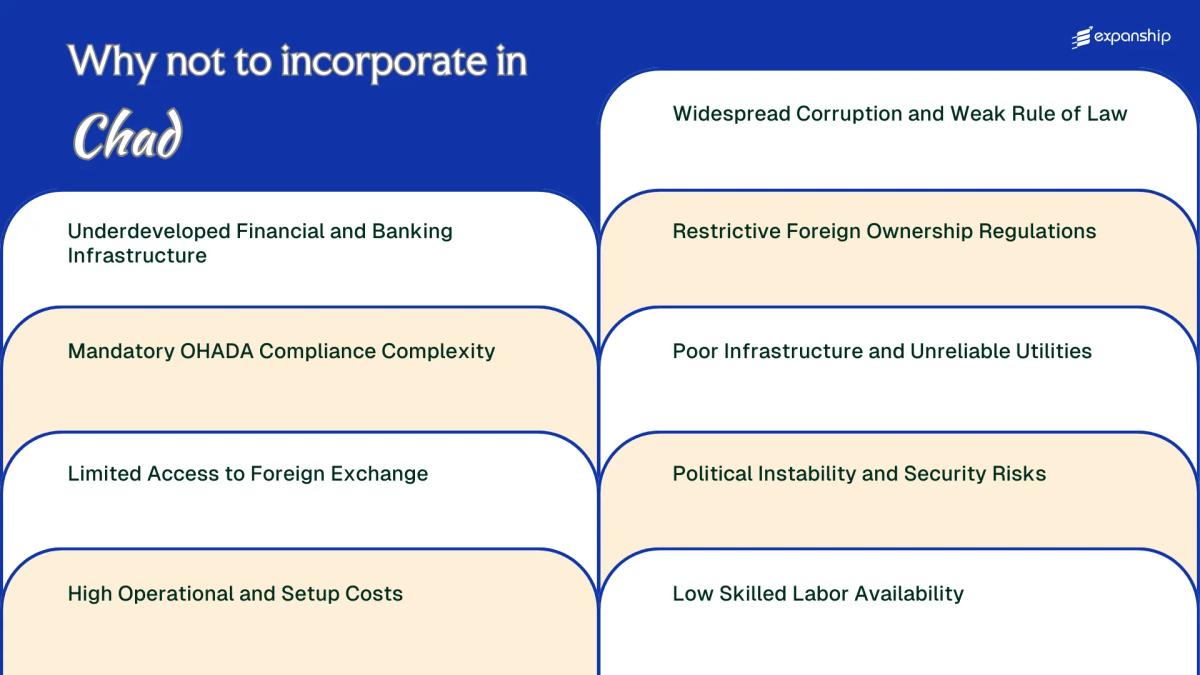
Underdeveloped Financial and Banking Infrastructure
Chad banking infrastructure problems present one of the most tangible operational barriers for foreign businesses attempting to establish a functional financial base in the country.
Limited Branch Networks and Banking Access
The banking sector in Chad remains underdeveloped, with a small number of commercial banks operating primarily in N'Djamena. Branches outside the capital are sparse, meaning your business cannot reliably access banking services in secondary cities or operational regions.
Account opening procedures are slow and document-heavy, often requiring extended timelines that delay the start of actual business operations. For a foreign-incorporated entity, this translates directly into delayed capital deployment and disrupted cash flow management.
Systemic Constraints on Business Banking
Financial sector limitations in Chad are compounded by low banking penetration rates across the general population, which restricts your access to a commercially banked supplier and customer base. Most transactions outside formal urban centers still rely on cash, creating reconciliation and audit compliance burdens under OHADA accounting standards.
Chad business banking challenges are further intensified by the limited availability of trade finance products and credit facilities from local institutions. This forces foreign firms to depend on offshore financing, which introduces currency exposure and cross-border transfer complications.
Your business may be unable to open an operational bank account within a standard pre-launch timeframe, directly threatening your ability to pay suppliers, process payroll, or receive client payments at incorporation.
Mandatory OHADA Compliance Complexity
OHADA compliance challenges in Chad stem from the country's membership in the Organisation pour l'Harmonisation en Afrique des Affaires, a 17-member regional bloc whose Uniform Acts govern corporate formation, accounting, and commercial law. While the framework standardizes commercial rules across member states, applying it through Chad's domestic institutions adds considerable friction for foreign operators.
Your firm must comply with the OHADA Uniform Act on Commercial Companies (AUDSCGIE), which sets out mandatory procedures for incorporation, shareholder meetings, and capital structures. Non-compliance can result in the nullity of corporate acts, meaning procedural errors carry legal consequences beyond fines.
The practical burdens this creates include:
- Retaining locally qualified legal counsel familiar with both OHADA Uniform Acts and Chadian court interpretation, since regional law does not apply uniformly in practice
- Filing and maintaining statutory registers in French, which adds translation costs for non-Francophone ownership structures
- Meeting OHADA's mandatory audit thresholds, which can trigger statutory audit requirements earlier than foreign owners anticipate
The CCJA, OHADA's common court of justice, sits in Abidjan, not N'Djamena. Pursuing legal remedies through that body requires cross-border legal coordination, raising dispute resolution costs significantly.

Company Incorporation in Chad
Understand the legal requirements and procedural steps involved in setting up a business entity in Chad under OHADA regulations.
Limited Access to Foreign Exchange
Foreign exchange restrictions in Chad present a direct operational burden for businesses that rely on cross-border payments, supplier contracts, or profit repatriation. The country is a member of the Central African Economic and Monetary Community (CEMAC), and the FCFA (XAF) is managed by the Bank of Central African States (BEAC). All foreign exchange transactions are subject to BEAC regulations, and prior authorization is required for many transfers above defined thresholds.
| Transaction Type | Restriction / Threshold | Implication for Your Business |
|---|---|---|
| Current account transfers above threshold | Prior BEAC authorization required | Delays routine supplier or service payments |
| Capital account outflows | Subject to regulatory approval | Profit repatriation can be blocked or deferred |
| Foreign currency holdings | Must be surrendered to authorized banks within prescribed periods | Limits your ability to hold working capital in hard currency |
| Dividend remittances abroad | Require documented proof of tax compliance | Tax clearance delays extend repatriation timelines |
FCFA repatriation limitations in Chad mean that even after-tax profits cannot be freely transferred without meeting documentary requirements set by the BEAC and the Direction Générale des Impôts. This process is rarely swift given the country's banking infrastructure constraints.
Authorization delays can stretch for weeks, and during that period your capital is effectively frozen. Firms operating in sectors designated as strategic may face additional scrutiny beyond standard CEMAC controls.
High Operational and Setup Costs
High business setup costs in Chad begin before your company formally opens. Registering a Société à Responsabilité Limitée (SARL) requires a minimum share capital deposit, notarization of founding documents, and registration fees paid to the Registre du Commerce et du Crédit Mobilier (RCCM), with each step carrying its own costs that compound quickly.
Importing essential business equipment attracts high customs duties administered under Chad's tariff schedule, aligned with the CEMAC common external tariff framework. This means capital expenditure for any firm dependent on foreign-sourced machinery or technology is substantially higher than in markets with preferential import regimes.
Generator fuel, private water supplies, and contracted security services are routine operating expenses for foreign firms. These are not optional costs in most areas, making the true monthly overhead of a foreign business significantly higher than headline statutory rates suggest.
- Notarial fees and RCCM registration charges are mandatory at incorporation and cannot be deferred.
- Share capital must be deposited before registration is completed, tying up capital from day one.
- Customs duties under the CEMAC tariff apply to imported equipment, increasing setup costs for capital-intensive businesses.
- Costs for private infrastructure such as power backup are operational requirements, not discretionary spending.
- Corporate tax obligations under Chad's General Tax Code begin from the date of legal incorporation, not from the date of first revenue.
Chad's cost of establishing basic office infrastructure can exceed the statutory incorporation fees several times over, making the non-regulatory costs the dominant expense for most foreign entrants.
Widespread Corruption and Weak Rule of Law
Corruption risks doing business in Chad are among the most consistently documented obstacles for foreign investors. Transparency International's Corruption Perceptions Index regularly ranks the country near the bottom globally, reflecting systemic issues that affect day-to-day business operations.
Institutional Corruption Across Public Agencies
Government agencies involved in company registration, licensing, and customs clearance are frequently cited in reports by the U.S. Department of State and the OECD as environments where unofficial payments are solicited to advance routine processes. Your business may face delays that are effectively resolved only through facilitation payments, creating legal exposure under anti-bribery statutes in your home jurisdiction, such as the U.S. Foreign Corrupt Practices Act or the UK Bribery Act 2010.
Judicial Unreliability and Contract Enforcement
Chad's judiciary lacks functional independence, and commercial disputes are subject to political interference. Even though the country operates under the OHADA treaty framework, which provides a regional legal structure for commercial matters, enforcement of arbitral awards and court judgments through domestic courts remains unreliable in practice.
Contractual protections that would be enforceable in other OHADA member states carry reduced practical weight here, leaving your firm with limited recourse if a local partner or state entity defaults.
Managing Compliance and Governance Risks for Your Business in Chad
Speak with our team about structuring your corporate presence in Chad with an awareness of the governance and regulatory challenges that affect foreign-owned entities.
Restrictive Foreign Ownership Regulations
Foreign ownership restrictions in Chad create direct structural barriers that limit how much control a foreign investor can legally hold across key sectors. These restrictions are not uniformly codified in a single investment law but operate through a combination of sector-specific regulations and state participation requirements.
- Sectors deemed strategic, including hydrocarbons and mining, require mandatory state participation through entities such as the Société des Hydrocarbures du Tchad (SHT), which reduces your effective equity stake regardless of capital contribution.
- Foreign equity ownership rules in Chad can require local partnership arrangements in certain regulated industries, forcing dependency on local partners whose legal recourse options may be limited under existing frameworks.
- The Investment Charter (Law No. 009/PR/2008) governs foreign investment but leaves significant discretionary authority with government ministries, exposing your entity to inconsistent application of ownership thresholds.
- Chad equity ownership rules for foreigners in the petroleum sector are subject to renegotiation by the state, as demonstrated historically with production-sharing contract revisions, creating unpredictable ownership conditions for long-term investors.
- Foreign companies in Chad operating outside designated investment zones receive no automatic protection against ownership dilution through subsequent regulatory changes.
Poor Infrastructure and Unreliable Utilities
Poor infrastructure challenges in Chad create tangible operational costs that foreign businesses rarely anticipate at the incorporation stage. The country's power grid is fragile, with STEE (Société Tchadienne d'Eau et d'Electricité) historically unable to supply consistent electricity to commercial users in N'Djamena, let alone in secondary cities.
Outages are frequent enough that most mid-sized operations rely on private diesel generators, adding fuel procurement and maintenance costs to an already expensive operating environment. Supply chains compound this further — road networks outside the capital are largely unpaved, making logistics between regions slow and unpredictable.
Internet connectivity is limited in bandwidth and reliability, which affects financial reporting, communications with foreign partners, and compliance filings under OHADA's digital systems. Your firm's ability to maintain continuity of operations is directly constrained by infrastructure that sits outside your control.
- Diesel generator dependency adds recurring capital expenditure
- Road freight times are inconsistent, disrupting supply chain planning
- Telecommunications gaps delay mandatory regulatory reporting
A foreign-owned trading firm in N'Djamena operating a 50kVA backup generator can expect to spend upward of $1,500–$2,500 monthly on diesel fuel alone, purely to compensate for grid unreliability — a fixed cost with no equivalent in most regional peers such as Senegal or Côte d'Ivoire.
Political Instability and Security Risks
Political instability risks in Chad are not a theoretical concern — they are an operational reality that directly affects whether your business can function day-to-day. The country has experienced repeated coups, armed insurgencies, and inter-communal violence since independence, with the military transitional government that took power in 2021 only recently beginning a nominally civilian transition process.
Conflict zones are not confined to border regions. Active security threats from armed groups, including factions connected to broader Sahel instability, extend into areas where extractive and commercial operations are present.
Foreign firms face concrete consequences:
- Force majeure clauses are frequently triggered, yet local courts lack the consistency to adjudicate resulting contract disputes reliably.
- Security infrastructure costs — private guards, armored logistics, emergency protocols — add substantially to operational overhead.
- Repatriation of personnel and assets during escalations requires contingency planning that most jurisdictions do not demand at this level.
Travel advisories from the governments of France, the United States, and the European Union maintain elevated risk ratings for the country, which directly affects your firm's ability to secure corporate insurance at standard rates.
Even businesses operating in N'Djamena are not insulated from political risk; government policy can shift abruptly under military-influenced governance, creating regulatory exposure with no reliable administrative or judicial recourse.
Low Skilled Labor Availability
Skilled labor shortages in Chad present a direct operational constraint for foreign businesses, particularly those requiring technical, managerial, or specialized roles. Adult literacy rates remain among the lowest in sub-Saharan Africa, limiting the pool of candidates who can perform functions beyond basic manual work.
Tertiary enrollment is thin. Your firm may be unable to source qualified local accountants, engineers, or compliance officers without importing expatriate staff, which triggers work permit requirements under Chadian labor law and increases payroll costs substantially.
The Labour Code (Loi No. 038/PR/96) imposes local hiring quotas, meaning your staffing options are structurally constrained before recruitment even begins. Reliance on expatriates to fill skill gaps is permitted but subject to Ministry of Civil Service authorization, adding procedural delay.
Chad workforce limitations for companies extend to vocational training infrastructure, which remains underfunded at a systemic level, so organic improvement in available local talent is slow.
Overcoming Chad's Business Barriers
Overcoming business barriers in Chad requires structural preparation before incorporation, not reactive adjustments after problems emerge. The jurisdiction's overlapping legal, financial, and operational constraints demand a coordinated approach from the outset.
- Register your entity under the correct OHADA-compliant legal form through the RCCM to avoid post-incorporation structural corrections.
- Open a dedicated corporate account with a bank operating under BEAC oversight to manage foreign exchange restrictions within the formal monetary system.
- Obtain all sector-specific licenses through the Guichet Unique before commencing operations to satisfy Chad's multi-agency approval requirements.
- Structure your foreign ownership arrangements to comply with sector-specific caps under Chadian investment law before filing incorporation documents.
- Establish generator-backed power contingencies and independent logistics arrangements to account for unreliable public utility infrastructure.
- Conduct a security risk assessment aligned with current travel advisories and MINURCAT-era regional protocols before deploying personnel or capital.
These steps address the specific regulatory and operational constraints that Chad's incorporation framework imposes. Mitigating Chad incorporation risks remains an ongoing obligation, not a one-time process, given the country's fluid political and regulatory environment.
Chad's Investment Potential Weighed
:::
Chad's disadvantages are real and, for many business profiles, disqualifying. High setup costs, limited foreign exchange access, weak banking infrastructure, and persistent instability create a demanding operating environment. That said, the country's oil sector, underdeveloped consumer market, and regional position within the CEMAC zone do represent concrete commercial reasons for selective investor interest.
| Pros | Cons |
|---|---|
| Oil sector and extractive industries offer documented revenue potential for qualifying foreign firms | Foreign exchange access is restricted, making profit repatriation difficult and unpredictable |
| OHADA membership provides a standardised legal framework shared across 17 African states | OHADA compliance adds procedural complexity, including mandatory notarisation and capital requirements |
| CEMAC regional integration expands the addressable market beyond Chad's domestic economy | Corruption and weak rule of law increase the cost and uncertainty of doing business |
| Underpenetrated consumer market presents early-mover positioning in specific sectors | Poor infrastructure and unreliable utilities raise operational costs significantly |
| Government investment codes offer stated protections for registered foreign entities | Political instability and security risks remain active concerns with direct operational implications |
Skilled labour availability is thin domestically, and sourcing qualified personnel typically requires either investment in training or reliance on expatriate staff, both of which carry added cost.
Compliance Services for Companies in Chad
Maintaining good standing for a registered entity in Chad involves ongoing OHADA obligations, tax filings with the Direction Générale des Impôts, and adherence to COBAC-regulated banking requirements. This service covers the compliance functions your Chad-registered business must meet to remain operational and legally recognised.
Conclusion
Chad company incorporation drawbacks are well-documented across financial, legal, and operational dimensions, and the cumulative weight of those factors defines the firm's experience on the ground. Foreign exchange restrictions under Banque des États de l'Afrique Centrale policies, the depth of corruption embedded in public administration, and chronic infrastructure deficits collectively shape a difficult operating environment. Structural conditions of this kind do not resolve quickly. Your ability to manage them depends heavily on local expertise, regulatory familiarity, and established relationships with authorities who oversee OHADA compliance and sector-specific licensing.
Expanship's Chad Expansion Support
Incorporating in Chad means contending with the full weight of OHADA compliance obligations, limited banking access, foreign exchange restrictions, and an operating environment shaped by political volatility and infrastructure deficits. Expanship's Chad business expansion support services are designed to reduce the administrative and procedural burden these conditions place on your business, from structuring your entity correctly under OHADA rules to coordinating with local authorities and financial institutions on your behalf.
Our team handles the full scope of what establishment requires in this jurisdiction:
- We prepare and submit all company registration documents to the relevant Chadian authorities.
- A registered agent and local office address are provided to satisfy residency requirements.
- We manage government filings and liaise directly with regulatory bodies on your behalf.
- Post-incorporation compliance obligations are monitored and maintained on an ongoing basis.
- Banking introduction support connects your business with viable local financial institutions.
- Tax registration and coordination with local fiscal authorities are handled end to end.
Reach out to Expanship Chad to discuss your incorporation requirements.
Frequently Asked Questions (FAQ)
OHADA law applies to all commercial entities incorporated in Chad, regardless of size or foreign ownership percentage. The Uniform Act on Commercial Companies governs formation, governance, and dissolution requirements for structures such as the SARL and SA, meaning every registered firm must meet its standards. Non-compliance can result in the nullification of corporate acts or personal liability for directors.
Failures under OHADA's Uniform Act can expose directors to civil liability and, in some cases, criminal sanctions under Chadian commercial law. Courts within the OHADA zone can void resolutions or transactions that were adopted in breach of procedural rules, which creates material legal risk for foreign directors who are not closely supervising local management. The enforcement environment in Chad adds unpredictability to how and when these penalties are applied.
Chad operates under the CEMAC foreign exchange regulations administered by the Banque des États de l'Afrique Centrale, which restrict capital transfers outside the zone without prior central bank authorization. While this framework applies across all six CEMAC states, Chad's limited banking infrastructure means approvals take longer and documentation requirements are harder to satisfy in practice. Compared to Gabon or Cameroon, Chad has fewer operational banks to process cross-border transactions efficiently.
Political instability in Chad directly disrupts operations through curfews, border closures, and sudden regulatory changes that accompany periods of military governance. Since the April 2021 death of President Idriss Déby and the subsequent transitional military council, the business environment has seen abrupt policy shifts. Supply chains, staff movement, and contract enforcement have all been affected during periods of internal security deterioration.
Full foreign ownership is technically permitted in most sectors under Chadian investment law, but the Investment Charter contains sector-specific restrictions and local content expectations that can limit effective control. In practice, regulatory approvals, licensing, and operational permits are easier to obtain when a local partner is involved, which creates indirect pressure to dilute foreign ownership. Any firm operating in the oil sector faces additional constraints under agreements with the Ministry of Petroleum and Energy.
If BEAC authorization for a capital transfer is denied or delayed, profits remain trapped within the Chadian banking system with no guaranteed timeline for release. The limited number of correspondent banking relationships available through Chadian banks compounds this problem, as international wire transfers can fail at the intermediary bank level entirely. There is no automatic dispute mechanism that compels BEAC to approve repatriation within a set period.
Both contribute, but operational costs outside the tax system are often the larger burden. Unreliable electricity forces most businesses to invest in private generators, and poor road infrastructure raises logistics costs significantly beyond what formal import duties alone would impose. The tax burden under Chad's General Tax Code is also above the regional average, but it is the compounding effect of both formal and informal costs that makes initial setup disproportionately expensive.
Legal Disclaimer
The information provided in this article is for general informational purposes only and does not constitute legal, tax, or professional advice. While we strive to ensure the accuracy and timeliness of the content, laws and regulations are subject to change, and the application of laws can vary widely based on specific facts and circumstances.
Readers should not act upon this information without seeking professional counsel tailored to their individual situation. Expanship and its authors disclaim any liability for actions taken or not taken based on the content of this article.
For specific advice regarding your business setup, compliance requirements, or any legal matters, please consult with qualified legal and tax professionals in the relevant jurisdiction.