

Key Takeaways
- All companies registering in Serbia must submit formation documents through the Serbian Business Registers Agency (APR), which holds exclusive administrative authority over entity registration under the Companies Act (Zakon o privrednim društvima).
- A d.o.o. can be incorporated with a minimum share capital of just RSD 100, though this nominal threshold must still be formally declared and recorded at the point of registration.
- Beneficial ownership disclosure is a mandatory compliance obligation for Serbian companies, required under anti-money laundering regulations and enforced through the APR's UBO register.
- Foreign investors establishing a Serbian d.o.o. must maintain a local registered office address throughout the life of the company, as this forms a core legal requirement for maintaining valid registration status.
Incorporation requirements in Serbia are governed by the Companies Act (Zakon o privrednim društvima), with entity registration administered by the Serbian Business Registers Agency (Agencija za privredne registre, or APR). APR serves as the central authority for all formal registration procedures, from document submission to the issuance of a registration decision.
This article covers the principal formation requirements applicable to businesses establishing a legal presence under Serbian law.
Failure to satisfy these requirements results in rejection of the registration application by APR, or where partial non-compliance occurs post-incorporation, potential suspension of business activities or regulatory penalties. Specific requirements can differ based on entity type, the industry sector, or whether the investor is a foreign national or legal entity.
Foreign investors establishing a d.o.o. (društvo sa ograničenom odgovornošću), the most common private limited liability structure, will find this article directly relevant to understanding what Serbian company registration requirements apply before and during the formation process.
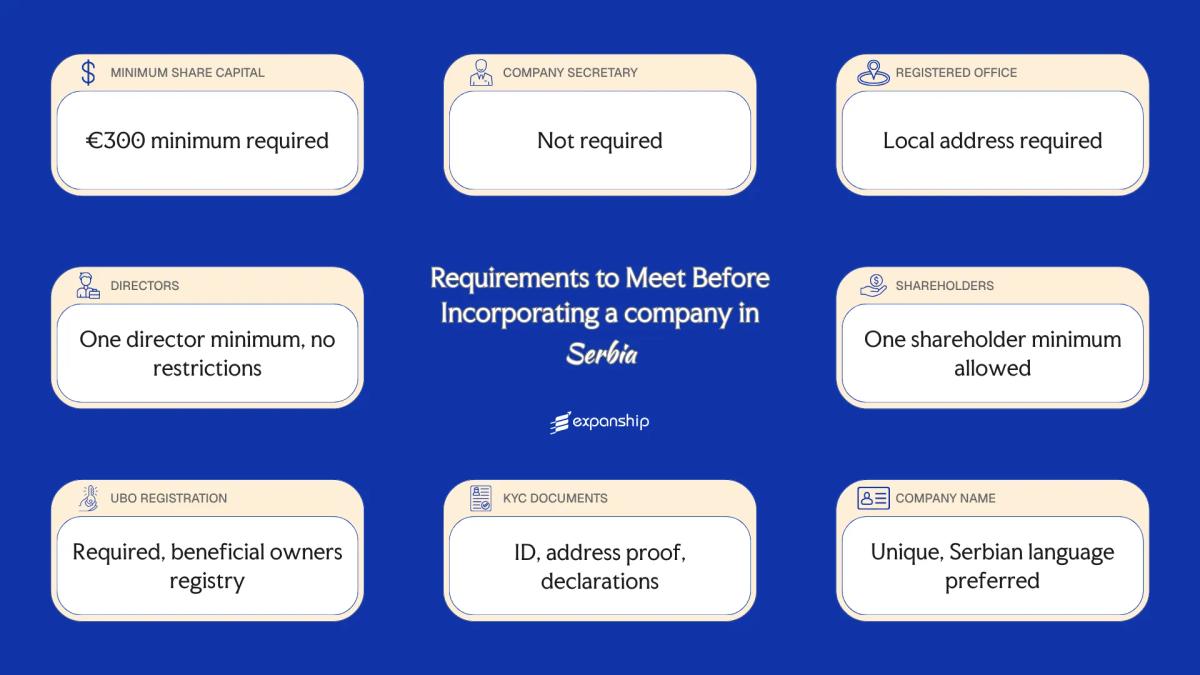
Minimum Share Capital Requirements in Serbia

Serbia minimum share capital requirements vary by legal form. For a private limited liability company (Društvo sa ograničenom odgovornošću, or d.o.o.), the Law on Companies sets a statutory minimum of RSD 100 (approximately EUR 1), making capital an accessible threshold rather than a substantive barrier. The Serbian Business Registers Agency (APR) oversees registration and verifies that capital obligations are met at the point of incorporation.
Share capital in a d.o.o. operates on a par value system, meaning each share carries a nominal value. Once registered, the minimum capital requirement functions as a one-time incorporation condition rather than an ongoing statutory obligation, though the APR retains authority to flag discrepancies in filed documentation.
| Parameter | Detail |
|---|---|
| Minimum Authorized Share Capital | RSD 100 (approximately EUR 1) |
| Maximum Authorized Share Capital | No statutory requirement |
| Minimum Paid-Up Capital | RSD 100 |
| Paid-Up Requirement at Incorporation | Full payment required at the time of registration |
| Accepted Currency | Serbian Dinar (RSD); foreign currency contributions permissible subject to valuation |
| Accepted Forms of Contribution | Cash and non-cash contributions (property, rights subject to appraisal) |
| Timeframe to Deposit Capital | Prior to or at the point of filing with the APR |
The RSD 100 minimum must be deposited before the registration application is submitted to the APR. Filing without confirmed capital deposit can result in rejection of the incorporation application.
Company Secretary Requirements in Serbia
Serbian company law does not impose a mandatory company secretary requirement for a d.o.o. (društvo s ograničenom odgovornošću). Serbia company secretary requirements, as commonly understood in common law jurisdictions, have no direct equivalent under the Companies Act framework administered by the Serbian Business Registers Agency (APR).
Certain corporate governance functions — such as maintaining statutory records, coordinating with the APR, and ensuring timely submission of annual financial statements — are handled internally or delegated to a legal representative. Your business must designate at least one statutory representative, who assumes responsibility for these obligations under the Law on Business Companies.
Qualification criteria for those serving in a statutory representative or equivalent governance capacity:
- No mandatory professional license is required to serve as a statutory representative.
- Both natural persons and legal entities may hold this role, subject to APR registration.
- Foreign nationals are eligible without a Serbian residency requirement.
- Individuals under legal incapacity or those subject to a court-imposed prohibition on conducting business are disqualified.

Incorporate a Company in Serbia
Set up your d.o.o. in Serbia with accurate APR filings, statutory documentation, and ongoing compliance support.
Registered Office Requirements in Serbia
Serbia registered office requirements are governed by the Law on Business Companies, which mandates that every registered entity maintain a designated legal seat on Serbian territory at all times. Failure to maintain a compliant address can result in the Serbian Business Registers Agency (APR) initiating proceedings to strike the company from the register.
- A physical address in Serbia is required; a P.O. box does not satisfy the legal seat obligation.
- Virtual office addresses are permissible provided the service provider can demonstrate that correspondence is received and accessible at that location.
- The address must be located within Serbia; foreign addresses are not accepted by the APR.
- Supporting documentation, such as a lease agreement or proof of ownership, must be submitted to confirm the entity's right to use the premises.
- The registered address is publicly listed in the APR's register and is accessible to third parties.
- Any change of registered address must be formally notified to the APR by filing an amendment to the registration data, after which the updated address takes effect upon entry in the register.
Director Requirements in Serbia

Under Serbian company law, directors of a društvo sa ograničenom odgovornošću (d.o.o.) assume full statutory responsibility for the entity's legal compliance, financial reporting, and operational decisions from the date of their appointment. Serbia director requirements incorporation rules are governed primarily by the Companies Act (Zakon o privrednim društvima), which sets out the duties of care, loyalty, and confidentiality that each director owes to the company.
| Parameter | Detail |
|---|---|
| Minimum Number of Directors | One director is required. |
| Maximum Number of Directors | No statutory maximum is prescribed for a d.o.o. |
| Local/Resident Director Required | No residency requirement exists under the Companies Act. |
| Nationality Restrictions | No nationality restrictions apply; foreign nationals may serve as directors. |
| Minimum Age Requirement | Directors must be at least 18 years of age. |
| Corporate Directors Permitted | Corporate directors are not permitted; only natural persons may be appointed. |
| Director Must Be a Shareholder | No requirement for a director to hold shares in the company. |
| Publicly Listed on Registry | Directors are registered with the Serbian Business Registers Agency (APR) and are publicly visible. |
| Disqualification Conditions | A person subject to a court-imposed ban on performing director duties, or convicted of certain criminal offences, is disqualified from appointment. |
Despite no residency requirement, a director's identity and appointment are fully public record through the APR, meaning foreign directors are just as visible on the Serbian registry as local ones.
Shareholder Requirements in Serbia
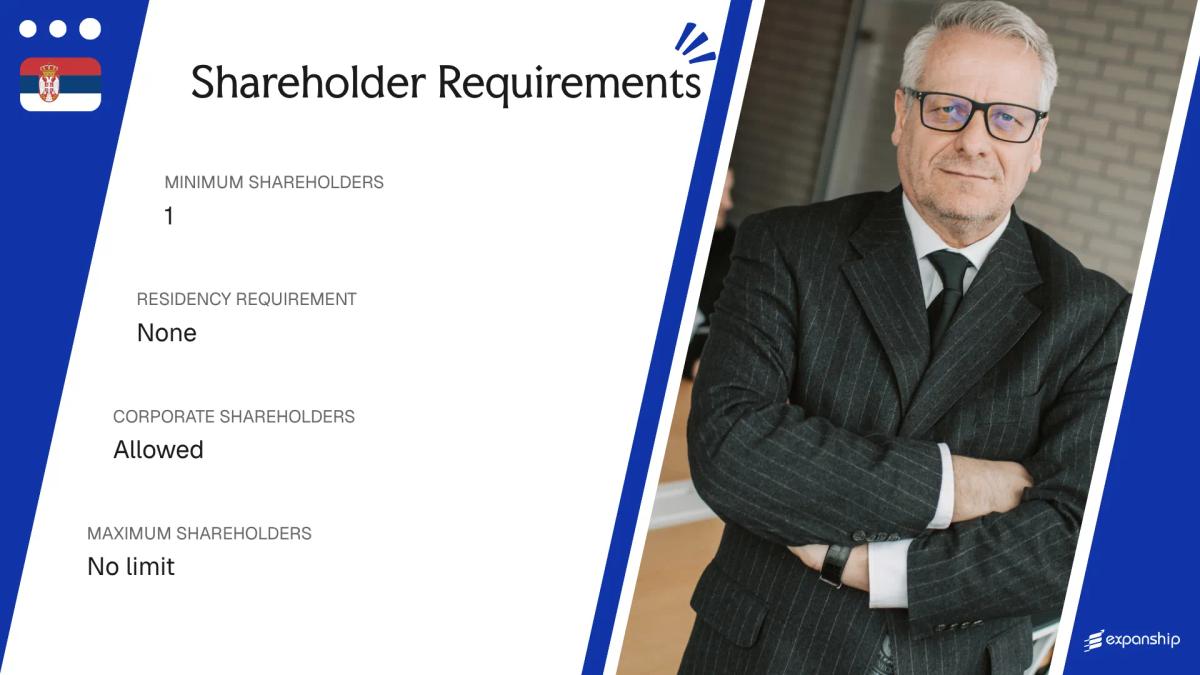
A Serbian d.o.o. (društvo s ograničenom odgovornošću) requires at least one shareholder, with no statutory maximum. A single individual or entity can hold 100% of the ownership interest, making the sole shareholder structure fully permissible under the Companies Act (Zakon o privrednim društvima).
Nationality and Residency Restrictions
No nationality or residency requirements apply to shareholders under Serbian company law. Foreign nationals and non-residents may hold full ownership of a d.o.o. without restriction on the percentage of equity held.
Corporate Shareholders
Legal entities, including foreign corporations, may act as shareholders in a Serbian d.o.o. No special conditions are imposed on corporate ownership beyond standard KYC and documentation requirements applied during registration.
Shareholder Liability
Shareholder liability is limited to the amount of each member's capital contribution. Under certain circumstances defined in the Companies Act, such as misuse of the legal form, courts may pierce the corporate veil and extend liability to individual shareholders.
Register of Shareholders
A d.o.o. must maintain an internal register of members, recording ownership interests and any transfers. This register is filed with the Serbian Business Registers Agency (Agencija za privredne registre) and is publicly accessible through the agency's online database.
Guidance on Shareholder Structuring for Your Serbia Incorporation
Get expert advice on meeting shareholder eligibility and ownership structure requirements when setting up a company in Serbia.
UBO / Beneficial Ownership Registration Requirements in Serbia
Serbia beneficial ownership registration requirements are governed by the Law on the Central Register of Beneficial Owners (Official Gazette RS, No. 41/2018), which defines a beneficial owner as any natural person who ultimately owns or controls an entity, directly or indirectly, through a shareholding or voting rights threshold.
- Identify all natural persons who meet the UBO threshold and collect the required personal data before registration.
- Submit UBO data to the Serbian Business Registers Agency (APR) at the point of incorporation.
- Report any subsequent changes to the registered UBO data within 15 days of the change occurring.
- Retain internal documentation supporting the UBO determination as required under AML obligations.
| Parameter | Detail |
|---|---|
| Ownership Threshold for UBO Status | 25% of shares, voting rights, or other ownership interest |
| Filing Authority | Serbian Business Registers Agency (APR) |
| Disclosure Deadline at Incorporation | At the time of registration |
| Publicly Accessible Register | Yes, the Central Register of Beneficial Owners is publicly accessible |
| Penalties for Non-Disclosure | Fines applicable under the Law on the Central Register of Beneficial Owners |
| Ongoing Update Obligation | Within 15 days of any change |
KYC / Document Requirements in Serbia
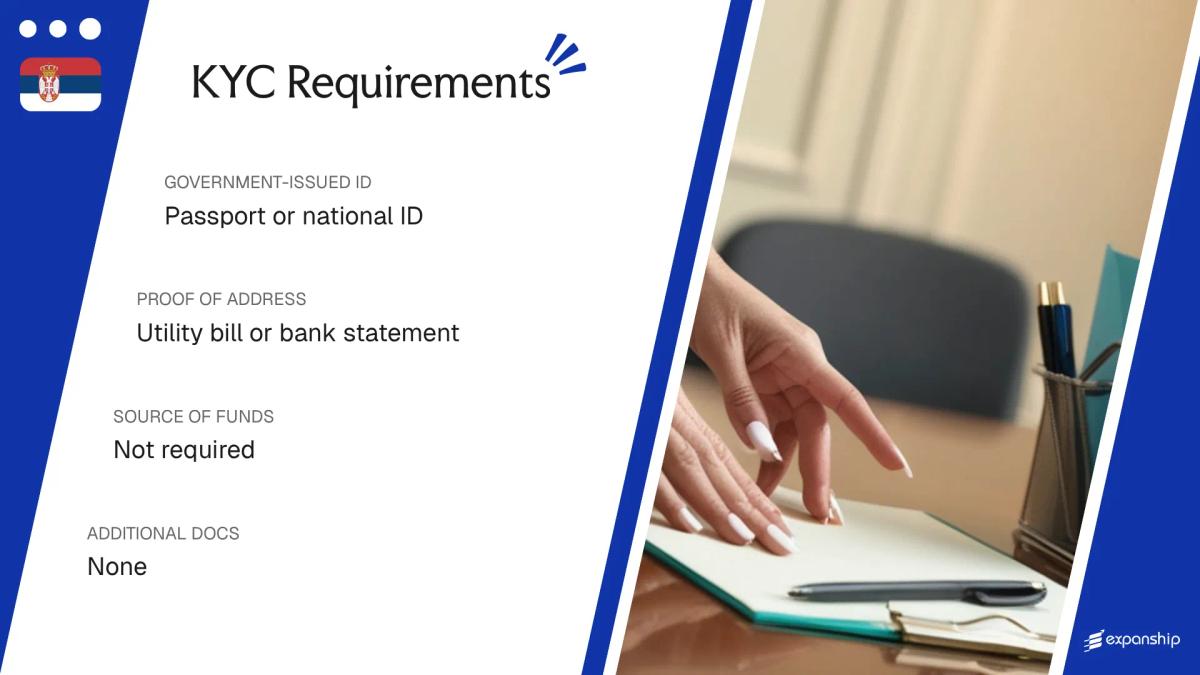
Serbia KYC document requirements for incorporation are governed by the Law on Prevention of Money Laundering and Terrorist Financing, administered by the Administration for the Prevention of Money Laundering, which sets the due diligence framework that registered agents and notaries must apply before an entity can be formally established.
Individual / Personal Documents
- Valid government-issued photo ID (passport or national identity card) for each director, shareholder, and beneficial owner
- Proof of residential address dated within three months, such as a utility bill or bank statement
- Personal tax identification number where the individual holds one in their country of residence
- Completed KYC declaration form confirming the individual's role and ownership percentage
Corporate Documents
- Certificate of incorporation or equivalent formation document for the corporate shareholder or director
- Articles of association or equivalent constitutional document
- Current register of directors and shareholders from the home jurisdiction
- Proof of the corporate entity's registered address
Source of Funds Documentation
- Recent bank statements (typically covering the last three to six months) evidencing available capital
- Audited financial statements where the shareholder is a corporate entity
- Written declaration of the origin of funds if bank documentation is insufficient
Notarisation and Apostille Requirements
- Foreign public documents must carry an Apostille under the Hague Convention before submission to the Serbian Business Registers Agency
- Documents issued in languages other than Serbian require a certified translation by a court-certified translator in Serbia
- Notarisation by a Serbian or foreign notary public may be required for executed signature pages
Apostille missing from foreign-issued corporate documents is the most frequent cause of registration rejection at the Serbian Business Registers Agency.
Company Name Requirements in Serbia
All proposed names for a Serbian d.o.o. or other legal form are reviewed for uniqueness and compliance before registration is confirmed. A name that is identical or confusingly similar to an existing registered entity will be refused.
The business name must be written in the Serbian language using Cyrillic script, though a Latin transliteration may also be registered alongside it. The legal form suffix — such as "d.o.o." for a limited liability company — is mandatory and must appear in the name.
Certain words are prohibited outright or require prior approval from a competent authority. Terms implying a state connection, references to regulated professions, or words associated with international organizations fall into the restricted category.
Name reservation is available through the Serbian Business Registers Agency (APR) prior to formal incorporation. The reservation holds the name for a fixed period, during which no other applicant may register it.
Compliance Services for Companies in Serbia
Ongoing compliance support for Serbian entities, covering statutory filings, regulatory obligations, and annual reporting requirements with the APR.
Conclusion
Serbia company incorporation requirements span several distinct areas governed primarily by the Law on Business Companies and administered through the Serbian Business Registers Agency (SBRA). Registration of a d.o.o. involves minimum share capital of RSD 100, a local registered office address, and mandatory UBO disclosure under anti-money laundering regulations. Once these requirements are understood, foreign investors move into the operational phase, which involves tax registration, opening a corporate bank account, and establishing ongoing compliance obligations with Serbian authorities.
Expanship's Corporate Services for Serbia Expansion
Engaging Expanship for Serbia company formation services means working with a team already familiar with the Agency for Business Registers (APR), Serbia's central body for entity registration and UBO disclosure. From preparing your foundation deed to coordinating registered office requirements and post-incorporation filings, Expanship handles the administrative layers that typically slow down foreign investors entering this market.
Beyond incorporation, our Serbia corporate expansion services cover a defined set of tasks:
- We prepare all registration documentation and submit your company to the APR on your behalf.
- A registered office and resident agent are provided to satisfy Serbia's local address requirements.
- Our team liaises directly with government bodies and regulatory authorities throughout the filing process.
- Post-incorporation compliance, including annual reporting obligations, is managed on an ongoing basis.
- We facilitate introductions to local banking institutions to support account opening.
- Tax registration and coordination with the Tax Administration of Serbia (PU) are handled as part of your setup.
To discuss your requirements, contact Expanship Serbia.
Frequently Asked Questions (FAQ)
A foreign national can serve as the sole director of a Serbian d.o.o. without any residency requirement. Serbian company law does not restrict directorial appointments based on nationality or domicile. That said, the appointed director must obtain a Personal Identification Number (PIB equivalent for individuals) from the Tax Administration if they will act as a legal representative.
Failure to register beneficial ownership data under Serbia's Anti-Money Laundering Law (Zakon o sprečavanju pranja novca) can result in misdemeanor liability for both the company and its responsible person. The Central Register of Beneficial Owners, administered by the SBRA, requires registration within 15 days of incorporation or any change in ownership structure. Non-compliance exposes the entity to fines and potential operational restrictions.
The SBRA does not operate a standalone pre-reservation system in the way some other jurisdictions do. Your chosen name is checked and confirmed as part of the registration application itself, meaning it is secured only once the registration is approved. Conducting a name search on the SBRA's publicly available database before submitting your application reduces the risk of rejection on name-conflict grounds.
A residential address can be used as the registered office for a Serbian d.o.o., provided the company has a legal basis to use that address, such as a lease agreement or owner's consent. The address must be a valid, locatable address within Serbia and is publicly listed in the SBRA register. Using a non-existent or unverifiable address is grounds for registration refusal.
Foreign individual shareholders must provide a certified copy of a valid passport and proof of address. Foreign corporate shareholders are required to submit an apostilled or legalized excerpt from their home jurisdiction's company register, along with a document confirming the identity of their own authorized representative. All foreign-language documents must be accompanied by a certified Serbian translation prepared by a court-certified translator.
The SBRA will reject the registration application outright if the proposed name conflicts with an existing registered entity, violates restrictions under the Companies Act (Zakon o privrednim društvima), or contains prohibited terms. There is no financial penalty for a failed name submission, but the application is returned and must be resubmitted with a compliant name, causing delays in the registration timeline. Certain terms referencing state institutions or regulated industries require prior approval from the relevant authority before the SBRA will accept them.
Legal Disclaimer
The information provided in this article is for general informational purposes only and does not constitute legal, tax, or professional advice. While we strive to ensure the accuracy and timeliness of the content, laws and regulations are subject to change, and the application of laws can vary widely based on specific facts and circumstances.
Readers should not act upon this information without seeking professional counsel tailored to their individual situation. Expanship and its authors disclaim any liability for actions taken or not taken based on the content of this article.
For specific advice regarding your business setup, compliance requirements, or any legal matters, please consult with qualified legal and tax professionals in the relevant jurisdiction.