
Key Takeaways
- Cabo Verde's restricted double taxation treaty network limits foreign investors' ability to efficiently repatriate profits or structure cross-border operations without exposure to withholding taxes in multiple jurisdictions.
- Companies incorporated under Cabo Verde's Commercial Code face mandatory minimum share capital requirements that can constrain early-stage foreign enterprises with limited initial funding.
- The Centro Nacional de Desenvolvimento Empresarial (CNDE) and Casa do Cidadão, despite serving as centralized registration points, are subject to bureaucratic delays that extend incorporation timelines beyond what comparable small-island jurisdictions require.
- Persistent weaknesses in Cabo Verde's intellectual property enforcement framework create measurable legal risk for businesses whose core assets are proprietary processes, trademarks, or digital content.
Cabo Verde operates under an evolving regulatory framework, shaped in part by its Commercial Code and the oversight of bodies such as the Centro Nacional de Desenvolvimento Empresarial (CNDE). The primary keyword — disadvantages of incorporating in Cabo Verde — covers a specific set of structural, financial, and administrative challenges that this article examines across multiple dimensions.
Not every obstacle applies equally to all business types. A service-based consultancy faces a different risk profile than a manufacturing or import-dependent firm registered under the same legal regime.
This article is most relevant to foreign investors and internationally mobile entrepreneurs considering a presence in the archipelago, particularly those weighing it against other small-island or lusophone jurisdictions. The governing commercial legislation is publicly accessible via the lei comercial on the official Cabo Verde legal gazette. Understanding the full scope of cons of registering a company in Cabo Verde requires examining each category of disadvantage on its own terms, as the risks of setting up a company in Cabo Verde are rarely uniform across sectors.
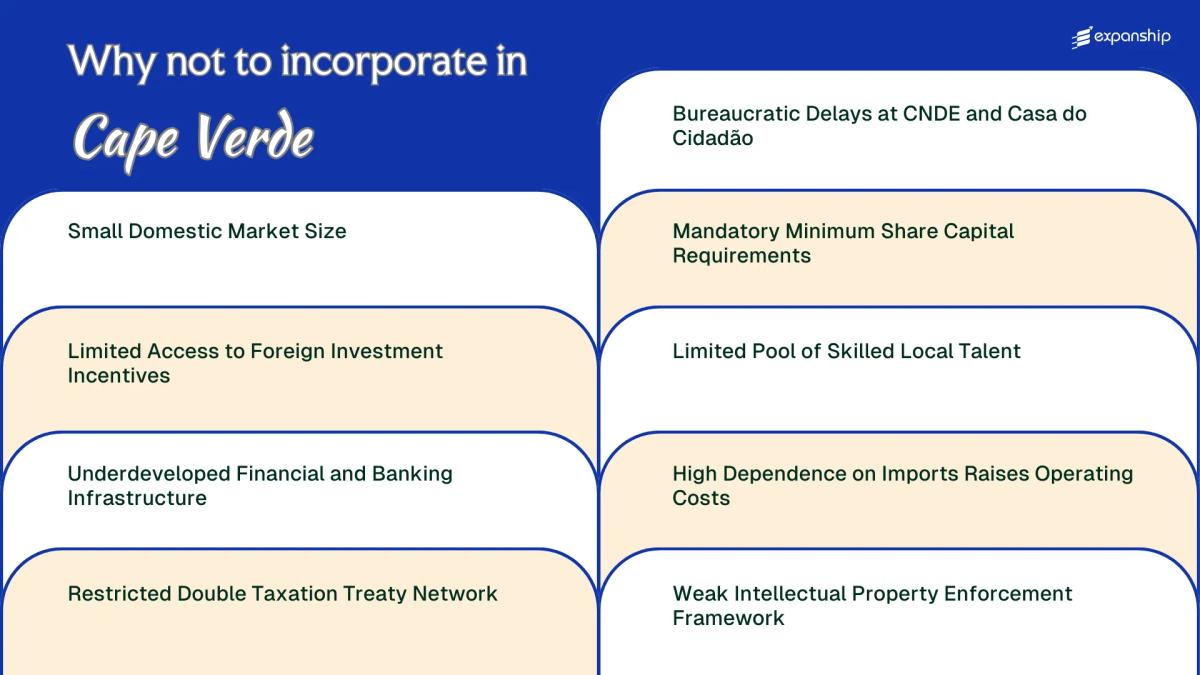
Small Domestic Market Size
Cabo Verde's small market size limitations present a fundamental structural challenge for any foreign business planning to generate revenue domestically. With a population of approximately 560,000 spread across nine inhabited islands, the consumer base is narrow by any measure.
A Consumer Base Too Small to Sustain Scale
Cabo Verde's GDP sits at roughly $2.2 billion USD, placing it among the smaller economies in West Africa. For a foreign firm expecting to recoup incorporation and operational costs through local sales, this ceiling is reached quickly across most product and service categories.
Retail, professional services, and consumer goods sectors face the sharpest constraints, since household purchasing power remains modest and concentrated in urban centers like Praia and Mindelo. Your addressable market is structurally limited before you have signed a single contract.
Export Dependency as the Only Viable Revenue Path
Businesses that cannot pivot to export-oriented models or serve the tourism sector directly tend to face chronic underperformance. Tourism accounts for a disproportionate share of economic activity, meaning domestic demand outside that sector is thin.
This dependency forces your business model to align with seasonal fluctuations and external demand patterns beyond your control.
A company incorporated here primarily to serve local consumers will encounter a limited consumer base in Cabo Verde that cannot absorb the fixed costs typical of a foreign-owned operation.
Limited Access to Foreign Investment Incentives
Cabo Verde foreign investment incentive restrictions affect foreign-owned companies more directly than locally controlled entities. Under the legal framework administered by CNDE (Centro Nacional de Desenvolvimento Empresarial), certain incentive programs are structured to favor businesses with substantial local ownership or those operating in designated sectors such as tourism and renewable energy, leaving general commercial entities with limited access.
Your firm may qualify for tax reductions on paper, yet the eligibility conditions often exclude standard holding structures or trading companies incorporated by non-resident investors.
The practical burdens this creates include:
- Fiscal incentives tied to job creation thresholds that most small foreign-owned entities cannot meet without disproportionate staffing costs
- Sector-specific benefits under the Investment Code that require local partnership arrangements, adding legal complexity and ownership dilution
- Import duty exemptions available only to pre-approved investment projects, requiring advance authorization that delays operational setup
Foreign investors operating outside approved priority sectors receive no preferential treatment under the current framework. That means your business absorbs standard corporate tax rates and import duties without the offsets available to qualifying domestic or joint-venture structures.

Company Incorporation in Cabo Verde
Set up your business entity in Cabo Verde with accurate guidance on eligibility, structure, and regulatory requirements from the outset.
Underdeveloped Financial and Banking Infrastructure
Cabo Verde banking infrastructure problems are a consistent friction point for foreign businesses seeking to establish and operate a corporate entity in the archipelago. The financial sector is small, concentrated, and heavily dependent on a handful of state-influenced commercial banks, which limits your ability to access competitive financial products.
Banco Comercial do Atlântico (BCA) and Caixa Económica de Cabo Verde dominate retail and commercial banking, with limited competition driving slower service standards and constrained product offerings. For a foreign-owned company, opening a corporate account can take several weeks, and documentation requirements frequently extend beyond what comparable offshore or emerging-market jurisdictions demand.
| Banking Constraint | Practical Impact on Foreign Business |
|---|---|
| Limited number of licensed commercial banks | Restricted choice; no meaningful competition on pricing or service terms |
| Prolonged corporate account opening timeline | Delays operational setup by weeks, deferring revenue activity |
| Scarce trade finance and credit facilities | Foreign firms typically cannot access local lending without collateral held in-country |
| Minimal international correspondent banking relationships | Cross-border transfers face additional routing costs and delays |
Credit access for incorporated businesses without a local asset base is particularly restricted. International correspondent banking relationships are limited, meaning cross-border transactions can incur additional routing fees and extended settlement periods.
The Banco de Cabo Verde, as the central regulatory authority, has modernised certain oversight standards, but the pace of banking sector development has not kept up with the compliance expectations of foreign investors used to EU or Lusophone hub alternatives.
Restricted Double Taxation Treaty Network
Cabo Verde double taxation treaty limitations pose a direct structural cost to foreign businesses that depend on cross-border income flows. The country's treaty network is narrow, covering a small number of partners, primarily Portugal, and leaves most trading relationships without bilateral protection against double taxation.
Without a treaty in force between Cabo Verde and your home country, income earned through the local entity may be taxed in full in both jurisdictions. That exposure falls entirely on you, with no statutory mechanism for relief unless domestic legislation provides a unilateral credit, which is subject to conditions and does not replicate treaty-level protections. The tax authority administering the IRPC (corporate income tax) operates within the Direcção Nacional das Receitas do Estado framework.
Dividends, royalties, and service fees remitted to a foreign parent entity are particularly exposed. This matters most when structuring intercompany arrangements or repatriating profits.
- [ ] Income from Cabo Verde may be taxable again in your country of residence with no bilateral relief mechanism
- [ ] Treaty coverage does not extend to most non-Lusophone jurisdictions by default
- [ ] Unilateral foreign tax credits under domestic law impose their own conditions and limits
- [ ] Royalty and dividend flows to non-treaty countries carry full withholding tax exposure
- [ ] Treaty status must be verified against the current DNRE registry, not assumed from regional agreements
Did You Know? Despite its strong trade ties with the EU, Cabo Verde has not signed a double taxation agreement with any major EU economy outside Portugal.
Bureaucratic Delays at CNDE and Casa do Cidadão
Cabo Verde CNDE bureaucratic delays affect incorporation timelines in ways that are difficult to predict and harder to manage from abroad.
Structural Bottlenecks in the Registration Process
The Centro Nacional de Desenvolvimento Empresarial (CNDE) and Casa do Cidadão serve as the primary gateways for company registration, but processing times frequently extend beyond official estimates. For a foreign business owner, this unpredictability makes it difficult to commit to operational start dates, lease agreements, or staff contracts with any confidence.
Document authentication requirements add another layer of friction, particularly when foreign-issued paperwork must be legalized and submitted through local notarial channels before CNDE will proceed. Each verification step introduces a potential hold point, and a single missing certification can suspend the entire process.
Practical Consequences for Foreign Investors
Delays at the registration stage translate directly into carrying costs: your business accrues expenses without generating revenue while awaiting formal legal existence. Remote founders face a compounded burden, since resolving procedural queries or submitting corrected documents typically requires a local representative or physical presence in the country.
This disadvantage is somewhat reduced for businesses structured under the Zona Franca da ilha do Sal or Boavista, where dedicated administrative channels may apply.
Support for Overcoming Incorporation Hurdles in Cabo Verde
Get guidance on managing registration timelines, document requirements, and coordination with CNDE and Casa do Cidadão.
Mandatory Minimum Share Capital Requirements
Cabo Verde minimum share capital requirements create a direct financial threshold that must be met before incorporation can proceed. Under the Commercial Companies Code, a Sociedade Anónima (S.A.) requires a minimum share capital of 2,500,000 CVE (approximately 22,700 USD), which must be fully subscribed at formation.
- Your capital is locked into the entity from day one, reducing liquidity available for operational expenses during the critical early trading period.
- The S.A. structure's high capital floor makes it a prohibitive option for small foreign investors who do not require a publicly tradeable share structure.
- Even the lighter Sociedade por Quotas (Lda.) structure carries a minimum capital requirement that, while lower, still imposes a statutory obligation rather than leaving capitalisation to shareholder discretion.
- Cabo Verde mandatory capital restrictions for companies mean that undercapitalising at formation to preserve cash is not a legally available option.
- Foreign founders cannot substitute the capital requirement with in-kind contributions of uncertain or unverifiable value without triggering additional regulatory scrutiny under local commercial law.
Limited Pool of Skilled Local Talent
Cabo Verde skilled workforce limitations stem directly from the country's small population of approximately 500,000 people spread across nine inhabited islands. For a foreign business that requires specialists in finance, engineering, technology, or legal compliance, the local hiring pool is structurally constrained in ways that create measurable operational friction.
The archipelago's geographic fragmentation compounds this problem. Skilled workers tend to concentrate in Praia and Mindelo, meaning firms operating in other islands face even thinner local talent markets.
Significant emigration further depletes the available workforce. A substantial share of educated Cabo Verdeans live and work abroad, particularly in Portugal, the Netherlands, and the United States.
When local hiring falls short, your firm must recruit internationally. Under Cabo Verdean labour law, hiring foreign nationals requires work authorisation through the Direção Geral do Trabalho, a process that adds time and administrative cost before an employee can begin.
- Sectors most affected include ICT, financial services, and technical engineering roles
- Bilingual professionals fluent in English are particularly scarce outside the tourism sector
A foreign-owned tech firm hiring two senior software engineers from abroad would need to budget for work permit processing fees, potential delays of several weeks through the Direção Geral do Trabalho, and relocation support, costs that a comparable hire in Lisbon or Porto would not require at the same administrative threshold.
High Dependence on Imports Raises Operating Costs
Cabo Verde import dependence operating costs represent a structural constraint, not a temporary condition. The archipelago produces very little domestically, which means most goods required to run a business, from raw materials to equipment to everyday consumables, must be shipped in from mainland Africa, Europe, or beyond.
Freight costs accumulate across multiple legs of transport before goods reach any of the islands. Inter-island logistics add another layer, since your supply chain doesn't end at the port of Praia or Mindelo.
- Shipping delays are common, particularly to smaller or less-serviced islands
- Customs processing at the Agência de Aviação Civil and port authorities can extend lead times unpredictably
- Import duties under the Customs Tariff Code apply to a wide range of goods, directly increasing procurement costs
For a foreign firm with operational timelines tied to inventory availability, these delays translate into real financial exposure. Sectors such as manufacturing, hospitality, and retail carry disproportionate cost burdens compared to service-based businesses operating primarily on digital infrastructure.
Supply chain challenges for companies in import-dependent markets typically compound during global freight disruptions, when Cabo Verde's geographic remoteness removes any buffer.
If your business model depends on physical goods, high-volume inventory, or time-sensitive materials, import reliance will materially affect your cost base regardless of the size or legal structure of your entity.
Weak Intellectual Property Enforcement Framework
Cabo Verde intellectual property enforcement problems stem from a combination of limited institutional capacity and an underdeveloped legal infrastructure for IP protection. The country is a member of the World Intellectual Property Organization (WIPO), but domestic enforcement mechanisms remain thin in practice.
The Industrial Property Institute (Instituto da Propriedade Industrial) holds primary responsibility for IP registration, but its operational reach is constrained by resource limitations. For your business, this means trademark registration does not reliably translate into enforceable protection against infringement.
Counterfeiting and unauthorized use of registered marks are difficult to prosecute locally, given the limited specialization within the judiciary on IP matters. Court proceedings involving IP disputes can be slow and procedurally uncertain.
Foreign firms holding patents, copyrights, or trademarks in larger jurisdictions cannot assume equivalent protection transfers here. Businesses in technology, branding, or creative industries carry the highest exposure to this structural gap.
Overcoming the Key Incorporation Challenges
Overcoming Cabo Verde incorporation challenges requires structural preparation before registration, not reactive fixes after problems surface. The friction points covered in this blog — from CNDE processing delays to thin treaty coverage — follow predictable patterns that foreign businesses can account for in advance.
- Elect a higher voluntary share capital at the point of CNDE registration to exceed the minimum threshold and signal financial credibility to local banks when opening a corporate account.
- Engage directly with the Casa do Cidadão portal for pre-submission document verification to reduce back-and-forth during the formation process.
- Structure the entity under a jurisdiction with an active double taxation agreement to manage cross-border tax exposure that Cabo Verde's limited treaty network does not cover.
- File intellectual property rights through WIPO's Madrid System, given the absence of a fully operational domestic IP enforcement regime.
- Source imported operational inputs under advance supply contracts to partially offset the cost volatility linked to import dependency.
These steps sit within a regulatory environment governed by the Código das Empresas Comerciais and overseen by bodies with defined but sometimes under-resourced mandates. Mitigating individual disadvantages does not eliminate the structural constraints that shape doing business here.
Cabo Verde's Overall Business Viability
Cabo Verde presents a credible, if constrained, option for foreign incorporation. The archipelago's political stability, ECOWAS access, and Special Economic Zone incentives give it structural advantages that many comparable small-island jurisdictions lack. That said, the Cabo Verde business viability risks and drawbacks covered throughout this blog are real operational factors, not minor friction points.
| Pros | Cons |
|---|---|
| ECOWAS membership provides preferential access to West African markets | The domestic consumer market is small, limiting local revenue potential |
| Special Economic Zones offer targeted fiscal incentives for qualifying activities | Investment incentive frameworks outside SEZs offer limited structured benefits for foreign firms |
| The escudo's peg to the euro reduces currency risk for European trade flows | Banking infrastructure remains underdeveloped, with restricted international correspondent relationships |
| Political and regulatory stability supports long-term business planning | Double taxation treaty coverage is narrow, increasing cross-border tax exposure |
| Casa do Cidadão centralises several registration procedures | CNDE processing timelines can extend incorporation due to bureaucratic delays |
Intellectual property protections exist on paper but are weakly enforced in practice. Combined with import-dependent operating costs and a shallow local talent pool, your entity will likely absorb higher baseline expenses than in more developed incorporation hubs.
Corporate Compliance Services in Cabo Verde
Keep your Cabo Verde entity in good standing with local regulatory requirements, annual filings, and ongoing statutory obligations.
Conclusion
The cons of Cabo Verde company registration are concentrated in a few structural areas that meaningfully affect operational and financial planning. A limited treaty network, persistent bottlenecks at agencies such as CNDE, and constrained domestic demand each present ongoing challenges rather than transitional ones. Addressing them requires deliberate preparation, not assumptions carried over from more established jurisdictions. Specialist guidance that accounts for these specific conditions remains the practical path forward for any business evaluating a Cabo Verde entity.
Expanship's Cabo Verde Incorporation Support
Cabo Verde incorporation support for foreign companies involves more than filing documents with the CNDE or Casa do Cidadão. The challenges covered in this blog, from restricted treaty access and minimum share capital obligations to weak IP enforcement and import-driven operating costs, create real administrative and financial weight for foreign businesses. Expanship's role is to reduce that operational burden by handling the procedural and compliance work that would otherwise fall entirely on you.
Our services across the full incorporation and post-registration cycle include:
- Preparing and filing all company registration documentation with the relevant Cabo Verdean authorities.
- Providing a registered agent and local office address to satisfy domestic presence requirements.
- Acting as your liaison with government bodies, including regulatory and tax authorities.
- Managing ongoing post-incorporation compliance obligations as they arise.
- Facilitating introductions to local banking institutions to support account opening.
- Handling tax registration and coordination with local municipal and national authorities.
To discuss your specific situation, contact Expanship Cabo Verde.
Frequently Asked Questions (FAQ)
The requirement varies by legal structure. A Sociedade Anónima (SA) carries a significantly higher minimum capital threshold than a Sociedade por Quotas (Lda), making the SA structure materially more capital-intensive to establish for a foreign investor. Your choice of entity type directly affects how much capital must be locked in at incorporation, so the burden is not uniform across all business structures.
Delays at the Centro de Negócios e Desenvolvimento Empresarial (CNDE) and Casa do Cidadão affect multiple stages of the incorporation process, including business name reservation, deed registration, and tax identification issuance. In practice, the timeline can extend well beyond the officially published estimates, particularly when document authentication or notarization is required. This is a structural issue, not an isolated occurrence, and it affects both new incorporations and subsequent statutory filings.
The talent constraint is most acute in specialized fields such as financial services, technology, and legal compliance, where Cabo Verde's domestic workforce is comparatively thin. General commercial and hospitality roles are more readily filled given the islands' established tourism economy. For a business that depends on locally hired technical or professional staff, the gap is a real operational constraint that often requires either importing expatriate talent or investing heavily in training.
Cabo Verde is a member of the World Intellectual Property Organization, and IP registration is possible domestically, but enforcement through the courts is slow and inconsistently applied. A foreign firm holding a registered trademark or patent may find that local infringement goes unchallenged for extended periods due to limited judicial resources and technical expertise in IP matters. This makes Cabo Verde a higher-risk environment for IP-dependent business models compared to jurisdictions with dedicated IP tribunals.
Cabo Verde's import dependency is structurally comparable to other small island developing states, but the absence of significant domestic manufacturing means virtually all equipment, materials, and many consumer goods carry import duties and freight costs that directly inflate your operating budget. Unlike Madeira or the Canary Islands, which benefit from EU customs arrangements, Cabo Verde operates under its own tariff schedule, and preferential trade access is more limited. The cost differential is meaningful, particularly for capital-intensive businesses.
The Zona de Desenvolvimento Turístico Integrado (ZDTI) and the broader special regime zones impose sector-specific and geographic eligibility conditions, meaning not all business types qualify for the preferential tax and customs treatment. Technology and international services companies may access the Centro Internacional de Negócios de Cabo Verde (CINECV) framework instead, but that too carries its own compliance and operational requirements. A business that does not meet the specific criteria for these regimes defaults to the standard tax treatment, which is considerably less favorable.
Failure to maintain statutory filings, including annual accounts and changes to corporate structure, can result in administrative penalties and, in more serious cases, the entity being struck from the commercial register. Cabo Verde's regulatory framework requires periodic filings with the Conservatória do Registo Comercial, and lapses are recorded against the entity's standing. A deregistered or non-compliant company loses its legal capacity to contract, hold assets, or operate, and reinstatement involves additional procedural steps that extend timelines and costs.
Legal Disclaimer
The information provided in this article is for general informational purposes only and does not constitute legal, tax, or professional advice. While we strive to ensure the accuracy and timeliness of the content, laws and regulations are subject to change, and the application of laws can vary widely based on specific facts and circumstances.
Readers should not act upon this information without seeking professional counsel tailored to their individual situation. Expanship and its authors disclaim any liability for actions taken or not taken based on the content of this article.
For specific advice regarding your business setup, compliance requirements, or any legal matters, please consult with qualified legal and tax professionals in the relevant jurisdiction.