

Key Takeaways
- CAR's membership in the OHADA framework requires incorporated entities to comply with the Uniform Acts — a regionally standardized but procedurally demanding body of commercial law that adds a layer of compliance obligation beyond domestic registration requirements.
- Chronic political instability and active security threats across much of CAR's territory create operational continuity risks that are difficult to mitigate through standard corporate structuring or insurance mechanisms.
- The combination of a small consumer base and severely limited purchasing power constrains the addressable market for most foreign-owned businesses, making revenue projections difficult to justify against formation and compliance costs.
- Persistent, systemic corruption embedded within regulatory and licensing processes increases the practical cost and unpredictability of obtaining and maintaining the approvals necessary to operate legally in the jurisdiction.
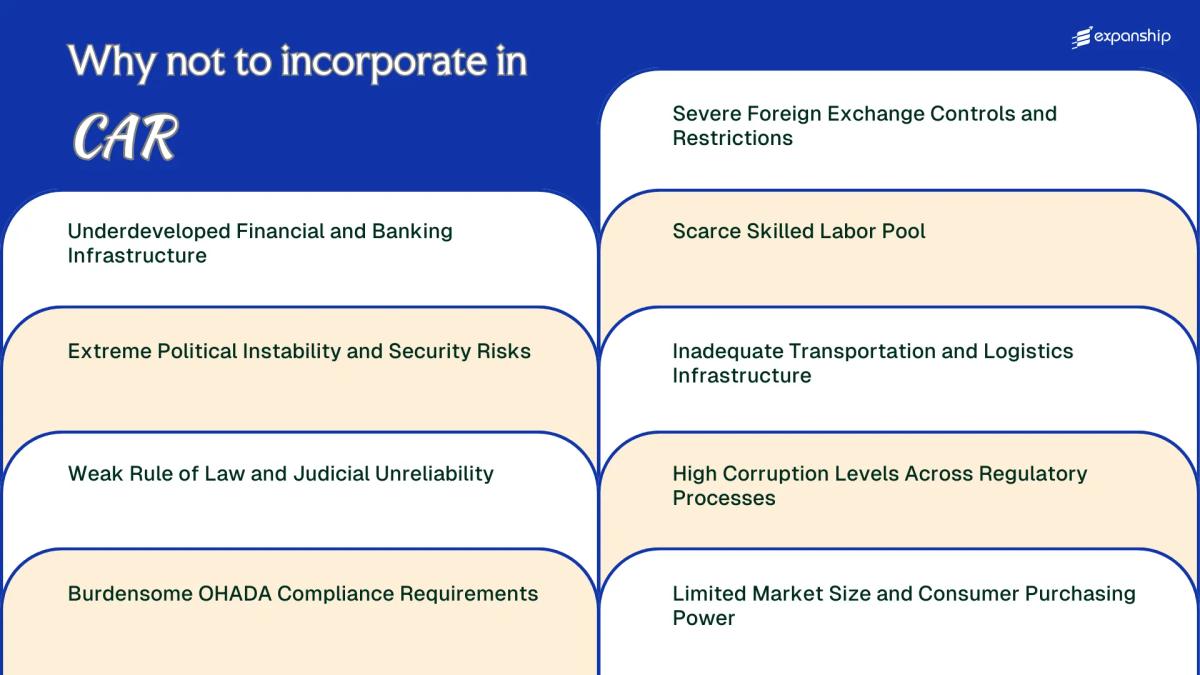
The disadvantages of incorporating in Central African Republic span regulatory, infrastructural, and operational dimensions that distinguish this jurisdiction from more commercially developed markets. CAR operates within the OHADA legal framework — the Organisation pour l'Harmonisation en Afrique des Affaires du Droit — which imposes a regionally standardized but procedurally demanding compliance structure on registered entities.
The categories examined across this article range from banking access to labor availability, each presenting distinct friction points for foreign-owned businesses. How severely any one factor affects your operations depends heavily on your industry, entity structure, and intended activity.
The OHADA Uniform Acts govern commercial law in CAR and form the primary legislative basis for company formation and ongoing corporate obligations. Risks of company formation in CAR are most acute for small to mid-sized foreign investors entering without an established local partner or regional operational base.
Underdeveloped Financial and Banking Infrastructure
Central African Republic banking infrastructure problems extend beyond simple inconvenience — the financial system imposes structural constraints that directly limit how a registered entity can operate, receive payments, and manage capital.
Limited Banking Network and Account Access
Formal banking penetration in the CAR sits below 5% of the adult population, with only a handful of commercial banks, including CBCA and BSCA, maintaining operations primarily in Bangui. Your business will likely find that correspondent banking relationships with international institutions are either absent or deeply restricted, making routine cross-border transactions unreliable and slow.
Payment Infrastructure Gaps
Digital payment infrastructure remains underdeveloped outside mobile money services, which themselves face coverage limitations in rural zones. A foreign firm dependent on card processing, SWIFT transfers, or multi-currency accounts will encounter persistent friction that inflates operational costs and delays supplier or client settlements.
For businesses in sectors requiring frequent international payments, the absence of a functional secondary banking market means financial transactions that take days elsewhere can take weeks here.
Your firm may be unable to open a functional corporate account with international transaction capabilities within a reasonable timeframe after incorporation, directly disrupting business operations from day one.
Extreme Political Instability and Security Risks
Central African Republic political instability risks are among the most severe faced by any foreign investor operating on the African continent. Since independence in 1960, the country has experienced repeated coups, prolonged armed conflict, and successive transitional governments, leaving no consistent institutional framework for businesses to rely on.
Active armed groups, including factions operating outside the 2019 Political Agreement for Peace and Reconciliation, continue to control significant portions of territory outside Bangui. Your business cannot realistically operate in those areas, which cuts off access to resource extraction zones, supply routes, and regional markets.
The practical costs this creates for a foreign-owned entity include:
- Forced reliance on private security contractors, which adds recurring operational costs that are difficult to budget predictably
- Insurance underwriters classify CAR as a high-risk territory, driving up premiums for property, cargo, and liability coverage
- Staff evacuation protocols require contingency planning and dedicated reserves that domestic competitors do not face
- Supply chain disruptions from road blockages and territorial insecurity regularly delay goods, increasing holding costs
UN Multidimensional Integrated Stabilization Mission (MINUSCA) maintains a presence, but its mandate does not extend to protecting commercial interests.

Company Incorporation in Central African Republic
Understand the full regulatory and operational requirements before committing to a corporate presence in CAR.
Weak Rule of Law and Judicial Unreliability
Weak rule of law in Central African Republic creates direct, measurable risk for any foreign business attempting to enforce contracts or protect assets. The national court system operates under severe structural strain, with inadequate funding, a shortage of trained judges, and limited geographic reach outside Bangui. Rulings that favor your firm on paper may carry no practical weight outside the capital.
| Constraint | Practical Impact on Foreign Business |
|---|---|
| Enforcement limited largely to Bangui | Court orders outside the capital face near-zero compliance |
| Judiciary formally under executive influence | Impartial adjudication cannot be reliably expected |
| No specialized commercial court | Contract disputes handled by under-resourced civil chambers |
| Prolonged case timelines | Multi-year delays make litigation an ineffective remedy |
CAR formally operates under the OHADA Uniform Act on Commercial Law, which provides a regional framework for contract disputes. However, the local judiciary lacks the capacity to apply OHADA rules consistently, meaning the theoretical legal protections the framework offers are frequently unavailable in practice.
Intellectual property protections follow a similarly compromised path. Registered rights are difficult to enforce without sustained legal action, which itself carries unpredictable costs and outcomes. For foreign investors, judicial unreliability effectively transfers dispute risk back onto the contracting parties themselves, with no reliable neutral arbiter available.
Burdensome OHADA Compliance Requirements
OHADA compliance challenges Central African Republic businesses face stem from a regional legal framework that was designed for economies with functioning institutional infrastructure. The CAR operates under the Organisation for the Harmonisation of Business Law in Africa, which imposes uniform obligations across member states regardless of local administrative capacity.
The OHADA Uniform Acts cover everything from commercial companies to accounting standards, insolvency procedures, and securities law. For a foreign entity, this means meeting standardized reporting deadlines and structural requirements that local courts and notaries often lack the technical capacity to process efficiently.
The Acte Uniforme relatif au droit des sociétés commerciales requires specific share capital thresholds, mandatory auditor appointments for entities above certain thresholds, and formalized governance documentation. Meeting these obligations in Bangui creates friction that wouldn't exist in more institutionally developed OHADA states like Côte d'Ivoire or Senegal.
- Annual financial statements must comply with OHADA's Système Comptable OHADA (SYSCOHADA) accounting standards
- Société Anonyme structures require a statutory auditor (commissaire aux comptes) appointment
- Share capital must meet minimum thresholds set under the Uniform Act on Commercial Companies
- Corporate resolutions and governance records must be formally notarized under OHADA procedural rules
Despite being an OHADA member since 2004, the Central African Republic has no specialized OHADA commercial court, meaning disputes under regional business law are heard by general civil courts with limited commercial law expertise.
Severe Foreign Exchange Controls and Restrictions
Central African Republic foreign exchange restrictions stem from the BEAC (Banque des États de l'Afrique Centrale) regulatory framework, which governs all cross-border capital movements for member states including CAR. Foreign firms operating through a local entity face mandatory prior authorization requirements for transferring profits, dividends, or loan repayments abroad.
Structural Limits on Capital Mobility
BEAC regulations require that external transfers above defined thresholds receive advance approval, a process that can delay access to funds for weeks or longer. For a foreign investor, this means your capital is effectively immobilized during review periods, disrupting treasury management and intercompany financing arrangements.
Repatriation Risks for Foreign Investors
CFA franc repatriation restrictions in CAR compound the difficulty of extracting returns from an investment. Approval is not guaranteed, and even approved transfers may be subject to documentary requirements that a locally understaffed entity struggles to fulfill. While the CFA franc's peg to the euro provides nominal currency stability, it does not remove the procedural barriers that restrict actual fund movement.
Managing Foreign Exchange Challenges in the Central African Republic
Learn how Expanship supports foreign businesses in addressing exchange control requirements and BEAC compliance when operating in the Central African Republic.
Scarce Skilled Labor Pool
The skilled labor shortage in Central African Republic is a structural constraint, not a temporary gap. Literacy rates remain among the lowest globally, and tertiary enrollment figures reflect a workforce with limited access to technical or professional training.
- The country's adult literacy rate sits below 40%, which significantly narrows the pool of candidates qualified for administrative, financial, or managerial roles within a registered entity.
- CAR has no established professional licensing infrastructure for many technical fields, so verifying the credentials of locally hired staff carries inherent uncertainty for your business.
- Brain drain to neighboring francophone countries reduces the availability of mid-to-senior level talent, leaving firms dependent on costly expatriate hires.
- Human capital challenges incorporating in Central African Republic extend to language barriers, as French-language business proficiency is unevenly distributed outside Bangui.
- Workforce limitations for businesses operating under OHADA-compliant structures are compounded by the absence of recognized local accounting or legal training institutions.
Inadequate Transportation and Logistics Infrastructure
Central African Republic logistics infrastructure problems are among the most operationally disruptive barriers facing any foreign-incorporated entity. The country is landlocked, and its road network is predominantly unpaved, with only a fraction of approximately 24,000 kilometers classified as paved.
Goods moving to or from Bangui typically transit through Cameroon via the Bangui-Douala corridor, adding transit time, customs friction, and third-country transport costs to every supply chain cycle. Delays at border crossings are routine, and your firm absorbs those costs directly.
There is no functioning rail network. Air freight capacity at Bangui M'Poko International Airport is limited, making it unsuitable as a consistent logistics channel for high-volume commercial operations.
Seasonal conditions compound the problem further. Unpaved roads become impassable during the rainy season, effectively cutting off supply routes to interior regions for months each year.
A hypothetical importer of industrial equipment in Bangui could face 30 to 45 additional transit days compared to a coastal West African hub, with multi-country transshipment fees potentially adding 25–40% to total landed costs — a structural cost burden that cannot be mitigated through operational efficiency alone.
High Corruption Levels Across Regulatory Processes
Corruption risks incorporating in Central African Republic are not incidental — they are embedded in routine administrative processes. Transparency International's Corruption Perceptions Index consistently ranks CAR among the lowest-scoring countries globally, reflecting systemic dysfunction rather than isolated incidents.
Obtaining business registration documents, permits, or licenses often involves unofficial payments to officials within agencies like the Registre du Commerce et du Crédit Mobilier (RCCM). These demands are rarely documented, which means your firm has no legal recourse when payments are extorted or commitments are broken.
Foreign companies incorporated under OHADA structures are still subject to local administrative gatekeepers who operate outside any formal legal framework. The gap between statutory procedure and actual practice creates unpredictable costs that cannot be budgeted in advance.
CAR is a signatory to the United Nations Convention Against Corruption (UNCAC), but enforcement capacity remains negligible. For your business, this means anti-corruption statutes offer little practical protection on the ground.
Bribery risks in Central African Republic business operations extend beyond incorporation into ongoing compliance activities, including tax filings, customs clearances, and contract renewals with state entities.
Foreign companies subject to extraterritorial anti-corruption laws — including the US Foreign Corrupt Practices Act (FCPA) or the UK Bribery Act 2010 — remain legally liable for payments made by local agents or employees, even when those payments were made under duress.
Limited Market Size and Consumer Purchasing Power
Central African Republic limited market size drawbacks are structural, not cyclical. With a population of approximately 5.5 million and a GDP per capita consistently ranked among the lowest globally, the addressable consumer base for most goods and services is extremely narrow.
Household purchasing power is severely constrained by poverty rates exceeding 70%, meaning demand for non-essential goods, professional services, and imported products remains minimal. A foreign entity targeting domestic consumption will find that realistic sales volumes cannot justify the operational costs of formal incorporation and local staffing.
The economy is heavily concentrated in subsistence agriculture and artisanal mining, leaving limited formal-sector activity for businesses outside those segments to engage with. Even within mining, regulatory access is restricted and not open to standard commercial entities without specific licensing under the country's Mining Code.
Urban commercial activity is largely confined to Bangui, which further compresses the viable market footprint for any firm seeking national reach.
Strategies to Overcome These Barriers
Overcoming Central African Republic incorporation barriers requires structural preparation rather than reactive adjustments once problems surface. No single fix addresses the full range of challenges; instead, a combined approach targeting finance, compliance, and governance reduces aggregate exposure.
- Register your entity under the OHADA Uniform Act on Commercial Companies (AUSCGIE) to ensure your corporate structure meets the binding regional legal framework applicable in CAR.
- Open a CFA franc account through a BEAC-member correspondent bank before commencing operations to address both foreign exchange restrictions and limited local banking access.
- File all tax declarations through the Direction Générale des Impôts to maintain a documented compliance record that can serve as evidence in disputes before weak judicial institutions.
- Engage local transport and logistics partners registered with Bangui's CCIMA to manage infrastructure gaps affecting supply chains.
- Structure ownership and contracts under a recognized OHADA arbitration clause to reduce dependence on domestic courts when enforcing agreements.
Mitigating CAR business risks strategies must account for the BEAC's monetary oversight and OHADA's supranational authority, both of which operate independently of domestic institutions. These frameworks provide the most reliable procedural footing available within the jurisdiction's current regulatory conditions.
Central African Republic Still Worth Considering
Asking whether the Central African Republic is worth incorporating in depends entirely on what your business needs from a jurisdiction. The documented disadvantages are real and measurable, yet the country holds natural resource wealth and sits within the OHADA legal framework, which gives it a degree of structural comparability with other Francophone African markets.
| Pros | Cons |
|---|---|
| OHADA membership provides a codified, regionally recognized commercial law framework | OHADA compliance requirements add procedural complexity and ongoing reporting obligations |
| Natural resource endowment creates documented sector-specific commercial opportunities | Extreme political instability and active security risks directly threaten operational continuity |
| CEMAC membership offers a shared currency (XAF), reducing intra-regional exchange risk | Severe foreign exchange controls restrict the movement of capital in and out of the country |
| Formal judicial structures exist under OHADA-aligned procedures | Weak rule of law means contract enforcement through local courts is unreliable in practice |
| Low baseline market competition in several sectors | A limited consumer base and low purchasing power constrain domestic revenue potential |
Corruption across regulatory processes, underdeveloped banking infrastructure, and logistics gaps compound each other in ways that raise the effective cost of doing business well beyond what statutory fees suggest.
Corporate Compliance Services in the Central African Republic
Maintain your CAR entity in good standing under OHADA regulations and local statutory requirements.
Conclusion
The Central African Republic company formation drawbacks summary is straightforward: this is a jurisdiction defined by compounding structural constraints rather than isolated regulatory friction. Political instability, sustained armed conflict across multiple prefectures, and a near-absent formal banking sector represent the most consequential barriers for any foreign entity considering registration. Corruption embedded across OHADA compliance processes adds further operational exposure. Structural conditions of this depth do not resolve quickly. Professional guidance grounded in current, jurisdiction-specific knowledge remains the most reliable factor in determining whether incorporation here is viable for your business.
Expanship's Support for Your CAR Expansion
Expanship Central African Republic company formation support is structured around the specific friction points this jurisdiction creates: OHADA-governed entity setup, ANIF compliance obligations, BEAC foreign exchange protocols, and the day-to-day burden of operating within one of the world's most demanding regulatory environments. Expanship reduces the administrative weight of each stage without overstating what outside help can change on the ground.
From initial registration through ongoing compliance, the firm covers the full formation and maintenance cycle.
- Your company registration documents are prepared in accordance with OHADA Uniform Act requirements and submitted to the RCCM.
- A registered agent and local office address are provided to satisfy CAR's physical presence requirements.
- Government filings and regulatory body liaison are handled directly, reducing back-and-forth with ANIF and other authorities.
- Post-incorporation compliance is monitored on your behalf to keep the entity in good standing.
- Banking introductions are facilitated to help your business establish an operational account.
- Tax registration and liaison with the Direction Générale des Impôts are managed as part of the setup process.
Reach out through Expanship Central African Republic to discuss your specific requirements.
Frequently Asked Questions (FAQ)
OHADA law applies to all commercial entities incorporated in CAR, as the country is a signatory to the OHADA Treaty. This means your business must comply with the Uniform Acts governing commercial companies, accounting standards, and insolvency procedures, regardless of the size or sector of the firm. There are no carve-outs for foreign-owned entities or small enterprises.
Without an active bank account, your entity cannot process payroll, receive client payments, or remit taxes to the Direction Générale des Impôts. CAR has one of the most underdeveloped banking sectors in the CEMAC region, and correspondent banking relationships with international institutions are extremely limited, meaning even basic cross-border transactions can stall indefinitely.
CAR consistently ranks at or near the bottom of Transparency International's Corruption Perceptions Index, scoring lower than most other CEMAC members including Chad and the Republic of Congo. Corrupt practices are reported across customs clearance, business registration, and tax administration, meaning your firm is likely to encounter demands at multiple regulatory touchpoints. This is not an isolated risk confined to one agency or process.
CAR operates within the BEAC (Banque des États de l'Afrique Centrale) monetary framework, which imposes prior authorization requirements for transfers of funds outside the CEMAC zone. Repatriating dividends or capital requires documentation that is difficult to assemble given CAR's weak administrative infrastructure, and processing times are unpredictable. In practice, this means your returns may be trapped in-country for extended periods.
Contract disputes in CAR are subject to a judiciary that is chronically under-resourced, poorly trained, and vulnerable to political interference. Even where OHADA's Uniform Act on Arbitration provides an alternative dispute resolution mechanism, the practical enforcement of arbitral awards within CAR remains unreliable. Foreign businesses effectively have no dependable legal remedy if a local partner or counterparty defaults.
OHADA's Uniform Act on Accounting Law (SYSCOHADA) requires companies to maintain accrual-based accounts prepared by qualified accountants, but CAR has a critically thin pool of certified accounting professionals. Hiring locally compliant finance staff is difficult, and relying on expatriate personnel significantly increases your operating cost base. Non-compliance with SYSCOHADA can expose the company's directors to personal liability.
Legal Disclaimer
The information provided in this article is for general informational purposes only and does not constitute legal, tax, or professional advice. While we strive to ensure the accuracy and timeliness of the content, laws and regulations are subject to change, and the application of laws can vary widely based on specific facts and circumstances.
Readers should not act upon this information without seeking professional counsel tailored to their individual situation. Expanship and its authors disclaim any liability for actions taken or not taken based on the content of this article.
For specific advice regarding your business setup, compliance requirements, or any legal matters, please consult with qualified legal and tax professionals in the relevant jurisdiction.