

Key Takeaways
- Foreign investors establishing a legal presence in Brazil must appoint a Brazil-resident legal representative, a mandatory condition tied to CNPJ registration and enforced by the Receita Federal.
- Entity formation under either the Sociedade Limitada or Sociedade Anônima structure requires registration with the Junta Comercial of the relevant state, with federal coordination administered through the DREI.
- Beneficial ownership disclosure obligations apply throughout the CNPJ registration process, requiring accurate reporting of ultimate beneficial owners to Brazilian federal tax authorities.
- Under the Corporation Law (Lei nº 6.404/1976) and the Civil Code (Lei nº 10.406/2002), the specific capital structure, director, and shareholder requirements an entity must satisfy vary according to the chosen corporate form and the investor's country of origin.
Entity formation in Brazil is governed primarily by the Civil Code (Lei nº 10.406/2002) and the Corporation Law (Lei nº 6.404/1976), with registration administered through the Junta Comercial (Commercial Registry) of the relevant state, and federal coordination handled by the DREI (Departamento de Registro Empresarial e Integração).
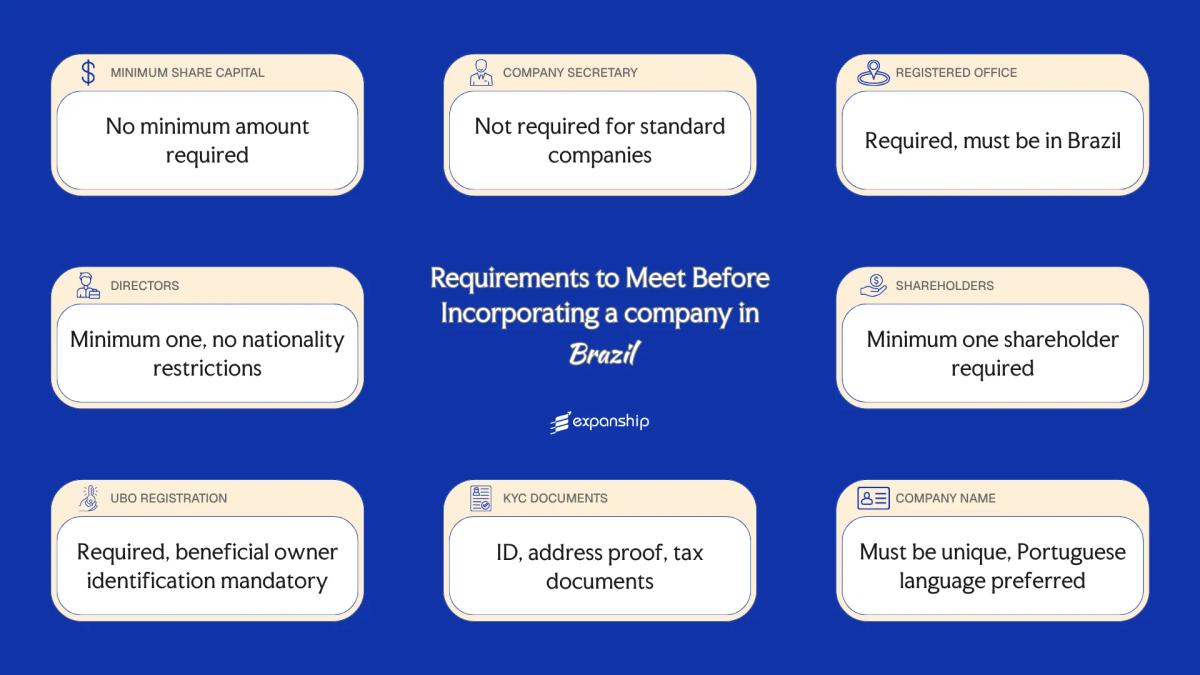
Meeting the Brazil company registration requirements involves satisfying several distinct categories of obligations before the entity can be legally formed and operational.
Failure to satisfy these requirements results in rejection of the registration application or, if discovered post-formation, potential fines and suspension of operating licenses issued by federal and municipal authorities.
Specific obligations vary depending on the entity type selected, whether a Sociedade Limitada (Ltda.) or a Sociedade Anônima (S.A.), and may differ further based on the industry sector or the investor's country of origin.
This article is most relevant to foreign investors and business owners assessing Brazil business incorporation rules prior to establishing a legal presence in the country.
Minimum Share Capital Requirements in Brazil

Brazil minimum share capital requirements depend on the legal entity type selected at registration. For a Sociedade Limitada (Ltda.), the Código Civil (Law No. 10,406/2002) sets no statutory minimum, while a Sociedade Anônima (S.A.) is governed by Law No. 6,404/1976, which establishes specific paid-up conditions tied to public offerings rather than a fixed floor amount.
Share capital in both structures is registered through the Junta Comercial (state commercial registry) and, where applicable, the Receita Federal. Capital deposit verification occurs at the banking level prior to or concurrent with registration, not through a centralized federal authority.
| Parameter | Detail |
|---|---|
| Minimum Authorized Share Capital | No statutory minimum for Ltda.; no fixed minimum for S.A. under Law 6,404/1976 |
| Maximum Authorized Share Capital | No statutory maximum |
| Minimum Paid-Up Capital | No statutory minimum for Ltda.; S.A. requires at least 10% of cash contributions paid up at incorporation |
| Paid-Up Requirement at Incorporation | 10% of subscribed cash capital for S.A.; no mandatory percentage for Ltda. |
| Accepted Currency | Brazilian Real (BRL) |
| Accepted Forms of Contribution | Cash or non-cash assets (bens); services are excluded for S.A. under Law 6,404/1976 |
| Timeframe to Deposit Capital | No fixed statutory deadline for Ltda.; S.A. cash contributions must be deposited in Banco do Brasil or authorized institution before registration |
No statutory minimum for a Ltda. does not mean capital structure is optional. The capital social must still be declared in the articles of association (contrato social) and recorded with the Junta Comercial, forming the legal basis for each quotaholder's liability.
Company Secretary Requirements in Brazil
Under Brazilian corporate law, there is no statutory requirement for a dedicated company secretary role in the same form as seen in common law jurisdictions. For a Sociedade Limitada (Ltda.) or Sociedade Anônima (S.A.), Brazil corporate secretary obligations are distributed among designated officers, partners, or board members rather than held by a separately titled secretarial function.
In an S.A., the Board of Directors (Conselho de Administração) and the fiscal body (Conselho Fiscal) handle governance oversight collectively. Day-to-day company administration requirements are typically fulfilled by the designated officer (Diretor), who maintains corporate records, executes minutes, and ensures filings with the Junta Comercial remain current.
Eligibility to perform these administrative functions is subject to the following general conditions:
- Individuals must be at least 18 years of age and have full legal capacity under Brazilian civil law.
- No prior conviction disqualifying the person from commercial management roles under applicable federal rules.
- For an S.A., directors serving administrative functions must hold their appointment on the registered corporate register.
- Foreign nationals may serve but are subject to residency and visa conditions under Brazilian immigration regulations.
- Legal entities cannot directly hold an officer or secretarial function; only natural persons qualify.

Incorporate Your Company in Brazil
Set up your legal entity in Brazil with structured support across entity selection, documentation, and Junta Comercial registration.
Registered Office Requirements in Brazil
Registered office requirements in Brazil mandate that every empresa (company) maintain a physical sede social within the country, formally recorded with the Junta Comercial (Commercial Registry) of the state where the business is domiciled.
- A physical address is required; a purely virtual office address does not satisfy the sede social obligation under Brazilian law.
- The address must be located within Brazil, in the specific state where the entity is registered with the Junta Comercial.
- Proof of occupancy is required, either through property ownership documentation or a valid lease agreement for the premises.
- The registered address is publicly listed in the Junta Comercial records and reflected in the firm's CNPJ registration with the Receita Federal.
- Any change to the legal address requires a formal amendment to the company's articles of association (contrato social or estatuto social) and must be filed with the relevant Junta Comercial.
- Operating with an incorrect or non-compliant address can result in the Receita Federal classifying the entity as inapta (unfit), which suspends the CNPJ and blocks the business from issuing invoices or entering into government contracts.
Director Requirements in Brazil

Under Brazilian corporate law, director requirements in Brazil are governed primarily by the Lei das Sociedades Anônimas (Law No. 6.404/1976) for S.A. entities and the Código Civil (Law No. 10.406/2002) for Limitadas. Upon appointment, a director (administrador) assumes personal liability for acts performed in breach of the law, the company's articles, or fiduciary duties owed to the entity.
| Parameter | Detail |
|---|---|
| Minimum Number of Directors | One director (administrador) is sufficient for a Limitada; an S.A. requires at least two board members (diretores). |
| Maximum Number of Directors | No statutory maximum is set for a Limitada; S.A. bylaws define the upper limit. |
| Local/Resident Director Required | At least one director must be resident in Brazil, regardless of nationality. |
| Nationality Restrictions | No nationality restrictions apply, provided the residency requirement is satisfied. |
| Minimum Age Requirement | Directors must be at least 18 years of age and must not be legally incapacitated. |
| Corporate Directors Permitted | Corporate directors are not permitted; only natural persons may serve as administradores. |
| Director Must Be a Shareholder | No statutory requirement exists for a director to hold shares in the company. |
| Publicly Listed on Registry | Director appointments are registered with the Junta Comercial (Board of Trade) of the relevant state. |
| Disqualification Conditions | Individuals convicted of bankruptcy-related offenses, fraud, or crimes against the economy are disqualified under Law No. 6.404/1976. |
Even a fully foreign-owned company must appoint a Brazil-resident director, meaning foreign founders who do not relocate must engage a local individual before the entity can be registered.
Shareholder Requirements in Brazil

A Sociedade Limitada (Ltda.) requires a minimum of two quotaholders, though the 2019 reform introduced by Lei da Liberdade Econômica (Law 13.874/2019) permits single-quotaholder Ltdas. A Sociedade Anônima (S.A.) requires at least two shareholders, with no statutory maximum in either structure.
Nationality and Residency Restrictions
Foreign nationals may hold shares or quotas without restriction on ownership percentage. No minimum local shareholding is mandated, making full foreign ownership permissible under Brazilian corporate law.
Corporate Shareholders
Legal entities, whether domestic or foreign, may serve as shareholders or quotaholders. No special conditions are imposed solely by virtue of a corporate shareholder's foreign incorporation status.
Shareholder Liability
In an Ltda., each quotaholder's liability is limited to their subscribed capital contribution, though all quotaholders bear joint liability until the share capital is fully paid in. S.A. shareholders are liable only to the extent of their subscribed shares.
Register of Shareholders
An Ltda. maintains its quotaholder register within the articles of association filed with the Junta Comercial. S.A. entities must maintain a separate Livro de Registro de Ações Nominativas, which is not publicly accessible but must reflect any transfers promptly.
Structure Your Shareholder Setup for Brazilian Incorporation
Get guidance on quotaholder and shareholder requirements specific to your chosen entity type in Brazil.
UBO / Beneficial Ownership Registration Requirements in Brazil
Under Brazilian federal rules, UBO registration requirements Brazil compliance is governed primarily by Receita Federal (RFB) Normative Instruction 1,863/2018, which defines the beneficiário final as any individual holding, directly or indirectly, more than 25% of a legal entity's capital or exercising effective control.
- Identify all individuals meeting the 25% ownership or effective control threshold within the corporate chain.
- Declare beneficiário final data to Receita Federal through the CNPJ registration system at the time of incorporation.
- Submit updates to RFB within 90 days whenever ownership structures change.
- Entities regulated by the CVM must also comply with CVM beneficial ownership disclosure obligations under separate securities regulations.
| Parameter | Detail |
|---|---|
| Ownership Threshold for UBO Status | 25% direct or indirect shareholding, or effective control |
| Filing Authority | Receita Federal do Brasil (RFB) via CNPJ system |
| Disclosure Deadline at Incorporation | At time of CNPJ registration |
| Publicly Accessible Register | No public register; data held by RFB |
| Penalties for Non-Disclosure | CNPJ suspension and fines under RFB enforcement powers |
| Ongoing Update Obligation | Within 90 days of any structural change |
KYC / Document Requirements in Brazil

KYC document requirements Brazil are governed primarily by Lei nº 9.613/1998 (the Anti-Money Laundering Law), as amended, with oversight exercised by the COAF, Brazil's Financial Intelligence Unit.
Individual / Personal Documents
- Valid government-issued photo identification (passport or national ID card)
- Brazilian CPF (Cadastro de Pessoas Físicas) number, or equivalent foreign tax identification
- Proof of residential address dated within the last 90 days
- Signed declaration of beneficial ownership where the individual holds qualifying interest
Corporate Documents
- Certificate of incorporation or equivalent constitutional document from the entity's home jurisdiction
- Current articles of association or bylaws
- Register of directors confirming the identity of authorised signatories
- Proof of the corporate entity's registered office address
Source of Funds Documentation
- Recent bank statements covering a minimum of three to six months
- Audited financial statements or accountant-certified accounts where bank statements are insufficient
- Written declaration identifying the origin of capital being introduced into the firm
Notarisation and Apostille Requirements
- Foreign documents must be apostilled under the Hague Convention of 1961 before submission to the Junta Comercial
- All non-Portuguese documents require certified translation by a sworn translator (tradutor juramentado) registered in Brazil
- Notarisation by a Brazilian notary (tabelião) is required for documents executed domestically
Untranslated or non-apostilled foreign documents are the most common cause of registration rejection at the Junta Comercial.
Company Name Requirements in Brazil
Company name requirements in Brazil are assessed by the relevant state commercial registry (Junta Comercial) at the point of incorporation. Each proposed name is checked for uniqueness within the registry's database before approval is granted.
Your firm's name must be expressed in Portuguese and must include a legal suffix identifying its corporate form, such as "Ltda." for a limited liability company or "S.A." for a corporation. No minimum word count is formally prescribed, but the name must be sufficiently distinct from existing registered names.
Certain words are restricted. Terms implying government affiliation, financial institution status, or professional designations require prior authorisation from the relevant supervisory authority before the registry will accept them.
Name reservation is available through the Junta Comercial prior to formal incorporation. The reservation period and exact procedure vary by state, so you should confirm current terms directly with the registry where your entity will be domiciled.
Compliance Services for Companies in Brazil
Expanship supports businesses with ongoing compliance obligations under Brazilian corporate law, including name maintenance, registry filings, and regulatory reporting.
Conclusion
Brazil company incorporation requirements span several regulated dimensions, from capital structure under the Lei das Sociedades Anônimas to director residency rules and UBO disclosure obligations enforced through the Receita Federal. Among the most consequential requirements for foreign investors are the mandatory appointment of a Brazil-resident legal representative and the beneficial ownership reporting framework tied to the CNPJ registration process. Once these obligations are understood, the practical next step is engaging qualified local counsel and a registered entity to manage ongoing compliance with the Junta Comercial and federal tax authorities.
Expanship's Corporate Services for Brazil Expansion
Incorporating in Brazil involves specific structural requirements — from appointing a resident administrator to registering with the Junta Comercial and obtaining CNPJ registration through the Receita Federal. Expanship's Brazil corporate services expansion support is built around these precise obligations, helping your business move through each layer of the process without accumulating unnecessary delays or compliance gaps.
Our service scope covers the full incorporation and post-registration cycle:
- We handle company registration and prepare all formation documents in accordance with Brazilian corporate requirements.
- A registered agent and local office address are provided to satisfy residency and domicile obligations.
- We manage government filings and liaise directly with regulatory bodies including the Junta Comercial and Receita Federal.
- Ongoing post-incorporation compliance is handled to keep your entity in good standing.
- Banking introduction assistance is available to support your account-opening process with local institutions.
- Tax registration and liaison with relevant local authorities, including state and municipal bodies where applicable, are included in our scope.
To discuss your specific requirements, contact Expanship Brazil.
Frequently Asked Questions (FAQ)
The obligation to appoint a Brazilian-resident legal representative applies to any foreign individual or entity holding an equity stake in a Brazilian company. This is a statutory requirement under Brazilian corporate law and is enforced at the point of registration with the Junta Comercial. The representative must hold a valid Brazilian CPF (individual taxpayer number) and be permanently resident in Brazil.
Failure to comply with beneficial ownership disclosure obligations can result in fines and suspension of the company's CNPJ (Cadastro Nacional da Pessoa Jurídica), which effectively blocks the entity from issuing invoices or operating bank accounts. The Receita Federal has authority to apply these sanctions administratively, without requiring a court order. Continued non-compliance can escalate to criminal liability for the responsible parties under Brazil's anti-money laundering framework (Law 9.613/1998).
There is no statutory minimum share capital for a Sociedade Limitada (Ltda.) under the current Brazilian Civil Code. However, regulated industries such as financial institutions, insurance companies, and healthcare providers are subject to sector-specific minimum capital thresholds set by their respective regulatory bodies, such as the Banco Central do Brasil or the Agência Nacional de Saúde Suplementar. For standard commercial or service companies, the founders determine the capital amount, which must reflect the actual needs of the business.
A foreigner can serve as a director (administrador) of a Brazilian company, but must hold either permanent residency or a specific visa category that permits management functions in Brazil. Without the appropriate immigration status, the individual cannot be registered as a director with the Junta Comercial. This requirement is enforced at the point of registration and is not waived based on the shareholder structure.
Company name approval in Brazil is handled by the Junta Comercial of the state where the entity will be registered. Each state board maintains a database of registered names and will reject any proposed name that is identical or confusingly similar to an existing registration within that state. For national protection, the company must separately register its trade name or brand with the Instituto Nacional da Propriedade Industrial (INPI), as Junta Comercial registration does not confer nationwide exclusivity.
Yes, foreign-issued documents submitted during the incorporation process must be apostilled under the Hague Convention if the issuing country is a signatory, or otherwise legalized through consular channels if it is not. Following apostille, all documents must be translated into Portuguese by a sworn public translator (tradutor juramentado) registered in Brazil. Untranslated or un-apostilled foreign documents will not be accepted by the Junta Comercial or the Receita Federal.
Legal Disclaimer
The information provided in this article is for general informational purposes only and does not constitute legal, tax, or professional advice. While we strive to ensure the accuracy and timeliness of the content, laws and regulations are subject to change, and the application of laws can vary widely based on specific facts and circumstances.
Readers should not act upon this information without seeking professional counsel tailored to their individual situation. Expanship and its authors disclaim any liability for actions taken or not taken based on the content of this article.
For specific advice regarding your business setup, compliance requirements, or any legal matters, please consult with qualified legal and tax professionals in the relevant jurisdiction.