
Key Takeaways
- Foreign investors incorporating under the OHADA Uniform Act on Commercial Companies must navigate CEFORE's registration procedures, which routinely extend beyond published timelines and add unpredictable lead time to market entry.
- Burkina Faso's corporate tax environment, combined with mandatory CNSS employer contribution obligations, increases the effective cost of maintaining a compliant local entity beyond what the headline corporate tax rate alone suggests.
- Restricted foreign ownership rules in sectors such as mining and natural resources create structural barriers that require legal restructuring or local partnership arrangements before operations can commence.
- Persistent security conditions across large portions of the country's territory, combined with underdeveloped transport and digital infrastructure, materially constrain the operational viability of businesses that depend on reliable logistics or connectivity outside Ouagadougou.
Burkina Faso operates under an evolving regulatory framework shaped by OHADA (Organisation pour l'Harmonisation en Afrique des Affaires) treaty obligations and domestic commercial legislation, including the OHADA Uniform Act governing commercial companies. This framework imposes a defined set of compliance requirements on foreign-incorporated entities.
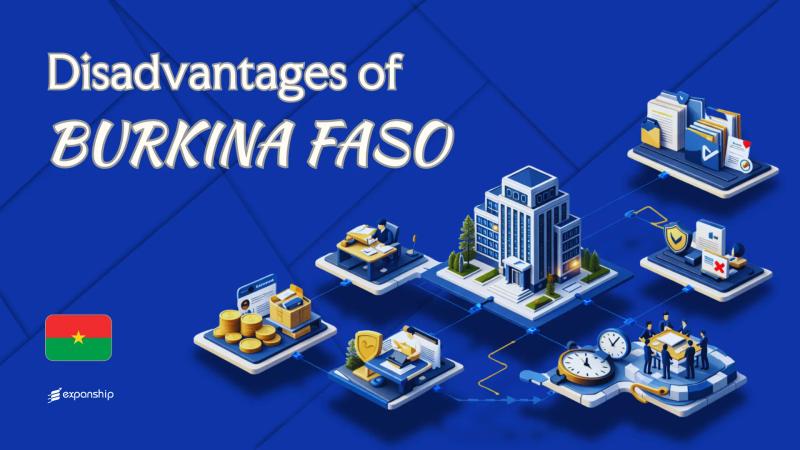
The disadvantages of incorporating in Burkina Faso span registration procedures, financial infrastructure, security conditions, and sector-specific restrictions. Each category carries distinct implications depending on whether your business is structured as an SA, SARL, or branch of a foreign entity.
The cons of setting up a company here are not uniform across industries. A firm operating in extractive sectors faces a different risk profile than one in retail or professional services.
This article is most relevant to foreign investors and internationally operating businesses considering a direct incorporation or subsidiary structure rather than a representative office arrangement.
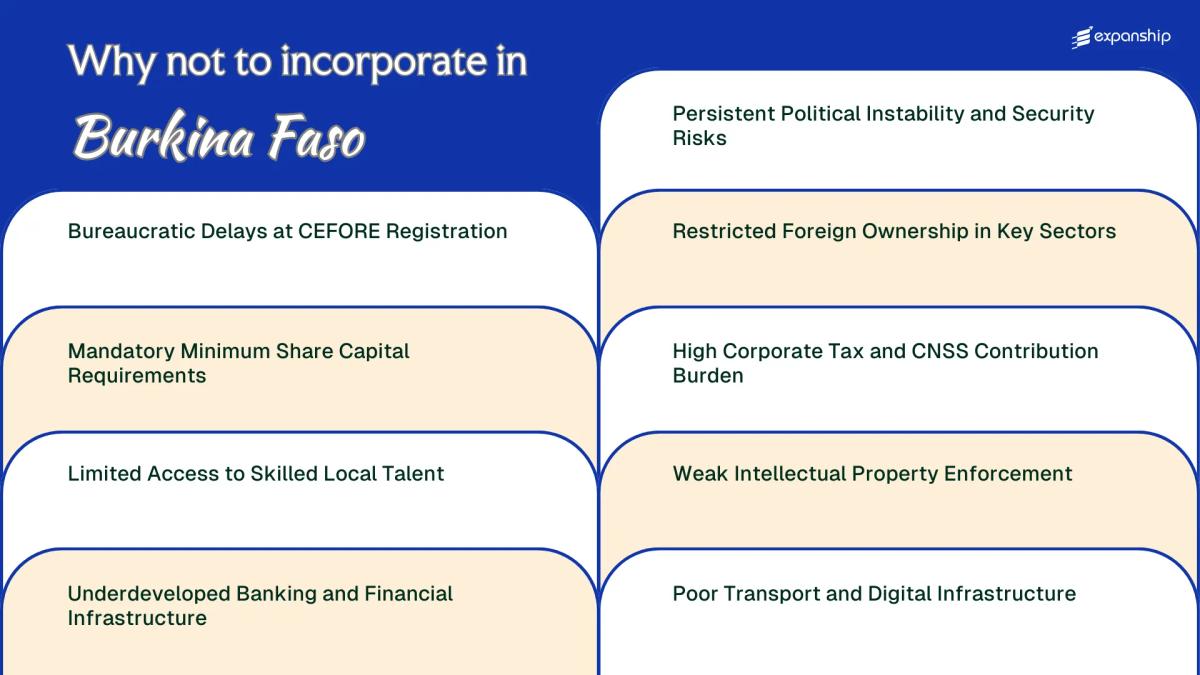
Bureaucratic Delays at CEFORE Registration
CEFORE registration delays in Burkina Faso create measurable friction for foreign incorporators, often extending what should be a straightforward process into weeks of administrative back-and-forth.
Structural Bottlenecks at the One-Stop Shop
CEFORE, the Centre de Formalités des Entreprises, operates as the official one-stop window for business registration and theoretically consolidates multiple administrative steps. In practice, dependency on manual document verification, coordination gaps between CEFORE and the tax authority (Direction Générale des Impôts), and the RCCM commercial register means delays compound across agencies rather than being absorbed by a single office.
For a foreign business owner, this fragmentation translates directly into unpredictable timelines that disrupt contractual commitments, staffing plans, and banking arrangements made in anticipation of a confirmed registration date.
Practical Consequences for Foreign Entrants
Official registration timelines are frequently cited as two to seven business days under optimistic conditions, but administrative backlogs regularly extend this period. Your entity cannot legally operate, open a corporate bank account, or execute local contracts until registration is confirmed, meaning every day of delay carries a direct commercial cost.
Delays at CEFORE are not purely procedural; they postpone your legal existence as a Burkinabe entity, blocking banking access and contract execution until the registration certificate is formally issued.
Mandatory Minimum Share Capital Requirements
Burkina Faso minimum share capital restrictions impose a direct financial barrier before your business generates a single franc of revenue. Under the OHADA Uniform Act on Commercial Companies, a Société Anonyme (SA) requires a minimum share capital of XOF 10,000,000, while a Société à Responsabilité Limitée (SARL) carries no statutory minimum under the same framework. That distinction, however, creates its own complication.
Without a minimum threshold, SARL creditors and local partners may treat undercapitalized entities as higher-risk counterparties, which can obstruct supplier credit terms and local banking relationships from the outset.
For firms structured as an SA, the XOF 10,000,000 threshold translates to approximately USD 16,000, capital that must be committed upfront with no guarantee of operational returns in a market affected by security constraints.
Practical burdens this creates for a foreign business owner include:
- Capital tied up during registration cannot be deployed for staffing, premises, or supply chain costs in the critical early months
- Meeting the SA threshold requires currency conversion at rates exposed to CFA franc fluctuations, adding unpredictable cost variance
- Proof of capital deposit typically requires engagement with a local notary and an approved banking institution, adding procedural layers before registration at CEFORE is complete
- Undercapitalizing a SARL to avoid the SA threshold may limit the entity's ability to bid on public procurement contracts

Company Incorporation in Burkina Faso
Set up your legal entity in Burkina Faso with full compliance across OHADA requirements and CEFORE registration procedures.
Limited Access to Skilled Local Talent
Skilled workforce limitations in Burkina Faso present a measurable operational constraint for foreign-incorporated entities. According to World Bank data, the adult literacy rate remains below 50%, and tertiary enrollment rates are among the lowest in West Africa. For firms requiring technical, financial, or managerial expertise, this means the qualified local candidate pool is genuinely narrow.
| Indicator | Figure | Business Implication |
|---|---|---|
| Adult literacy rate | ~46% | Restricts the base from which skilled candidates can be drawn |
| Tertiary education enrollment rate | ~5% of relevant age group | Severely limits supply of graduate-level professionals |
| Work permit requirement for foreign hires | Required per Labour Code (Law No. 028-2008) | Adds administrative burden and cost to filling skill gaps |
| Average time to secure a foreign work authorization | Several weeks to months | Delays operational readiness for incoming specialized staff |
Under Burkina Faso's Labour Code, hiring foreign nationals to fill skill gaps requires work authorization, adding both processing time and compliance costs to your hiring cycle. Those costs compound when the role demands sector-specific expertise, such as engineering, finance, or IT.
Local training pipelines are not structured to meet private sector demand at scale. Your firm effectively bears the cost of either extended recruitment timelines or internal capability-building that comparable operations in more developed markets would not require.
Underdeveloped Banking and Financial Infrastructure
The underdeveloped banking infrastructure in Burkina Faso creates direct operational friction for foreign-owned entities. Fewer than 15% of the adult population holds a formal bank account, which reflects systemic shallow penetration across the financial sector — and that limited reach extends to business banking services as well.
Corporate account opening is slow and document-intensive, often requiring multiple in-person visits to a local branch. For a foreign director without physical presence, this process can stall operations for weeks before a single transaction clears.
Access to trade finance, letters of credit, and multi-currency accounts remains constrained to a small cluster of commercial banks operating under the BCEAO regulatory framework. This concentration gives your firm little negotiating leverage on fees or service terms.
Cross-border wire transfers are subject to UEMOA foreign exchange regulations, which impose reporting obligations and can delay fund movements. Foreign firms regularly encounter friction when repatriating capital or paying overseas suppliers.
- Corporate account opening requires notarized incorporation documents, often including certified translations
- UEMOA zone rules restrict certain foreign currency transactions and require central bank declarations
- Local banks may impose minimum deposit thresholds for corporate accounts
- Transaction limits and processing delays apply to international transfers under BCEAO oversight
- Credit facilities for foreign-owned SMEs are limited and typically require local collateral
Burkina Faso operates within the CFA franc zone, meaning its monetary policy is set in Paris by the Banque de France in coordination with the BCEAO — your firm has no local central bank to petition on currency or liquidity issues.
Persistent Political Instability and Security Risks
Burkina Faso has experienced two military coups in less than 12 months — in January and September 2022 — making political instability risks Burkina Faso business owners face among the most acute in West Africa.
Scope of the Security Deterioration
The transitional government, led by the Mouvement Patriotique pour la Sauvegarde et la Restauration (MPSR), suspended the constitution and dissolved the National Assembly, removing the institutional checks that foreign investors typically rely on for contract enforcement and dispute resolution. Active jihadist insurgencies affiliated with JNIM and GSIM have displaced over two million people internally and rendered entire northern and eastern provinces effectively inaccessible for commercial operations.
Consequences for Foreign-Owned Entities
Your firm's ability to enforce contracts, repatriate profits, or exit an investment depends on functioning courts and regulatory continuity — neither of which is guaranteed under the current transitional framework. Foreign companies operating under mining or energy concessions face particular exposure, as the government has signaled willingness to renegotiate or revoke agreements perceived as unfavorable to national interests. The security risks for investors extend to supply chain disruption, insurance unavailability, and the near-impossibility of obtaining standard commercial cover for assets located outside Ouagadougou.
Managing Political and Security Risks When Establishing in Burkina Faso
Our team can advise on the structural and compliance implications of operating under Burkina Faso's transitional regulatory environment.
Restricted Foreign Ownership in Key Sectors
Foreign ownership restrictions in Burkina Faso sectors apply unevenly across industries, and failing to account for them before incorporation can force structural changes after the fact.
- Mining and extractive operations are governed by the Code Minier, which requires the state to hold a minimum 10% free-carried interest in any mining permit, reducing the effective equity share available to foreign investors from the outset.
- Certain agricultural land-use rights are legally reserved for Burkinabè nationals, which means a foreign-owned agribusiness entity cannot hold direct title to land and must instead negotiate lease arrangements.
- Broadcasting and media sectors restrict foreign equity participation, limiting your firm's ability to establish full ownership of a media operation without a qualifying local partner.
- Public procurement contracts in priority sectors frequently impose local content or national participation thresholds that a wholly foreign-owned firm may not meet, shrinking the addressable market.
- No single consolidated foreign investment restriction law exists, so sector-specific foreign equity caps are dispersed across multiple regulatory texts, increasing legal due diligence costs.
High Corporate Tax and CNSS Contribution Burden
The corporate tax burden in Burkina Faso sits at a standard rate of 27.5% on net profits, applied under the General Tax Code (Code Général des Impôts). For a foreign-owned entity operating in a market with limited consumer purchasing power, this rate compresses margins from the outset.
Payroll costs compound this pressure. Employers are required to contribute to the Caisse Nationale de Sécurité Sociale (CNSS), with employer contribution rates covering family allowances, occupational risk, and pension branches — collectively adding a significant percentage on top of gross wages. This makes each local hire considerably more expensive than the gross salary figure suggests.
The minimum flat-rate tax (impôt minimum forfaitaire) applies even when your business records a loss, meaning the tax liability does not disappear in low-revenue periods.
A company with ten salaried employees earning an average of XOF 150,000 per month faces CNSS employer contributions estimated at roughly 16% of the gross payroll — approximately XOF 288,000 monthly in social charges alone, before corporate income tax is calculated on any profit generated.
Weak Intellectual Property Enforcement
Intellectual property enforcement problems in Burkina Faso stem from both institutional capacity and structural legal gaps. The country is a member of the African Intellectual Property Organization (OAPI), which governs trademark, patent, and copyright registration across 17 member states through the Bangui Agreement. However, OAPI membership does not translate into on-the-ground enforcement.
Registered rights frequently go undefended. Local courts have limited experience adjudicating IP disputes, and the judicial process for seeking damages or injunctive relief is slow and unpredictable, meaning counterfeit goods or unauthorized use of your brand can persist for extended periods without remedy.
For foreign firms operating in consumer goods, pharmaceuticals, or technology, this gap creates direct commercial exposure. Trademark registration through OAPI establishes legal ownership, but the burden of detecting and pursuing infringers effectively falls on the rights holder.
- Counterfeiting and informal market activity are widespread in the commercial sector
- Civil IP litigation can take years to resolve, with inconsistent outcomes
- Criminal enforcement referrals are rare and difficult to pursue without well-connected local legal support
Even with a valid OAPI trademark registration, your rights will not be proactively enforced by any authority, making your IP only as protected as your ability to fund independent legal action in local courts.
Poor Transport and Digital Infrastructure
Poor infrastructure challenges Burkina Faso business operations in ways that directly increase costs and extend delivery timelines. Only about 20% of the country's road network is paved, meaning goods moving between Ouagadougou and secondary commercial centers often face damaged or impassable routes, particularly during the rainy season.
Landlocked geography compounds this problem. Your supply chain depends on transit corridors through neighboring countries, primarily via the Abidjan-Ouagadougou corridor, which adds cross-border logistics costs and exposure to external disruptions.
Digital connectivity limitations create a separate set of operational constraints. Internet penetration remains among the lowest in West Africa, with fixed broadband infrastructure concentrated almost entirely in Ouagadougou. Businesses operating outside the capital face unreliable connectivity that affects financial transactions, cloud-based operations, and remote management.
Mobile data coverage from operators such as Orange Burkina and Moov Africa extends to urban areas but remains inconsistent in rural zones where extractive or agribusiness operations typically sit.
Strategies to Overcome These Obstacles
Overcoming business obstacles in Burkina Faso requires a structural approach built around the country's specific legal and regulatory architecture, not generic market-entry assumptions. The challenges covered in this blog span registration, capital, taxation, security, and infrastructure, each requiring a distinct but coordinated response.
- Register your entity through CEFORE to consolidate the administrative steps required under the OHADA Uniform Act on Commercial Companies.
- Confirm your sector-specific ownership ceiling under the Investment Code before structuring equity, particularly in mining, telecoms, or energy.
- Account for CNSS employer contribution rates and the Direction Générale des Impôts corporate tax schedule when modelling your operational cost baseline.
- File for trademark and patent protection with the Organisation Africaine de la Propriété Intellectuelle (OAPI) to establish enforceable IP rights within the region.
- Factor security risk classifications issued by national and international authorities into your operational zone decisions and business continuity planning.
- Structure banking arrangements with institutions licensed by the Banque Centrale des États de l'Afrique de l'Ouest (BCEAO) to maintain compliant financial operations.
Mitigating incorporation risks in Burkina Faso depends on how accurately your entity structure reflects the existing legal framework rather than assumptions drawn from other OHADA-member states. Each mitigation step above corresponds to a constraint that is codified in local regulation, not discretionary policy.
Burkina Faso's Overall Investment Potential
Burkina Faso investment risks and potential extend well beyond any single disadvantage. The barriers documented across this blog are real and, in several cases, structural rather than transitional. That said, the country remains an operational base for businesses oriented toward West African agricultural supply chains, mining services, and regional trade, provided they enter with a clear-eyed understanding of the compliance and security environment.
| Pros | Cons |
|---|---|
| CEFORE's one-stop-shop model consolidates registration steps into a single administrative point. | Registration delays at CEFORE frequently extend beyond official timeframes due to administrative backlogs. |
| Burkina Faso's position within WAEMU provides access to a regional market of over 130 million people. | Persistent armed conflict in multiple provinces creates operational and personnel security risks. |
| The Investment Code offers exemptions and preferential treatment for qualifying priority sectors. | Foreign ownership is restricted in mining, media, and other strategically designated industries. |
| Membership in OHADA standardises commercial law and dispute resolution across 17 member states. | CNSS payroll contributions and the flat corporate income tax rate increase the total cost of employing staff. |
| The CFA franc's peg to the euro reduces currency exchange volatility for European trade partners. | Weak IP enforcement under OAPI means registered rights offer limited practical protection domestically. |
Poor transport connectivity and underdeveloped digital infrastructure further constrain day-to-day operations for foreign-owned entities.
Corporate Compliance Services in Burkina Faso
Maintain your company's good standing under Burkina Faso's regulatory framework, covering annual filings, CNSS obligations, and ongoing statutory requirements.
Conclusion
Burkina Faso company formation drawbacks summary points to a jurisdiction where structural constraints are real and documented. Security deterioration under successive transitional governments, the CNSS contribution burden on payroll, and weak IP enforcement through the OAPI framework each carry direct operational consequences for registered entities. Structural issues around CEFORE processing times and underdeveloped financial infrastructure compound the difficulty. For businesses that proceed despite these conditions, working with advisors who have direct experience across OHADA-governed jurisdictions and local regulatory bodies reduces exposure to procedural and compliance risk.
Expanship's Expertise in Burkina Faso
Expanship's work in Burkina Faso is built around the specific compliance obligations and structural friction that incorporating there actually involves. From managing CEFORE registration timelines to handling CNSS enrollment, tax filings with the Direction Générale des Impôts, and sector-specific ownership restrictions, Expanship Burkina Faso incorporation challenges support means reducing the administrative weight on your team, not overpromising on what the regulatory environment will allow.
Our corporate services in Burkina Faso cover the full incorporation and compliance cycle.
- We prepare and file all company registration documents through the CEFORE process.
- A registered agent and local office address are provided for your entity's statutory requirements.
- We liaise directly with government bodies and regulatory authorities on your behalf.
- Post-incorporation compliance obligations, including annual filings, are managed on an ongoing basis.
- Banking introductions are facilitated to support your firm's initial financial setup.
- Tax registration with the Direction Générale des Impôts and local authority liaison are handled as part of our scope.
Reach out to Expanship Burkina Faso to discuss your incorporation requirements.
Frequently Asked Questions (FAQ)
Restrictions apply to specific sectors rather than across the board. Under Burkina Faso's Investment Code and sector-specific regulations, industries such as mining, land ownership, and certain agribusiness activities carry caps or conditions on foreign equity participation. Your legal structure must be reviewed against the applicable sectoral law before committing to a ownership arrangement.
The Caisse Nationale de Sécurité Sociale requires employer contributions at a rate of approximately 16% of gross salary, and this obligation applies from the moment you hire your first employee under a formal contract. Combined with income tax withholding obligations under the General Tax Code, the total payroll cost burden is materially higher than the base salary figure alone.
Falling below the statutory minimum share capital after incorporation can expose your company to legal challenges regarding its validity as a corporate entity under the OHADA Uniform Act on Commercial Companies, which governs corporate law across Burkina Faso. The Tribunal de Commerce has authority to order dissolution if capital adequacy conditions are not maintained. Shareholders may also face personal liability depending on the corporate form chosen.
Enforcement is weaker than in several peer ECOWAS jurisdictions. While Burkina Faso is a member of the African Intellectual Property Organization (OAPI), registration through OAPI does not guarantee practical enforcement at the local level, and judicial proceedings for IP infringement are slow and inconsistently applied. Compared to Senegal or Côte d'Ivoire, where enforcement infrastructure is more developed, your registered IP rights carry less operational protection in Burkina Faso.
Using a local representative can reduce logistical friction, but it does not bypass the underlying procedural requirements at the Centre de Formalités des Entreprises. Document authentication, tax identification issuance, and registration with the Registre du Commerce et du Crédit Mobilier still follow the same sequential process regardless of who submits the application. Delays caused by inter-agency coordination, particularly between CEFORE and the tax authority, affect all applicants equally.
Access to trade finance, multi-currency accounts, and international wire transfers is limited relative to more developed financial centers. Most commercial banks in Burkina Faso operate within the West African Economic and Monetary Union's CFA franc framework, and correspondent banking relationships with non-francophone institutions can be slow and costly. Repatriating profits or servicing foreign invoices routinely involves delays that would not occur in jurisdictions with deeper financial infrastructure.
Legal Disclaimer
The information provided in this article is for general informational purposes only and does not constitute legal, tax, or professional advice. While we strive to ensure the accuracy and timeliness of the content, laws and regulations are subject to change, and the application of laws can vary widely based on specific facts and circumstances.
Readers should not act upon this information without seeking professional counsel tailored to their individual situation. Expanship and its authors disclaim any liability for actions taken or not taken based on the content of this article.
For specific advice regarding your business setup, compliance requirements, or any legal matters, please consult with qualified legal and tax professionals in the relevant jurisdiction.